
Internet speeds tests aren’t only for people who obsess about their internet connection. My first recommendation to my friends and parents when they experience an inevitable home internet slowdown is to run a speed test. I’ve used and tested dozens of speed tests – the market is flooded with them. The best internet speed test should diagnose your bandwidth problems as simply as possible. This means no ads, no extra features that you don’t understand, and no slowing your Wi-Fi.
Although speed tests are not new to the home internet, I have never seen one quite like this. Orb is placed before.
Meet Orb
At the end of April, the creators of Ookla, the industry’s leading speed test, launched Orb. Disclaimer: Ookla’s parent company is the same as CNET Ziff Davis. After downloading the app on my iPhone and computer a few months ago, I changed my mind. I was sceptical about the value Orb would bring to the market of internet speed testing. Orb is an advanced, free speed testing app. It does not just test your download or upload speeds, but also measures the overall health and performance of your home network using multiple metrics. Orb CEO Doug Suttles tells me that Orb isn’t a speed test.
Suttles tells us that “we’re not a test of speed, to put it simply.” “We have speed-testing functionality, but our focus is on what we call responsiveness.”
What is Orb tracking?
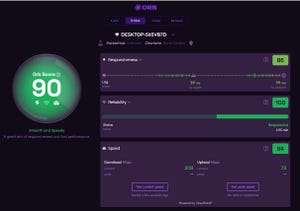
Orb uses a few different metrics to measure responsiveness. You can see what your best (and worst) lag times look like.
Screenshot by Cierra Nofke/CNETResponsiveness — which includes measurements like lag, latency, jitter and packet loss — is the main metric Orb uses to “grade” your internet connection out of 100. Reliability, or the network’s responsiveness over time, and speed are secondary measures that Orb takes into account.
“It’s a different side of broadband that we’re focusing on,” Suttles says. “The things that we built at our past company were perfect for the time when we built them, when broadband was in its infancy, and you needed to measure throughput first and foremost.”
With data use surging and internet speeds soaring, our lives are more connected than ever — but speed, or throughput, alone is no longer the only factor in determining a good internet plan.
I see this often while reviewing home internet plans: While most internet shoppers mainly focus on speed and cost, plenty of other factors, beyond advertised max speeds, determine whether a connection is reliable or consistent.
Jamie Steven, president and co-founder of Orb, says a reliable internet connection, not just a fast one, is vital for his rurally located home.
“The connection would go down all the time,” Steven says, “Speed wasn’t always or very often was not the issue. The issue was reliability and responsiveness.”
Suttles and Steven say that standard internet speed tests are akin to measuring a car’s top speed. Instead of focusing solely on speeds, Orb focuses on whether your internet stalls or how quickly it can accelerate. Additionally, Steven notes that the top speed of most cars is impractical for everyday use.
“It’s not what you’re doing day-to-day,” Steven says, referring to max internet speeds. “For us, it was more about continuous measurement of your internet experience.”
How does Orb function?
Orb measures your internet’s current speeds as well as its peak speeds.
Screenshot by Cierra Nofke/CNETPart of Orb’s ingenuity is its ability to run those continuous speed tests, instead of only running speed tests when you’re experiencing delays or interruptions. My first thought was that such an approach would strain your network’s bandwidth. But Suttles assured me that Orb uses a much smaller payload (around 10MB) compared to popular speed test alternatives. For rural internet users like Steven, that lighter payload makes all the difference in keeping his internet connection stable.
If you’d like to give your internet a stress test, Orb does come with a “peak speed” function to test your network’s capacity, which uses a much heavier payload, but that’s not a continuous test.
Every device you connect to your internet acts as an “orb” or “sensor” that tests your internet connection from whatever room in your house or apartment they’re in. You can also set up a dedicated device to continuously monitor your network, 24/7.
There is one downside to Orb as it compares to other speed tests: You can’t run the tests in a browser. You’ll have to download the application to a device (which could be anything from a spare smartphone to a Raspberry Pi). Once you create an account, you can basically download Orb to anything with a hard drive — and easily diagnose your internet issues in different rooms, simultaneously.
Orb
Orb is completely free and easy to use. A few weeks ago, I installed it on my phone and personal computer and used it to test my fiber internet connection. Using a scale of 0 to 100, Orb gives your internet a grade that’s pretty easy to understand: Red (0 to 49) means poor performance and green (90 to 100) means your internet is performing excellently. My internet connection gets a solid 90 most of the time — not bad for AT&T’s cheapest speed tier.
“We want consumers to use this because these are problems that all of us on the founding team have had at home,” Steven says. “We want this to be free forever.”
“There’s more value in building a brand than in trying to monetize consumers for something that, quite frankly, we’re so passionate about, we just want to give it away anyway,” Suttles says.
I used Orb to test the internet connection in my office and the speeds I was getting in the living room where my TV is. Both tests showed results typically consistent with what I’d see using Ookla.
You can add as many devices to your Orb network as you’d like; they’ll all play a role in measuring your internet connectivity.
Screenshot by Cierra Nofke/CNETOrb is still in its beginning stages — while it’s an effective tool for understanding how your internet connection works, there are a few features coming to the app that will make it even more user-friendly, like the ability to access historical data (similar to Ookla).
“Orb does record all data locally first,” Steven notes. “We just hadn’t presented it in the UI, but that was something we were very passionate about. We didn’t want to require cloud connectivity to be able to see the past.”
Perhaps most importantly, Orb will eventually start releasing recipes for measuring the connectivity of specific applications or services, like Microsoft Teams or Slack and, eventually, even specific internet services.
“Different web services use different sorts of protocols,” Steven says. “So Zoom might use this special RTSP protocol — can my connection open that port to that service? Is it accessible? What’s its responsiveness?”
Down the road, Suttles and Steven would like to see Orb used by the community to create different “recipes” and ways of measuring reachability.
“At its core, Orb is really a recipe engine,” Suttles says. “Our vision is to release and share new recipes, then have the community start creating them.”
Final thoughts
While it may be tempting to simply buy more speed, you can do better by diagnosing your connection and boosting it first. Orb and the internet are constantly evolving, so it’s important to understand your network’s connectivity in a holistic way.

