
OpenAI abruptly removed a feature of ChatGPT which allowed public chats to be searched through Google. Users were surprised to learn that private information shared through ChatGPT is now publicly accessible as a Google result.
Dane Stuckey announced the shutdown Thursday. The feature was disabled Friday morning. OpenAI has begun cleaning search engine indexes for previously shared conversations.
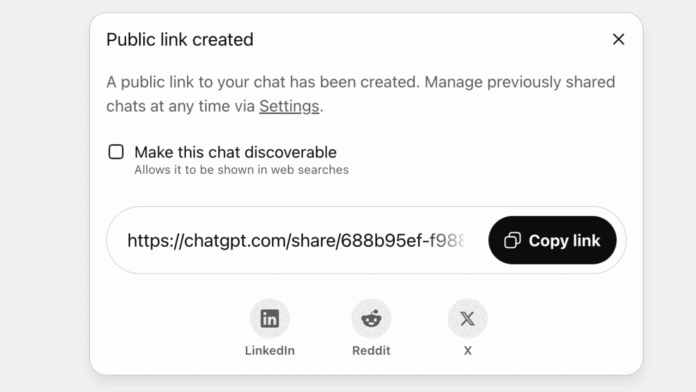
OpenAI created the “Make this hyperlink discoverable” checkbox that they had clicked to give more users access to potentially useful conversations between ChatGPT with different users. In practice, this opened the door to new forms of digital exposure. Criminal confessions, corporate practices, and personal secrets were all just a few key words away from being found in a Google search.
It was not some obscure setting hidden in the developer console. It was in the sharing menu for any ChatGPT conversations users wanted to make public links. OpenAI thought the wording was clear, but many users did not. They believed the link would be private or not visible unless it was explicitly shared.
This is more than just a technical glitch for the average user of ChatGPT, who uses it to plan a resign letter, troubleshoot relationships, or develop a legal strategy. It’s an internal check. There’s a good chance that someone will find your conversation if you have ever shared the link.
Among the conversations that were indexed, there were internal job applicant evaluations and sensitive mental health disclosures. There were also confessions of crimes, proprietary software code, and confidential information about criminals. ChatGPT was being used as if it was private, but anyone who toggled the setting found it to be not.
We have just removed a feature in @ChatGPTapp which allowed users to make their conversation discoverable by search engine, such as Google. This was a short experiment to help people find useful conversations. This feature required users to opt-in, first by picking a chat… pic.twitter.com/mGI3lF05Ua July 31, 2025 (19659014)
OpenAI deserves credit for removing the feature as quickly as possible. The fallout raises questions about not only privacy, but also how much users should be expected to know about the tools that they use. The “discoverable checkbox” didn’t hide behind walls, but it didn’t communicate the full extent of its implications very well. It’s one to share a URL, but it’s another to index it in global search engine indefinitely.
Sign up to receive breaking news, reviews and opinions, top tech deals and more.This is fascinating. It shows how users interact with AI. They test ideas, vent their frustrations, and write things that they would never type into a search box. It’s worth checking if you’ve shared a ChatGPT discussion.
OpenAI works with Google and other search engine to remove previously indexed content. However, search crawlers are very persistent. Some content may linger for a while, even if deleted. OpenAI disabled the feature immediately, but it may have already done damage to some users.
I hope the lesson will stick in the minds of the public. Just as the idea that not deleting embarrassing browsing histories has evolved from a joke to something that only the most clueless people would forget. The magic of ChatGPT is in the way they create an illusion of a real conversation. If you forget that this is an illusion, then you may not see the risks of buttons that send your digital heart to heart straight to Google.
You may also like
- ChatGPT crossed a new AI threshold after beating the Turing Test
- AI has made a huge leap forward in IQ and now a quarter Gen Z believes AI is conscious.
- ChatGPT Model Matchup – I pitted OpenAI’s o3, GPT-4o and GPT-4.5 AI against each other, and the results surprised
Eric Hal Schwartz has been a freelance writer at TechRadar for more than 15 years. He has covered the intersection of technology and the world. He was the head writer of Voicebot.ai for five years and was at the forefront of reporting on large language models and generative AI. Since then, he has become an expert in the products of generative AI, including OpenAI’s ChatGPT and Anthropic’s Claude. He also knows Google Gemini and all other synthetic media tools. His experience spans print, digital and broadcast media as well as live events. He’s now continuing to tell stories that people want to hear and need to know about the rapidly changing AI space and the impact it has on their lives. Eric is based out of New York City.

