
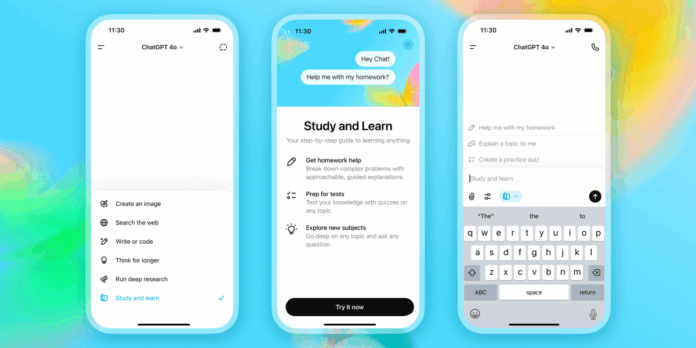
OpenAI has launched Study Mode, an updated version of ChatGPT, for college students. It promises that the tool will act more like a friend and always-available tutor, rather than a simple lookup tool. The company is pushing to integrate AI into classrooms as the new academic year begins in September.
OpenAI demonstrated to reporters what happens when a Student asks Study Mode a question about a subject such as game theory. The chatbot asks the student what they want to know, and then tries to build an exchange where the two work together to find the answer. OpenAI claims that the tool was developed after consulting with pedagogy specialists from over 40 institutions.
OpenAI’s testing group included a few college students from Princeton, Wharton and the University of Minnesota. They gave Study Mode positive reviews, saying that it did an excellent job of checking understanding and adapting to each student’s pace.
Christopher Harris, a New York educator who has developed a curriculum for AI literacy, believes that the learning methods OpenAI has programmed in Study Mode are sound. They could give educators more confidence to allow, or even encourage, their students use AI. “Professors are going to see this as a way to work with them to support learning, rather than just a way for their students to cheat on assignments,” says he.
Study Mode has a more ambitious goal. OpenAI, in partnership with the leading teachers’ unions has recently demonstrated its efforts to rebrand chatbots into tools for personalized learning instead of cheating. This promise includes the idea that AI will act as expensive tutors, which are currently only available to the wealthiest families.
OpenAI’s director of education says, “We can start to close the gap between those who have access to high-quality learning resources and those who are historically left behind.” Leah Belsky.
But presenting Study Mode as a tool that equalizes education obfuscates a major problem. It’s not a tool that is only trained on academic textbooks or other approved materials. Instead, it’s more like ChatGPT, with a new conversational filter that governs the way it responds to the students.
This AI tutor is more like what you would get if you hired an actual human tutor who had read every textbook and every incorrect explanation of a subject posted on Reddit, Tumblr and the most remote corners of the internet. AI is not able to differentiate between right and wrong information.
If professors encourage their students to use this tool, they run the risk that it will teach them the wrong way to approach problems. Or worse, they may be taught material which is fabricated or completely false.
Human tutors, who can charge up to $200 an hour for certain subjects, are usually only available to the wealthy. The idea that AI models could bring tutoring to everyone is appealing. It is supported by some early research which shows that AI models can adapt themselves to individual learning styles.
This improvement is not without a cost. Tools like Study Mode, for the time being, use large language models that mimic human conversational style, without fixing their flaws.
OpenAI acknowledges that the tool will not prevent a frustrated student from going back to ChatGPT. Belsky says that it is possible for someone to subvert the learning process and get answers in a more convenient way.
Students say that Study Mode is more fun than staring at a textbook about Bayesian theorem 100 times. Maggie Wang, who tested the tool, says that it’s “like a reward signal, like, oh wait, I can actually learn this small thing.” Praja Tickoo from Wharton says that the tool is currently free, but he would not need to be if he wanted to use it. “I would definitely pay for it,” he says.

