
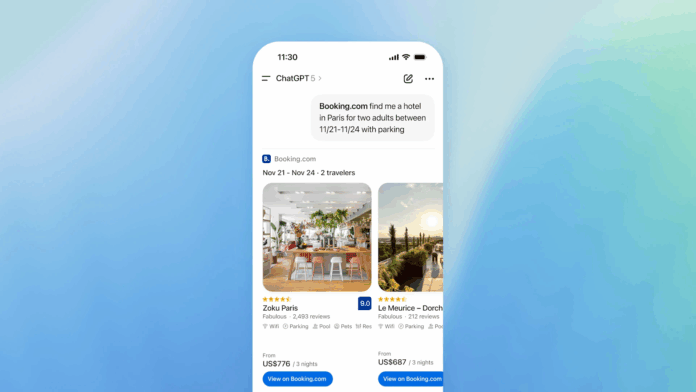
OpenAI Unveils Revolutionary In-Chat App Ecosystem at DevDay
At OpenAI’s highly anticipated DevDay event, co-founder and CEO Sam Altman introduced a groundbreaking feature that enables developers to create and monetize applications directly within ChatGPT. This innovation allows users to access and interact with multiple third-party apps seamlessly, without ever leaving the ChatGPT environment.
Seamless Integration: Apps Within ChatGPT
Traditionally, users have had to switch between different devices or platforms to use various applications. Now, ChatGPT serves as a unified hub where users can log into external services, retrieve personalized data, and perform complex tasks through conversational commands. Whether it’s designing presentations, browsing real estate listings, or engaging with educational content, all these activities can be conducted inside ChatGPT’s chat interface.
For example, users can instruct Canva to create a slide deck from a simple text prompt, query Zillow for homes matching specific criteria, or ask Coursera to explain a lesson while watching the video-all without leaving the chat window. This integration enhances productivity by combining the power of AI with familiar app functionalities.
Empowering Developers with the Apps SDK
OpenAI’s new Apps Software Development Kit (SDK), built on the Modular Chat Protocol (MCP) standard introduced by Anthropic, offers developers a robust framework to connect their services with ChatGPT. The SDK supports dynamic data exchange, enabling the AI to maintain real-time awareness of user interactions within third-party apps.
Developers can design apps that appear as compact inline cards or carousels, expand to immersive fullscreen modes for detailed tasks like map navigation or menu browsing, or utilize picture-in-picture layouts for live video, gaming, or interactive quizzes. This flexibility ensures that the conversational flow remains smooth while enriching user engagement with interactive elements.
Showcasing Early Collaborations: Coursera, Canva, Zillow, and More
During the keynote, OpenAI demonstrated early app integrations powered by the Apps SDK. Coursera’s integration allows users to log in and access course materials directly within ChatGPT, with video content pinned for continuous viewing alongside ongoing conversations. Users can ask ChatGPT to clarify or elaborate on video content in real time, leveraging backend data synchronization.
In another demonstration, Canva was used to generate marketing materials for a fictional dog walking business. ChatGPT autonomously executed design commands-selecting fonts, colors, and layouts-then presented multiple poster options for review and refinement within the chat. The process culminated in creating a full slide deck ready for investor presentations.
Further, Zillow’s integration enabled users to explore real estate listings interactively, with features such as map browsing, filtering by property attributes, and scheduling tours-all embedded inside ChatGPT. The AI also cross-references web search results to provide comprehensive property insights.
Additional partners announced include Booking.com, Expedia, Figma, Spotify, AllTrails, Peloton, OpenTable, Target, theFork, and Uber, spanning sectors like travel, design, entertainment, and commerce.
Commitment to Privacy, Security, and Quality Standards
OpenAI has established stringent guidelines to ensure that apps integrated into ChatGPT uphold user safety, privacy, and reliability. Apps must serve a clear purpose, behave predictably, and be appropriate for users aged 13 and above. Data collection is limited to essential information, with transparent privacy policies and explicit user consent required before app connection.
Developers are mandated to maintain app stability, provide customer support, and adhere to OpenAI’s design principles, which emphasize a consistent visual identity, accessibility, and a conversational, intuitive user experience. Brand customization is permitted only within defined boundaries to preserve ChatGPT’s core interface integrity.
Transforming ChatGPT into an AI-Powered Operating System
By integrating third-party apps and enabling in-chat payments, OpenAI is evolving ChatGPT beyond a conversational agent into a comprehensive AI operating system. This platform offers developers access to a vast user base exceeding 800 million, facilitating app discovery through natural dialogue tailored to user needs-whether for travel planning, education, or shopping.
For users, this means a streamlined experience where diverse tasks-from booking flights to creating presentations-can be accomplished within a single, intelligent interface.
Looking Ahead: Data Privacy and the Future of Custom GPTs
Despite the excitement, key questions remain regarding data governance: How will OpenAI handle the data exchanged between third-party apps and ChatGPT? Will this data be used to further train AI models? Additionally, the fate of OpenAI’s previously promoted custom GPT marketplace, which allowed developers to monetize specialized AI versions, is yet to be clarified.
OpenAI has been approached for comments on these issues, and updates will be provided as more information becomes available.

