
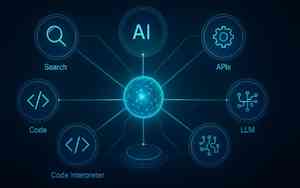
Introducing Orchestrator: A New Era in AI Tool Coordination
In a groundbreaking collaboration, Nvidia and the University of Hong Kong have unveiled Orchestrator, an innovative 8-billion-parameter model designed to seamlessly coordinate multiple AI tools and large language models (LLMs) to tackle intricate problems. This novel system not only surpasses larger models in accuracy on tool-use benchmarks but also operates more cost-effectively, aligning closely with user preferences regarding tool selection for specific queries.
Rethinking AI Tool Integration: Beyond Traditional LLMs
Extending the capabilities of LLMs by integrating external tools-such as search engines and code interpreters-has become a promising strategy to enhance AI performance beyond their original training data. These integrations enable AI agents to execute complex, agentic tasks with improved precision.
However, current methodologies predominantly rely on a single, large-scale model equipped with a limited set of basic tools. This approach underutilizes the potential of diverse, specialized resources. Drawing inspiration from human problem-solving-where individuals consult experts and leverage advanced systems-AI should similarly engage a broad spectrum of specialized tools to optimize reasoning and task execution.
The Orchestration Paradigm: Coordinating Specialized AI Tools
Orchestrator introduces a paradigm shift by employing a lightweight coordinating model that intelligently manages a suite of specialized AI tools and LLMs. Instead of burdening one monolithic model with all cognitive tasks, this orchestrator decomposes complex problems and delegates subtasks to the most suitable expert models.
For instance, a mathematical query might be routed to a dedicated math-focused model, while a coding challenge could be assigned to a code-generation specialist. This modular delegation enhances efficiency and accuracy by leveraging the unique strengths of each tool.
To realize this concept, the team developed ToolOrchestra, a training framework that teaches a compact language model to act as an orchestrator. The orchestrator learns optimal strategies for invoking various tools and synthesizing their outputs through multi-turn reasoning. Tools are described in a straightforward JSON schema detailing their names, functions, and parameters.
The training employs a reinforcement learning (RL) approach guided by a reward system balancing three key objectives: answer correctness, computational cost and latency efficiency, and adherence to user preferences. For example, the system penalizes excessive resource consumption and rewards the use of user-preferred tools, such as favoring open-source models over proprietary APIs to enhance privacy. To support this, an automated data pipeline generated thousands of verifiable training instances spanning ten diverse domains.
Performance Highlights: Small Model, Significant Impact
Leveraging ToolOrchestra, the researchers trained Orchestrator, an 8-billion-parameter model based on advanced transformer architectures. Its capabilities were benchmarked against three demanding tests: the Human-Level Evaluation (HLE), Tau2-Bench function-calling, and a multi-domain reasoning challenge. Comparisons included several large, off-the-shelf LLMs both with and without tool integration.
Findings revealed that even state-of-the-art large models struggle with complex reasoning tasks without tool assistance. While equipping these models with tools improved outcomes, it often resulted in substantial increases in computational cost and latency.
In contrast, Orchestrator demonstrated remarkable efficiency and effectiveness. On the HLE benchmark, which features PhD-level questions, it outperformed previous approaches while consuming significantly fewer resources. During the Tau2-Bench test, Orchestrator strategically invoked a large model like GPT-5 in only about 40% of the steps, relying on more economical alternatives for the remainder, yet still surpassing agents that used the large model exclusively.
Moreover, Orchestrator exhibited strong adaptability, adjusting its tool-use strategies to novel challenges and maintaining robust generalization to unseen models and pricing schemes. This versatility is particularly valuable for enterprises that deploy heterogeneous AI ecosystems combining public, private, and custom models. The model’s balance of lower cost, faster response times, and customizable behavior positions it as a practical solution for scalable, sophisticated AI agents.
Implications for Enterprise AI and Future Directions
As organizations increasingly adopt advanced AI agents, the orchestration framework offers a promising path toward systems that are not only more intelligent but also more economical and controllable. By distributing cognitive tasks across specialized tools under the guidance of a compact orchestrator, businesses can achieve enhanced performance without prohibitive costs.
Looking forward, the research envisions the evolution of recursive orchestrator systems that push the boundaries of AI intelligence and efficiency, enabling the resolution of ever more complex agentic tasks. This approach heralds a future where AI systems dynamically coordinate diverse expert models to deliver superior outcomes.

