
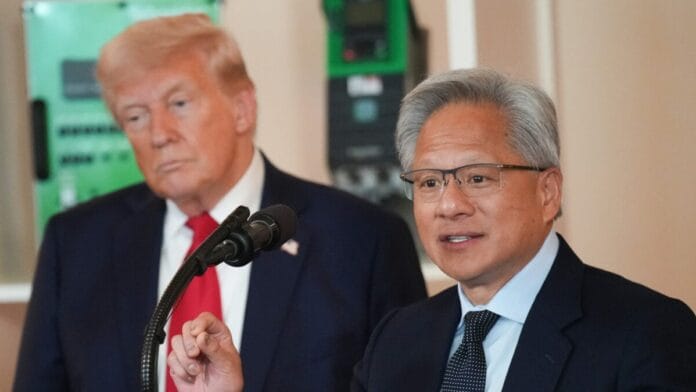
Huang, who met with President Donald Trump in Beijing and other senior officials recently, has secured a major win for his AI chip empire.
Nvidia announced on Monday that the U.S. Government will allow it resume sales of its AI chips H20 in China. The company must still obtain official licensing approval from Trump’s administration, but officials are reported to have assured Nvidia.will be granted.” The company stated in a post on its blog that it is already filing the necessary application and plans to start shipments soon.
This H20 chip is an abridged version of Nvidia’s powerful H100 semiconductor. It was built specifically for China to comply with U.S. Export restrictions. Nvidia still isn’t allowed to sell its most advanced chips in China because of national security concerns. The restrictions are part of a larger effort to maintain America’s edge in AI.
In April, these restrictions were tightened even further. After the unexpected success achieved by the Chinese AI startup DeepSeek the U.S. stopped exports of modified H20 chips. This could have cost Nvidia billions in sales.
It appears that Huang has convinced Trump that selling to China will actually be a win for America. Huang has argued that if AI is the future, then it’s best that it runs on American hardware.
“General purpose, open-source, research and foundation models are at the heart of AI innovation,” Huang said to reporters in D.C.
The news comes days after Nvidia became the first company to reach a $4 trillion market capitalization . Nvidia was founded in 1993 and its chips have been used in computer graphics and gaming for decades. However, they are now the backbone of major tech advancements including AI, robotics and autonomous vehicles. These victories also paid off for Huang personally, who is now the eighth-richest man in the world. His fortune has already exceeded that of old-school entrepreneur Warren Buffett, and is only $1 billion short of catching up with internet pioneer Sergey Brin.

