
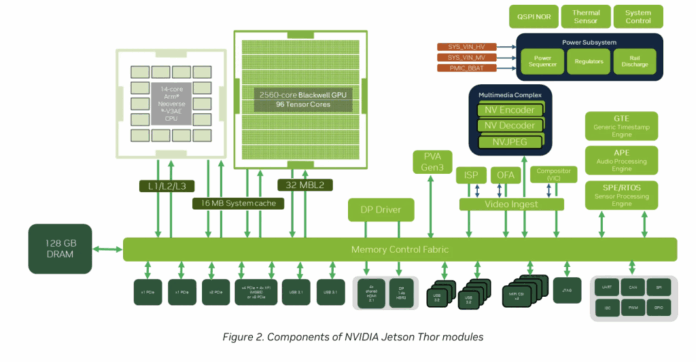
Designed as a cutting-edge supercomputer tailored for physical AI, the Jetson Thor platform revolutionizes edge computing by integrating generative reasoning with advanced multimodal sensor processing to enhance real-time inference and autonomous decision-making.
Key Architectural Innovations
Unmatched Computational Power
Powered by a Blackwell-based GPU, Jetson Thor achieves an impressive 2,070 FP4 teraflops (TFLOPS) of AI processing capability, marking a remarkable 7.5-fold increase compared to its predecessor, the Jetson Orin. This extraordinary performance is delivered within a 130-watt power envelope, which can be dynamically scaled down to 40 watts to optimize energy consumption without compromising throughput-offering roughly 3.5 times the efficiency of the previous generation.
Advanced Compute Architecture
At the heart of Jetson Thor lies a 2560-core Blackwell GPU featuring 96 fifth-generation Tensor Cores, supporting Multi-Instance GPU (MIG) technology that allows simultaneous partitioning of GPU resources for diverse parallel tasks. Complementing this GPU is a powerful 14-core Arm® Neoverse®-V3AE CPU, each core equipped with 1 MB of L2 cache and sharing a 16 MB L3 cache, ensuring seamless processing of complex workloads.
Robust Memory and Connectivity
The platform boasts 128 GB of LPDDR5X memory operating on a 256-bit bus, delivering a bandwidth of 273 GB/s to support data-intensive AI applications. Storage options include a 1 TB NVMe M.2 slot, while connectivity is comprehensive with HDMI, DisplayPort, multiple USB ports, Gigabit Ethernet, CAN headers, and QSFP28 interfaces capable of handling up to four 25 GbE lanes-critical for high-speed, real-time sensor data fusion.
Comprehensive Software Suite for Physical AI
Jetson Thor is supported by an extensive NVIDIA software ecosystem designed specifically for robotics and physical AI applications:
- Isaac (GR00T): Facilitates generative reasoning and humanoid robot control.
- Metropolis: Powers advanced vision AI capabilities.
- Holoscan: Enables ultra-low latency sensor processing and sensor-over-Ethernet communication through the Holoscan Sensor Bridge.
This integrated software stack empowers a single system-on-module to execute complex multimodal AI workflows-including vision, natural language understanding, and actuation-without the need for multiple chips or offloading tasks.
Understanding Physical AI and Its Impact
Generative Reasoning Meets Multimodal Integration
Physical AI represents the fusion of perception, cognitive reasoning, and action planning. Jetson Thor equips robots with the ability to “simulate potential scenarios, predict outcomes, and formulate both strategic plans and detailed motion controls,” enabling adaptability that mirrors human-like intelligence. By supporting real-time inference across language and visual data streams, it transforms robots from simple programmed machines into versatile, autonomous agents.
Real-World Applications
This technology enhances robotic performance in dynamic and unpredictable environments, allowing machines to manipulate objects with precision and follow intricate instructions without retraining. Its applications span diverse sectors such as advanced manufacturing, supply chain logistics, healthcare automation, precision agriculture, and beyond.
Availability and Pricing Details
- Jetson AGX Thor Developer Kit: Available now at a price of $3,499.
- Jetson T5000 Production Modules: Offered through NVIDIA’s authorized partners, with unit pricing approximately $2,999 for bulk orders of 1,000 units.
- Pre-orders indicate imminent broader market availability, catering to both research institutions and commercial robotics developers.
Final Thoughts
The NVIDIA Jetson Thor platform marks a transformative advancement in robotics computing by embedding server-grade multimodal inference and generative reasoning capabilities into a compact, power-efficient module. Its unparalleled 2,070 FP4 TFLOPS performance, combined with extensive I/O options and a rich software ecosystem, establishes it as a cornerstone for the next wave of physical AI innovations. Early adoption by leading robotics pioneers underscores its potential to accelerate the development of adaptable, intelligent machines capable of operating autonomously in complex real-world scenarios.

