
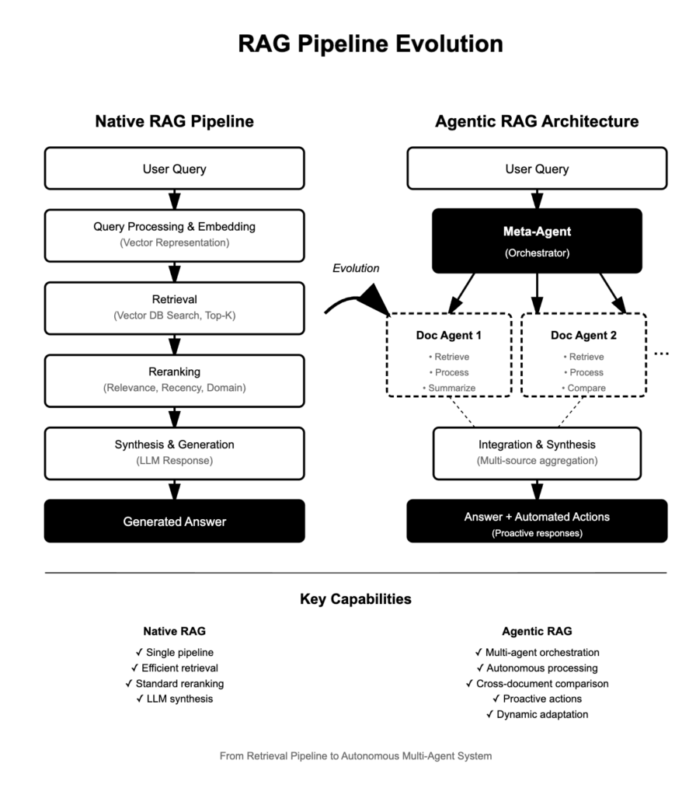
Retrieval-Augmented Generation (RAG) has become a pivotal method for enriching Large Language Models (LLMs) with up-to-date, specialized knowledge. As the field evolves rapidly, the prevalent approach known as “Native RAG” is now being complemented-and in some cases surpassed-by an innovative framework called “Agentic RAG,” which is reshaping AI-driven information synthesis and decision-making capabilities.
Understanding Native RAG: The Conventional Framework
Core Structure and Workflow
The Native RAG architecture integrates retrieval and generative techniques to address intricate queries while maintaining precision and contextual relevance. Its typical workflow includes:
- Query Refinement and Vectorization: User inputs are optionally reformulated and then transformed into vector embeddings using either an LLM or a specialized embedding model, setting the stage for semantic search.
- Information Retrieval: The system probes a vector database or document repository, extracting the top-k most pertinent segments based on similarity measures such as cosine similarity, Euclidean distance, or dot product. Approximate Nearest Neighbor (ANN) algorithms enhance retrieval speed and scalability.
- Result Prioritization: Retrieved data undergoes reranking to emphasize relevance, freshness, domain alignment, or user preferences. This step employs models ranging from heuristic rules to fine-tuned neural networks to ensure the highest quality content is surfaced.
- Response Generation: The LLM then synthesizes the prioritized information into a coherent, contextually aware answer tailored to the user’s query.
Enhancements and Innovations
Recent improvements in Native RAG include adaptive reranking strategies that modulate retrieval depth based on query complexity, fusion techniques that combine rankings from multiple queries for richer results, and hybrid models that merge semantic segmentation with agent-based selection to optimize both robustness and latency.
Agentic RAG: A Paradigm Shift Toward Autonomous Multi-Agent Systems
Defining Agentic RAG
Agentic RAG represents a transformative approach where multiple autonomous agents collaborate to process documents and answer queries. Unlike the linear pipeline of Native RAG, this model orchestrates a network of agents capable of complex reasoning, cross-document analysis, strategic planning, and dynamic adaptation in real time.
Fundamental Components
| Component | Functionality |
|---|---|
| Document Agent | Dedicated to individual documents, these agents independently handle queries, generate summaries, and extract relevant insights within their assigned scope. |
| Meta-Agent | Acts as the coordinator, managing interactions among document agents, integrating their outputs, and producing a unified, comprehensive response or decision. |
Distinctive Attributes and Advantages
- Independent Operation: Each agent autonomously retrieves, processes, and generates outputs for its specific document or task.
- Dynamic Strategy Adjustment: The system flexibly modifies its approach-such as reranking intensity, document prioritization, or tool usage-based on evolving queries and data contexts.
- Proactive Behavior: Agents anticipate information needs, initiate supplementary data retrieval, propose actionable steps, and refine their performance through learning from past interactions.
Expanded Functionalities
Moving beyond passive retrieval, Agentic RAG enables agents to perform comparative analyses across documents, synthesize or contrast specific content sections, consolidate insights from multiple sources, and even invoke external tools or APIs to enhance reasoning. This empowers applications such as:
- Automated multi-database research aggregation
- Advanced decision support, including detailed feature comparisons and summarization of product specifications
- Executive-level assistance requiring independent synthesis and real-time recommendations
Practical Use Cases for Agentic RAG
Agentic RAG excels in environments demanding sophisticated information processing and decision-making, including:
- Enterprise Knowledge Integration: Harmonizing responses across diverse internal data sources and repositories
- AI-Powered Research Assistance: Facilitating cross-document synthesis for technical authors, analysts, and business leaders
- Automated Workflow Execution: Enabling multi-step reasoning to trigger actions such as calendar management or database updates
- Complex Compliance and Security Evaluations: Real-time aggregation and comparison of evidence from multiple sources to support audits
Final Thoughts
While Native RAG has established a reliable method for embedding, retrieving, reranking, and synthesizing external knowledge to empower LLMs, Agentic RAG elevates this concept by introducing autonomous agents, orchestration layers, and adaptive workflows. This evolution transforms RAG from a straightforward retrieval mechanism into a sophisticated agentic framework capable of advanced reasoning and multi-document intelligence.
For organizations aiming to transcend basic augmentation and embrace flexible, deep AI orchestration, Agentic RAG offers a forward-looking blueprint for the next wave of intelligent systems.

