
Contents Overview
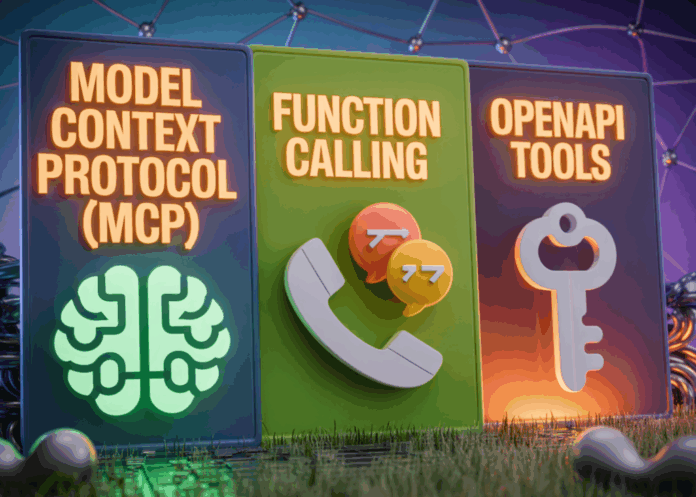
- Model Context Protocol (MCP): An open, transport-independent protocol designed to unify the discovery and execution of tools and resources across multiple hosts and servers. Ideal for multi-tool, multi-runtime, and portable environments.
- Function Calling: A vendor-specific feature where the language model chooses from predefined functions (described via JSON Schema), returns the necessary arguments, and the runtime executes them. Best suited for single-application, low-latency scenarios.
- OpenAPI Tools: Utilizes the OpenAPI Specification (OAS) 3.1 as a formal contract for HTTP services, enabling automatic generation of callable tools through agent or tooling layers. Optimal for service-mesh, governed integrations.
Side-by-Side Feature Comparison
| Aspect | MCP | Function Calling | OpenAPI Tools |
|---|---|---|---|
| Interface Definition | Protocol-level data model encompassing tools, resources, and prompts | Individual function definitions via JSON Schema | Comprehensive OAS 3.1 document |
| Discovery Mechanism | Dynamic discovery through tools/list endpoint |
Static function list supplied to the model | Extracted from OAS, enabling cataloging |
| Invocation Method | JSON-RPC session invoking tools/call |
Model selects function; application executes | HTTP requests aligned with OAS operations |
| Orchestration Scope | Host manages routing across multiple servers and tools | Local chaining within the application | Agent or toolkit routes intents to operations |
| Transport Protocol | Standard I/O or HTTP variants | In-band communication via LLM API | HTTP(S) requests to services |
| Portability | Supports cross-host and cross-server usage | Vendor-specific, limited portability | Vendor-neutral, based on open contracts |
Advantages and Drawbacks
Model Context Protocol (MCP)
- Advantages: Enables standardized tool discovery, supports reusable server components, facilitates orchestration across multiple tools, and is gaining traction with platforms like Microsoft Semantic Kernel and Cursor, with Windows integration underway.
- Drawbacks: Necessitates running dedicated servers and enforcing host policies such as identity verification, user consent, and sandboxing. The host must also manage session lifecycles and routing logic.
Function Calling
- Advantages: Minimal integration complexity, rapid control loops, and straightforward validation through JSON Schema.
- Drawbacks: Catalogs are confined to the local application, portability is limited and requires redefinition for each vendor, and discovery or governance features are minimal.
OpenAPI Tools
- Advantages: Established, mature interface contracts with built-in security schemes like OAuth2 and API keys, complemented by extensive tooling support including agent frameworks that generate tools from OAS.
- Drawbacks: While OAS defines HTTP service contracts, it does not inherently provide agentic control loops, necessitating an external orchestrator or host for complex workflows.
Security and Governance Considerations
- MCP: Enforces host-level policies including allowed server lists, user consent mechanisms, scoped tool permissions, and ephemeral credential management. Platform-level adoption, such as on Windows, emphasizes registry-based controls and consent prompts.
- Function Calling: Relies on validating model-generated arguments against JSON Schemas, maintaining allowlists, and logging function calls for auditing purposes.
- OpenAPI Tools: Leverages OAS-defined security schemes, API gateways, and schema-driven validation to restrict unauthorized requests and ensure compliance.
Adoption and Ecosystem Trends
- MCP Implementations: Supported by Microsoft Semantic Kernel (both host and server roles) and Cursor (which offers MCP directory and IDE integration). Microsoft has indicated plans for Windows-level support.
- Function Calling: Widely available across leading LLM APIs, including OpenAI, with consistent patterns involving schema definitions, function selection, and result handling.
- OpenAPI Tools: Multiple agent frameworks, such as LangChain (Python/JavaScript), automatically generate callable tools from OAS documents.
Guidelines for Choosing the Right Approach
- For localized automations with a limited set of actions and stringent latency requirements: Opt for Function Calling. Keep function definitions concise, enforce strict validation, and thoroughly unit-test the execution loop.
- When aiming for cross-runtime portability and shared integrations across agents, IDEs, desktops, and backends: Choose MCP. It offers standardized discovery and invocation, enabling server reuse across multiple products.
- For enterprise environments managing extensive HTTP services requiring formal contracts, security, and governance: Implement OpenAPI Tools alongside an orchestrator. Use OAS as the authoritative source, generate tools automatically, and enforce security via gateways.
- Hybrid Strategy (commonly adopted): Maintain OAS for your HTTP services, expose them through an MCP server to enhance portability, or selectively expose latency-critical endpoints as function calls for performance-sensitive applications.

