
The realm of AI-driven coding has recently experienced a significant transformation. Developers who have depended on models like Claude 3.5 Sonnet or GPT-4o are all too familiar with the trade-offs: impressive capabilities often come paired with steep costs or frustrating delays that disrupt productivity. This article delves into the technical innovations behind a new contender, MiniMax-M2, highlighting its architectural breakthroughs and how it redefines the cost-to-performance ratio for autonomous coding workflows.
MiniMax-M2: Revolutionizing Agentic Coding with Cost-Effective Speed
Marketed under the slogan “Mini Price, Max Performance,” MiniMax-M2 is engineered specifically for agentic coding tasks, boasting approximately double the speed of its top-tier rivals while operating at just around 8% of their cost. Beyond mere affordability, the model introduces a novel computational paradigm that reshapes how it reasons and executes complex coding and tool-based workflows.
Dynamic Reasoning Through Interleaved Thinking
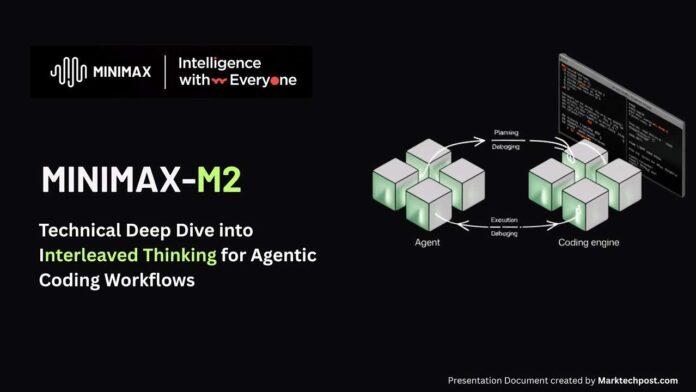
At the heart of MiniMax-M2’s innovation lies its proficiency in Interleaved Thinking, a method that fundamentally alters the traditional approach to AI reasoning in coding environments.
Conventional large language models (LLMs) typically follow a linear Chain of Thought (CoT) strategy: they plan all steps upfront and then sequentially invoke tools such as code execution or web searches. This rigid approach falters when unexpected outputs arise, causing the model’s initial plan to become outdated and leading to “state drift,” where the AI continues down an invalid path.
MiniMax-M2 circumvents this by implementing a continuous Plan → Act → Reflect cycle. Instead of front-loading all decisions, it alternates between reasoning and tool usage, allowing it to:
- Self-Correct: Immediately adapt when a command fails by analyzing error messages and revising subsequent actions.
- Maintain Context: Retain hypotheses and constraints across multiple steps, preventing the common issue of “memory loss” in extended coding sessions.
- Manage Complex Tasks: Effectively navigate long-term, multifaceted workflows such as developing entire application features where the solution path evolves dynamically.
Empirical results underscore the effectiveness of this approach: MiniMax-M2’s performance improved by over 3% on the SWE-Bench Verified benchmark and surged by 40% on BrowseComp when leveraging Interleaved Thinking.
Harnessing Mixture of Experts (MoE) for Optimal Speed and Intelligence
MiniMax-M2 achieves its remarkable balance of speed and sophistication through a Mixture of Experts (MoE) architecture. Although the model encompasses a colossal 230 billion parameters, it activates only about 10 billion parameters per token generation, employing a sparse activation mechanism.
This design offers two major advantages:
- Extensive Knowledge and Reasoning: The vast parameter pool equips the model with deep understanding and complex problem-solving capabilities akin to a 200B+ parameter model.
- Rapid Inference: Sparse activation ensures inference speed comparable to a lightweight 10B model, enabling real-time responsiveness crucial for interactive coding assistants.
For AI coding agents such as Claude Code, Cursor, and Cline, this low latency is essential to maintain seamless developer experiences without frustrating delays.
Built for Developers: Native Support for Agentic and Code-Centric Workflows
Unlike models trained solely on text, MiniMax-M2 is purpose-built for comprehensive developer workflows. It excels in managing intricate toolchains, including Model Context Protocol (MCP), shell command execution, browser-based data retrieval, and navigating complex codebases.
Its integration is already underway with leading AI coding platforms, including:
- Claude Code
- Cursor
- Cline
- Kilo Code
- Droid
Unmatched Affordability: Slashing Costs by 90%
MiniMax-M2’s pricing model is among the most competitive in the AI coding space, offering substantial savings compared to established models like Claude 3.5 Sonnet.
API Pricing Breakdown (Compared to Claude 3.5 Sonnet):
- Input Tokens: $0.30 per million (10% of Sonnet’s price)
- Cache Hits: $0.03 per million (10% of Sonnet’s price)
- Output Tokens: $1.20 per million (8% of Sonnet’s price)
For individual developers, MiniMax-M2 offers tiered subscription plans that significantly undercut market rates:
- Starter Plan: $10/month (with a $2 introductory discount for the first month)
- Pro Plan: $20/month
- Max Plan: $50/month (providing up to five times the usage limits of Claude Code Max)
Developer Engagement and Community Building
The company is actively recruiting developers with proven open-source contributions and familiarity with MiniMax models, especially those engaged on popular coding platforms.
Program Benefits Include:
- Exclusive Access: Complimentary enrollment in the MiniMax-M2 Max Coding Plan, early previews of upcoming video and audio AI models, and direct communication channels with product teams.
- Contribution Opportunities: Building public demonstrations, developing open-source utilities, and providing vital feedback on APIs ahead of official releases.
Conclusion: Setting a New Benchmark for AI-Powered Development
MiniMax-M2 challenges the conventional notion that enhanced intelligence necessitates slower speeds or higher costs. By combining the efficiency of Mixture of Experts with the adaptive reasoning of Interleaved Thinking, it presents a compelling solution for developers seeking powerful autonomous agents without prohibitive expenses.
As AI continues to evolve from merely generating code to architecting entire software systems, the ability to iteratively think, act, and reflect at scale and speed could establish MiniMax-M2 as the new gold standard in AI-driven software engineering.

