
Yandex has unveiled ARGUS, an advanced transformer-based framework for recommender systems that scales impressively to one billion parameters. This innovation positions Yandex alongside elite technology giants such as Google, Netflix, and Meta, who have successfully tackled the complex challenges of scaling recommender transformers to unprecedented levels.
Overcoming Long-Standing Challenges in Recommendation Technology
Recommender systems have traditionally faced three major hurdles: limited short-term memory, difficulties in scaling, and inadequate responsiveness to evolving user preferences. Most existing models focus only on a narrow window of recent user interactions, discarding extensive historical data accumulated over months or even years. This approach results in a superficial understanding of user intent, missing out on long-term habits, subtle preference shifts, and seasonal trends. As product catalogs grow to encompass billions of items, these truncated models not only lose accuracy but also struggle with the computational load required for personalized recommendations at scale. The consequence is often outdated suggestions, reduced user engagement, and fewer chances for unexpected discoveries.
Only a handful of companies have managed to scale recommender transformers beyond experimental phases. Industry leaders like Google, Netflix, and Meta have invested heavily in this domain, developing architectures such as YouTubeDNN, PinnerFormer, and Meta’s Generative Recommenders, which have demonstrated significant improvements. With ARGUS, Yandex joins this exclusive group by deploying billion-parameter recommender models in real-world applications. By analyzing complete behavioral timelines, ARGUS identifies both obvious and subtle correlations in user activity. This comprehensive perspective enables the system to capture evolving user intent and recurring patterns with remarkable precision. For instance, rather than merely reacting to a recent purchase, ARGUS can proactively suggest seasonal items-like surfacing a preferred brand of running shoes as marathon season approaches-without requiring users to repeatedly signal their preferences each year.
Innovative Features Powering ARGUS
ARGUS incorporates several groundbreaking technical advancements:
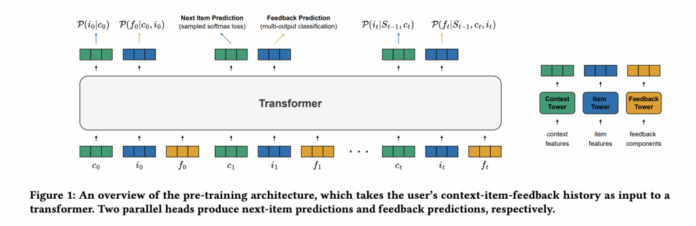
- Dual-objective pre-training: This method splits autoregressive learning into two focused tasks-predicting the next item and anticipating user feedback. This dual approach enhances the model’s ability to replicate historical system behavior while accurately capturing genuine user preferences.
- Highly scalable transformer encoders: ARGUS models range from 3.2 million to 1 billion parameters, consistently delivering performance gains across all evaluation metrics. At the billion-parameter scale, the system achieved a 2.66% increase in pairwise accuracy, highlighting a clear scaling law for recommender transformers.
- Extended context processing: The framework can process user histories containing up to 8,192 interactions in a single pass, enabling personalization that reflects months of user behavior rather than just recent clicks.
- Efficient fine-tuning architecture: Utilizing a two-tower design, ARGUS allows offline embedding computation and scalable deployment, significantly reducing inference costs compared to previous target-aware or impression-level online models.
Proven Impact in Real-World Applications
ARGUS has been successfully integrated into Yandex’s music streaming platform, serving millions of users daily. In controlled A/B testing environments, the system demonstrated remarkable improvements:
- 2.26% uplift in total listening time (TLT)
- 6.37% increase in the likelihood of users liking tracks
These results represent the most significant quality enhancements ever recorded on the platform for any transformer-based recommender model.
Looking Ahead: Expanding ARGUS’s Capabilities
Yandex’s research team aims to extend ARGUS to support real-time recommendation scenarios, refine feature engineering techniques for pairwise ranking, and adapt the framework to domains with extremely high item cardinality, such as large-scale e-commerce and video streaming services. The demonstrated scalability of transformer-based user-sequence modeling suggests that recommender systems are on a trajectory similar to that of natural language processing, with continuous improvements driven by increasing model size and data complexity.
Final Thoughts
With ARGUS, Yandex has cemented its position among the global pioneers advancing the frontier of recommender system technology. By openly sharing its innovations, Yandex not only enhances personalization across its own platforms but also accelerates the broader evolution of recommendation methodologies throughout the tech industry.

