
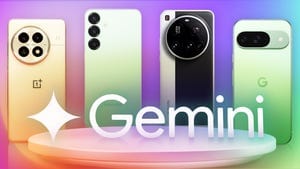
If your Android phone was purchased in the last year, you may have noticed that it is packed with AI features. You may have been aware of them before purchasing your phone, you may have assumed (safely, as it turns out), that you would find AI features on your new device, or you might have been completely surprised.
For example, if you purchased a Samsung Galaxy S25 you would have Gemini, Circle to Search and Galaxy AI available to you before you thought to download the ChatGPT application. It reminds me the early days of Android when phone makers tried to load their devices with their own apps and services, as well as overwrought UIs, in order to differentiate themselves. Which leads to the question: Is AI bloatware on Android?
Android phone makers have embraced the idea that AI could be a tool to help them stand out from their competitors. Most flagship Android phones have the same DNA. They all have a high-end chip (usually the top Snapdragon from Qualcomm), the most recent Android software, an excellent camera system, and a battery life of a day or longer. In reality, we often split hairs when recommending one phone over another.
When generative AI arrived on the scene, offering the potential to bring new experiences to mobile devices, Android phone-makers were keen to tap into those possibilities. Here was a new opportunity to differentiate themselves, and give people a fresh reason to choose them over a competitor. (And over the iPhone, as Apple slow-walks Apple Intelligence into being.)
In reality, it’s not quite playing out that way — and for a few different reasons. First, research conducted by CNET and supported by the findings of independent industry analysts consistently shows us that people aren’t upgrading their phones due to the availability of AI features. Instead, the things they care about, in order of importance are price, longer battery life, storage, cameras. In other words, the same exact things they’ve prioritized for years when choosing a new phone.
The second issue is that in spite of some manufacturers’ best efforts, AI isn’t the differentiator they thought it would be. At the heart of this problem is that there’s barely an Android phone hitting the market right now that doesn’t already have the most cutting-edge tech built into it thanks to Google Gemini. Every Android phone-maker has its own flavor of AI, but more often than not, this means a bunch of gimmicky features added onto the existing software in a haphazard fashion, creating something of a Frankenstein effect.
Early-mover advantage: Galaxy AI
Of all the Android phone-makers trying to make their own AI brand stick in our minds, it’s perhaps Samsung that’s in with the best chance. Compared to rivals, it was relatively early to jump onto the AI bandwagon, launching Galaxy AI in January 2024, giving it a strategic headstart that it’s built on ever since.
Last week it followed the launch of its latest foldables with an AI forum, during which it revealed that 70% of Galaxy S25 owners were using Galaxy AI features. More than half, it added, were using Circle to Search. This year it will bring Galaxy AI to more than 400 million devices.
Android’s Circle to Search feature originally launched on Samsung Galaxy S24 and Pixel 8 phones in January 2024.
Samsung/Screenshot by CNETThis all sounds positive, until you remember that Circle to Search is a Google feature, not a Samsung feature. Google, which makes the Android OS, often hands out temporary exclusives to Android phone-makers on new Gemini features, as it initially did with Circle to Search for Samsung in 2024. It did it again this year with an image-to-video generator, which debuted with Honor.
It’s surely a nice sweetener for Google’s relationships with phone-makers to be able to offer them these exclusives. But most of the standalone AI mobile tools we’ve seen grab the headlines are ultimately Gemini features made by Google, not the work of individual phone-makers, and it’s only a matter of time before they become available on other Android devices – including Google’s own Pixel phones.
To Google, “nothing is more important than Gemini,” said Ben Wood, chief analyst at CCS Insight. It is a “strategic pillar of the future of Google.” And how better, he adds, to ensure its success than getting it into people’s hands through the 3 billion Android phones in the marketplace (which puts Samsung’s 400 million into perspective)?
Samsung might have the largest market share of any Android phone-maker, but when you look at its reach compared to Google’s, it’s clear that Galaxy AI, which sits on top of Gemini, is at a competitive disadvantage.
Bonus you have
Of course Samsung and other Android phone-makers will say their own flavors of AI don’t compete with Gemini, but complement it. And there is some validity in this idea.
It’s rare that a phone-maker attempts to replicate something Google has already done. Instead they look for opportunities to add their own AI twist — often in the form of camera features. But whether they do this well enough for it to make any kind of meaningful impact on people’s decisions to buy their phones is another question entirely.
This week, OnePlus began rolling out its own suite of AI features, announced back in May, to the OnePlus 13 and 13R. These include some photo tools and an AI content hub called Plus Mind to act as your memory for important information.
OnePlus’ natural language search within “Mind Space” worked well for me.
Katie Collins/CNETIt would be a waste of time for OnePlus to replicate features in house that have already been developed by Google, said Arthur Lam in an interview at the software launch. A central part of the company’s AI strategy is to “embrace and integrate [Google AI features] as fast as possible,” he said.
“At the same time, we should have our own proposition, our own idea about what OnePlus AI should stand for,” added Lam.
This is where Plus Mind comes in. It’s an interesting first step from the company, although perhaps not quite as compelling as a company such as Motorola, which is investing in a LAM (large action model) — as opposed to an LLM, or large language model — that will respond to questions with actions, not just words. The idea is that it will use its understanding of your environment and reduce the number of interactions you need to have with your phone to order a coffee or an Uber, for example.
All roads lead to Gemini
As for Google, the company thinks it’s “great” that phone-makers are developing their own AI to complement the suite of tools it’s providing them. That’s what Sameer Samat, president of Android, told Tech Radar is this week. He said
“If the features are great, it’s more value for the consumers and more innovation,” . “But I think for us, as Google, we want to make sure those two pieces [Circle to Search and Gemini] are very clearly accessible, very clearly identifiable across all the different devices that consumers are considering.”
This is a very telling statement from Samat that supports the theory that Google wants to be the final boss in the AI smartphone experience. Wood says: “All roads lead to Gemini.”
In the end, it’s not just Google’s reach, but also the budget and talent that the company has dedicated to AI. Individual phone-makers simply can’t compete.
When it comes to differentiation AI is unlikely to set brands like Samsung and OnePlus apart. Wood.
True Differentiation: The Nothing Story
A UK-based company, Nothing, seems to have realized it. In the last year, I’ve been to almost all major Android phone launches, either in person, or virtually. A Google representative is usually on stage promoting the benefits of Gemini.
The company broke this trend at the launch of the Nothing Phone 3 earlier this month in London. Carl Pei, the founder and CEO of Nothing, estimates that the company has a tiny share of the market — around 0.2%. Since its launch in 2022, the company has thrived and grown in a highly competitive, mature market for smartphones, thanks in large part to its design-focused approach.
Nothing’s focus on design sets it apart.
Andrew Lanxon/CNETThat’s not to say it’s ignored AI, but it has taken a different approach. Earlier this year it launched “Essential Space,” an AI-powered portal for storing and organizing everything important on your phone, from screenshots to calendar invites. It was a unique feature that’s already been effectively copied by some other phone-makers (see OnePlus’ efforts above).
Nothing does use Gemini, but it’s not reliant on it in the same way its competitors are. “We don’t want to do the model side,” Pei explained to me at its Phone 3 launch earlier this month. “There’s companies that are really good at it. They’re very well funded and they’re all competing against each other.”
Instead, Nothing has built its AI platform to be “model agnostic,” he said. “When the models get better, we just switch to the best one. Right now, I think it’s powered by Gemini, but there’s no stopping us from changing to the latest and greatest.”
The uphill battle ahead
A flexible approach to AI seems like the safest bet at this time when the technology is changing minute by minute. It’ll be an uphill battle for Android phone-makers to keep up, and hope their own efforts will remain relevant and prove useful as Google charges ahead offering best-in-class mobile AI experiences.
The real fight here is the same one we’ve seen play out for the past decade and a half: It’s Apple versus Google. The true differentiation we’re seeing in mobile AI right now is between Google Gemini and Apple Intelligence, with the former leading the field and the latter trailing in its wake.
For as long as Google attempts to aggressively build upon its early AI lead while holding the Android ecosystem in the palm of its hand, phone-makers will need to do more than just rely on AI to persuade us that their Android offering truly is the best of the best.

