
Most Native American languages have no word for art. The closest terms are not those that refer to objects, but rather to action and intention. In Lakota “wowachiNGthaNGka”, “deep thought or reflection” is equivalent to “wochekiye”, “offering or prayer”. Art is not separate to life; it’s ceremony, instruction, and design. It is a form of knowledge and responsibility, just like architecture or code. Its power is not in its preservation or display, but in the way it moves, teaches and connects with users–principles which challenge the tech industry’s assumptions about intelligence.
A vanguard of Native Artists–Suzanne Kite, Raven Chacon, and Nicholas Galanin–are building upon this principle. They are not united by stereotypical weaving or carving, nor by a revanchist critique Silicon Valley. Instead, they reject extractive data models and prefer relationship-based systems. These technologists place the human-tech connection at the heart of their work.
Suzanne Kite’s AI art installations for example, model the Lakota framework of Data Sovereignty: intelligence that only emerges through reciprocal, consenting interaction. Her kinetic machines, unlike systems that assume consent through opaque terms of service or other means, require the physical presence of the viewer and give something in return.
It’s my data. It’s mine. I know exactly how I trained it. Kite says, “It’s not a big model, but a small one. “I don’t care about making the most advanced technology. I’m an artist; I don’t make tech demos. The complexity must be at multiple levels, not just technical.
While Kite builds working AI prototypes based on consent, other artists in the cohort explore the ways that sound, robotics and performance can challenge the logic of automation and surveillance. Native people and technology have always been interconnected. The land, labor, and lifeways that built America’s infrastructure–including its tech–are Indigenous. The question is not whether Native cultures contribute now, but rather why they were considered separate.
The Native technologies reject false binaries that are the foundation of much Western innovation. These artists pose a more radical idea: What if intelligence could only be gathered after a relationship was established? What if the default was refusal and not extraction? These artists don’t ask to be included in the current systems. They’re constructing what will come next.
Suzanne Kite
2020
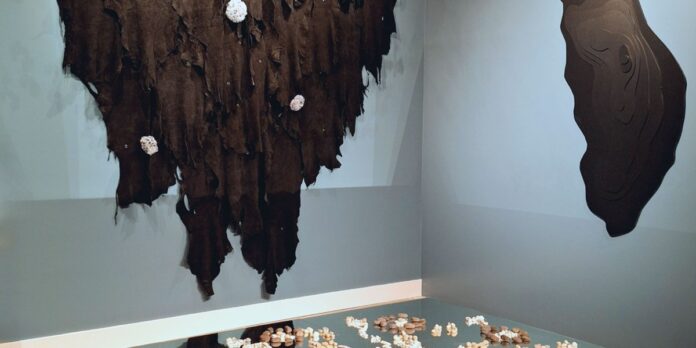
Kite believes that the fundamental flaw in Western technology is the separation of knowledge from the human body. In this installation, a 4-meter-long hair braid with embedded sensors converts the artist’s movements into machine-learning algorithms. Kite performs live while the braid reads her gestures and generates audio responses. The Institute of American Indian Arts, Santa Fe, New Mexico, is filled with the sounds of Kite’s performance. Below her, stones arranged into patterns that reflect Lakota star charts anchor the performance to traditional astronomical knowledge.
COURTESY THE ARTIST.
2019
This installation uses embedded AI to speak and respond to viewers, upending assumptions about intelligence and agency. “People listen close, I whisper / The rock speaks beyond hearing … Many nations speaking / We speak to each other without words,” it intones, its lights shifting as viewers engage with its braided tendrils. The piece aims to convey what Kite calls “more-than-human intelligence”—systems rooted in reciprocity, the fundamental principle that all relationships involve mutual exchange and responsibility.
COURTESY OF THE ARTIST
Raven Chacon
2021
Raven Chacon’s Pulitzer Prize–winning musical composition Voiceless Mass premiered in 2021 at the Cathedral of St. John the Evangelist in Milwaukee. The piece generates what he calls “sounds the building can hear”—electronic frequencies that exploit the cathedral’s acoustics to create spectral voices without human vocal cords, a technological séance that gives presence to historical absence. Each site-specific performance is recorded, generating material that mirrors how sensor networks log presence—but only with explicit consent.
COURTESY OF THE ARTIST
Nicholas Galanin
2025
Galanin’s mechanical drum installation stages a conflict between machine motion and human memory, asking what happens when culture is performed without a consenting body. A box drum—an instrument historically carved from red cedar and hung with braided spruce root—is here made of cherrywood and suspended from the ceiling at the MassArt Art Museum in Boston as is traditionally done in Tlingit plank houses. Played at tribal meetings, celebrations, and ceremonies, these drums hold sonic memory as well as social function. A mechanical arm strikes, unfaltering, at the tempo of a heartbeat; like a warning, the sound pulses with the tension between automation and ancestry.
COURTESY OF THE ARTIST
2025
This Herculean bronze sculpture cast from deconstructed faux totem blocks serves to indict settler sabotage of Native technology and culture. Unlike today’s digital records—from genealogical databases to virtual versions of sacred texts like the Bible—Tlingit data is carved in wood. Galanin’s totem poles underscore their function as information systems, their carvings encoding history, mythology, and family.
COURTESY OF THE ARTIST
Petala Ironcloud is a California-born Lakota/Dakota and Jewish writer and textile artist based in New York.

