
Designing a Meta-Reasoning Agent: Strategically Deciding How to Think
In this guide, we develop a meta-reasoning system that determines the optimal way to approach a problem before attempting to solve it. Instead of relying on a uniform reasoning method for every input, our agent assesses the complexity of each query and dynamically selects between rapid heuristics, in-depth chain-of-thought analysis, or specialized tool-assisted computation. This approach enables the agent to balance speed and precision effectively, tailoring its cognitive effort to the nature of the task at hand. Through this process, we transition from simple reactive responses to deliberate, strategic thinking.
Establishing the Analytical Framework for Query Assessment
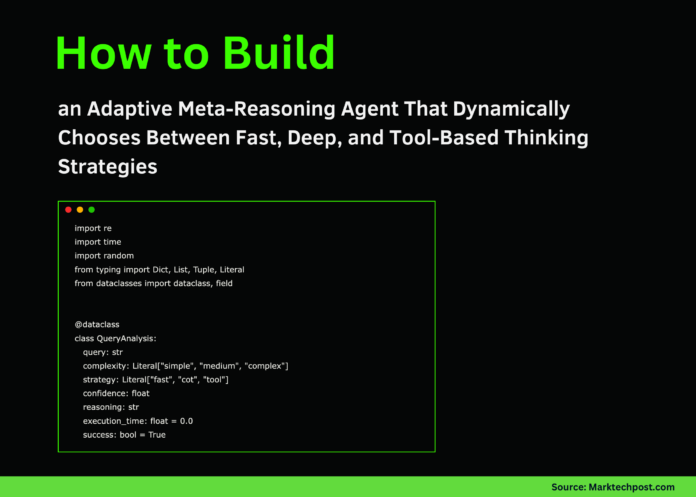
To empower our agent with the ability to evaluate incoming questions, we first define a structure that categorizes query complexity and identifies key patterns. This foundation acts as the agent’s “pre-thinking” mechanism, guiding it to choose the most suitable reasoning strategy.
import re
from typing import List, Literal
from dataclasses import dataclass

@dataclass
class QueryProfile:
    query: str
    complexity: Literal["simple", "moderate", "complex"]
    strategy: Literal["fast", "chain_of_thought", "tool_assisted"]
    confidence: float
    rationale: str
    execution_duration: float = 0.0
    success: bool = True

class QueryEvaluator:
    def __init__(self):
        self.history: List[QueryProfile] = []
        self.patterns = {
            'arithmetic': r'(d+s*[+-*/]s*d+)|calculate|compute|sum|multiply',
            'current_info': r'latest|current|news|today|who is|what is.*now',
            'creative_task': r'write|poem|story|joke|imagine',
            'logical_reasoning': r'if.*then|because|therefore|prove|explain why',
            'basic_fact': r'^(what|who|when|where) (is|are|was|were)',
        }

    def evaluate(self, query: str) -> QueryProfile:
        q_lower = query.lower()
        contains_arithmetic = bool(re.search(self.patterns['arithmetic'], q_lower))
        requires_search = bool(re.search(self.patterns['current_info'], q_lower))
        is_creative = bool(re.search(self.patterns['creative_task'], q_lower))
        is_logical = bool(re.search(self.patterns['logical_reasoning'], q_lower))
        is_basic = bool(re.search(self.patterns['basic_fact'], q_lower))
        word_count = len(query.split())
        has_multiple_clauses = '?' in query[:-1] or ';' in query

        if contains_arithmetic:
            complexity = "moderate"
            strategy = "tool_assisted"
            rationale = "Arithmetic detected - employing calculator tool for precision"
            confidence = 0.9
        elif requires_search:
            complexity = "moderate"
            strategy = "tool_assisted"
            rationale = "Dynamic information requested - utilizing search tool"
            confidence = 0.85
        elif is_basic and word_count < 10:
            complexity = "simple"
            strategy = "fast"
            rationale = "Straightforward factual query - fast heuristic sufficient"
            confidence = 0.95
        elif is_logical or has_multiple_clauses or word_count > 30:
            complexity = "complex"
            strategy = "chain_of_thought"
            rationale = "Requires deep reasoning - applying chain-of-thought method"
            confidence = 0.8
        elif is_creative:
            complexity = "moderate"
            strategy = "chain_of_thought"
            rationale = "Creative prompt - generating ideas via chain-of-thought"
            confidence = 0.75
        else:
            complexity = "moderate"
            strategy = "chain_of_thought"
            rationale = "Ambiguous complexity - defaulting to chain-of-thought"
            confidence = 0.6

        return QueryProfile(query, complexity, strategy, confidence, rationale)
Implementing Diverse Reasoning Engines for Adaptive Thinking
Next, we build the core reasoning modules that execute the selected strategies. These include a rapid heuristic engine for quick lookups, a chain-of-thought engine for comprehensive reasoning, and a tool executor capable of performing calculations or simulated searches. This modular design allows the agent to fluidly switch between different cognitive modes.
class RapidHeuristicEngine:
    def __init__(self):
        self.knowledge = {
            'capital of germany': 'Berlin',
            'capital of italy': 'Rome',
            'speed of sound': '343 meters per second',
            'freezing point of water': '0°C or 32°F at sea level',
        }

    def respond(self, query: str) -> str:
        q = query.lower()
        for key, value in self.knowledge.items():
            if key in q:
                return f"Answer: {value}"
        if 'hello' in q or 'hi' in q:
            return "Hi there! How can I assist you today?"
        return "Rapid heuristic: No direct answer found."

class ChainOfThoughtEngine:
    def respond(self, query: str) -> str:
        steps = []
        steps.append("Step 1: Comprehending the question")
        steps.append(f"  → Query involves: {query[:50]}...")
        steps.append("nStep 2: Decomposing the problem")
        if 'why' in query.lower():
            steps.append("  → Causal inquiry detected; identifying causes and effects")
        elif 'how' in query.lower():
            steps.append("  → Procedural question; outlining necessary steps")
        else:
            steps.append("  → Analyzing key concepts and their interrelations")
        steps.append("nStep 3: Integrating insights")
        steps.append("  → Synthesizing information from previous steps")
        steps.append("nStep 4: Formulating final response")
        steps.append("  → [Comprehensive answer based on reasoning]")
        return "n".join(steps)

class ToolExecutor:
    def calculate(self, expression: str) -> float:
        match = re.search(r'(d+.?d*)s*([+-*/])s*(d+.?d*)', expression)
        if match:
            a, operator, b = match.groups()
            a, b = float(a), float(b)
            operations = {
                '+': lambda x, y: x + y,
                '-': lambda x, y: x - y,
                '*': lambda x, y: x * y,
                '/': lambda x, y: x / y if y != 0 else float('inf'),
            }
            return operations[operator](a, b)
        return None

    def search(self, query: str) -> str:
        return f"[Simulated search results for: {query}]"

    def execute(self, query: str, tool_type: str) -> str:
        if tool_type == "calculator":
            result = self.calculate(query)
            if result is not None:
                return f"Calculator output: {result}"
            return "Unable to parse mathematical expression."
        elif tool_type == "search":
            return self.search(query)
        return "Tool execution completed."
Integrating Components into a Cohesive Meta-Reasoning Agent
We now combine the evaluation and reasoning modules into a single agent that orchestrates the entire decision-making process. This agent analyzes each query, selects the appropriate reasoning method, executes it, and records performance metrics to monitor efficiency and effectiveness.
import time

class AdaptiveMetaReasoningAgent:
    def __init__(self):
        self.evaluator = QueryEvaluator()
        self.rapid_engine = RapidHeuristicEngine()
        self.cot_engine = ChainOfThoughtEngine()
        self.tool_executor = ToolExecutor()
        self.performance = {
            'fast': {'count': 0, 'total_time': 0},
            'chain_of_thought': {'count': 0, 'total_time': 0},
            'tool_assisted': {'count': 0, 'total_time': 0},
        }

    def handle_query(self, query: str, verbose: bool = True) -> str:
        if verbose:
            print("n" + "="*60)
            print(f"QUERY: {query}")
            print("="*60)
        start_time = time.time()
        profile = self.evaluator.evaluate(query)

        if verbose:
            print(f"n🧠 META-REASONING ANALYSIS:")
            print(f"   Complexity: {profile.complexity}")
            print(f"   Strategy: {profile.strategy.upper()}")
            print(f"   Confidence: {profile.confidence:.2%}")
            print(f"   Rationale: {profile.rationale}")
            print(f"n⚡ EXECUTING {profile.strategy.upper()} STRATEGY...n")

        if profile.strategy == "fast":
            response = self.rapid_engine.respond(query)
        elif profile.strategy == "chain_of_thought":
            response = self.cot_engine.respond(query)
        elif profile.strategy == "tool_assisted":
            if re.search(self.evaluator.patterns['arithmetic'], query.lower()):
                response = self.tool_executor.execute(query, "calculator")
            else:
                response = self.tool_executor.execute(query, "search")
        else:
            response = "No valid strategy selected."

        elapsed = time.time() - start_time
        profile.execution_duration = elapsed
        self.performance[profile.strategy]['count'] += 1
        self.performance[profile.strategy]['total_time'] += elapsed
        self.evaluator.history.append(profile)

        if verbose:
            print(response)
            print(f"n⏱ Execution time: {elapsed:.4f} seconds")
        return response

    def display_performance(self):
        print("n" + "="*60)
        print("AGENT PERFORMANCE SUMMARY")
        print("="*60)
        for strategy, data in self.performance.items():
            if data['count'] > 0:
                avg_time = data['total_time'] / data['count']
                print(f"n{strategy.upper()} Strategy:")
                print(f"  Queries processed: {data['count']}")
                print(f"  Average response time: {avg_time:.4f} seconds")
        print("n" + "="*60)
Demonstrating the Agent’s Adaptive Reasoning in Action
To illustrate the agent’s capabilities, we run a series of diverse queries that trigger different reasoning strategies. This demonstration highlights how the agent dynamically adjusts its approach based on the query’s demands.
def demo_meta_reasoning_agent():
    print("""
    META-REASONING AGENT DEMONSTRATION
    "When to Think Deeply vs Respond Quickly"

    Features showcased:
    1. Rapid heuristic vs deep chain-of-thought vs tool-assisted reasoning
    2. Dynamic strategy selection based on query analysis
    3. Real-time adaptation and performance tracking
    """)

    agent = AdaptiveMetaReasoningAgent()
    sample_queries = [
        "What is the capital of Germany?",
        "Calculate 128 / 4",
        "Why do whales migrate annually?",
        "What is the latest weather update?",
        "Hi there!",
        "If all mammals breathe air and dolphins are mammals, what does that imply?",
    ]

    for query in sample_queries:
        agent.handle_query(query, verbose=True)
        time.sleep(0.5)

    agent.display_performance()
    print("nDemo complete!")
    print("• Meta-reasoning guides how the agent thinks")
    print("• Different questions require tailored strategies")
    print("• Intelligent agents adapt their reasoning dynamicallyn")
Launching the Tutorial
Finally, we initiate the tutorial with a simple main execution block, allowing the full meta-reasoning pipeline to run and demonstrate its adaptive intelligence.
if __name__ == "__main__":
    demo_meta_reasoning_agent()
Summary
By constructing this meta-reasoning agent, we move beyond static, one-size-fits-all responses toward a system that self-regulates its cognitive processes. The agent evaluates each query’s complexity, selects the most effective reasoning method-whether rapid heuristics, detailed chain-of-thought, or tool-assisted computation-and executes it efficiently. Tracking performance metrics further enables ongoing optimization. This framework offers valuable insights into building intelligent systems capable of strategic, adaptive thinking that enhances both speed and accuracy.

