
Essential Insights
- Graffiti represents a deliberate and artistic endeavor, not merely random wall paint.
- Its vivid hues and distinctive shapes serve as clear visual cues for detection systems.
- Advanced vision technologies analyze “before and after” imagery to rapidly identify new graffiti.
- Geospatial alerts enable maintenance teams to pinpoint exact locations requiring cleanup.
Urban environments evolve constantly. A freshly sprayed tag on a subway pillar or train car can materialize between commutes and be replaced or removed by the next day.
For transit authorities and maintenance crews, promptly identifying these new markings is critical-not just for aesthetics but for operational efficiency.
Quick detection helps maintain asset appearance, optimizes cleaning schedules, and reveals hotspots of graffiti activity, guiding the strategic placement of patrols and surveillance cameras. The main hurdles are the vast scale and rapid pace of changes.
With countless walls, tunnels, and vehicles generating enormous volumes of images and video, manual review is impractical.
Modern computer vision systems transform raw visual data into actionable insights about “what’s new” and “where,” enabling dispatchers to respond within minutes rather than days.
This article begins by exploring the artistry behind graffiti-how pieces and tags are crafted-before delving into the technical frameworks, datasets, and detection pipelines that empower machines to spot fresh paint on urban infrastructure swiftly.
The Artistry Behind Graffiti: Techniques and Creative Expression
At the heart of impactful graffiti lies the mastery of letterforms. Many artists begin by practicing “handstyles,” fluid signature-like scripts that develop muscle memory and personal flair.
From these foundations, they construct letters with depth, incorporating volume, shadows, and highlights inspired by calligraphy, comic art, and traditional sign painting.
Color selection is intentional: contrasting fills stand out against gritty concrete, while complementary outlines enhance legibility from moving trains or distant viewpoints.
Spray caps and nozzles vary line thickness and texture-from fine hairline strokes to broad fills-allowing a single can to produce outlines, gradients, and soft blends.
Despite common misconceptions, graffiti is far more than vandalism; it is a meaningful form of self-expression and cultural storytelling.
Listening to veteran artists reveals the depth of this craft. For example, a renowned street artist recounts navigating complex urban canvases, adapting to surfaces and environmental conditions in ways that remain largely unknown to the public.
Understanding these artistic processes sheds light on how detection technologies are designed to recognize graffiti.
Surface texture plays a crucial role: rough brick absorbs paint differently than smooth tiles or metal train panels, which flex and require adjusted spray techniques.
Tools like stencils and rollers enable rapid coverage for large areas, while freehand fades add dimensionality. Although many pieces are pre-planned, artists often improvise in response to factors like paint drips, wind, or architectural features disrupting letter shapes.

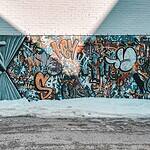
This striking Budapest mural reimagines a famous animated robot character with bold outlines, metallic shading, and glowing eyes, showcasing the artist’s skill in adapting pop culture icons into street art.
The ingenuity lies in transforming typography into dynamic motion, making colors resonate on uneven surfaces, and composing within unconventional spaces like columns or door recesses.
Graffiti artists operate under constraints such as limited light, tight spaces, and time pressure, yet consistently produce vibrant, living artworks.
This blend of meticulous planning and spontaneous creativity is what makes graffiti visually distinctive and highly detectable by cameras and algorithms.
Rapid Detection of New Graffiti Using Advanced Vision Technologies
At the operational level, effective graffiti detection combines change detection with object recognition.
Systems first establish “baseline” images of walls, tunnels, and train exteriors. Subsequent images are precisely aligned to these baselines using techniques like structure-from-motion and orthophoto generation, ensuring pixel-perfect comparisons over time.
Once aligned, detection algorithms isolate painted markings and analyze differences to identify new graffiti.
For instance, a model trained on façade imagery achieved an 88% accuracy rate in spotting new markings on orthophotos, leveraging a Faster R-CNN architecture and a meticulously annotated dataset of over 1,600 markings across 1,000+ images.
The detection pipeline stitches façade images and automatically generates bounding boxes to quantify where fresh paint has appeared.
Timeliness is paramount. One dataset designed for change detection included nearly 7,000 image pairs collected over multiple sessions along a 50-meter test corridor.
To ensure fairness and consistency, synthetic camera models and exclusion masks account for lighting variations and occlusions, which can otherwise confuse detection.
Performance varies by application. A study in Lisbon implemented a two-step system: first classifying images into categories, then localizing graffiti areas. It reported an 81.4% classification accuracy and a 70.3% intersection-over-union (IoU) for localization, demonstrating that city-scale monitoring can be built using existing architectures enhanced by transfer learning.
On transit platforms and rolling stock, these principles translate into fixed cameras, scheduled inspections, and “what changed?” alerts linked to precise map coordinates.
When image alignment is accurate, even subtle letter outlines stand out against previous imagery, enabling maintenance crews to intervene before graffiti accumulates.
Optimizing Alert Systems for Stations and Maintenance Yards
Speed is critical in railway environments. Practical detection pipelines ingest video frames, stabilize them to compensate for train movement, normalize colors to reduce shadow effects, and apply hybrid change detection combining pixel-level differences with feature-based matching.
Recent evaluations on nearly 7,000 image pairs showed this hybrid method achieving a median F1-score of approximately 80%, with recall at 77% and precision at 87%, processing each image pair in about 16 seconds on a standard desktop CPU.
This performance supports overnight monitoring sweeps and near-real-time surveillance in busy stations.
One study summarized: “With an 87% precision and 77% recall, the proposed workflow effectively flags newly added graffiti.”
Scalability also hinges on alert quality. Large-scale transport trials have demonstrated that AI-enhanced CCTV systems can generate tens of thousands of real-time graffiti alerts annually at a single station.
Managing this alert volume requires sophisticated queuing, throttling, and operator handoff protocols to ensure rapid response without overwhelming staff.
Frequently Asked Questions
Q1: How do computer vision systems detect new graffiti?
A: They start by capturing baseline images of urban surfaces. Later images are aligned pixel-by-pixel to these baselines, and change detection combined with object recognition models highlights newly painted areas.
Q2: What types of models and data underpin these detection systems?
A: Most use deep learning frameworks like Faster R-CNN, trained on extensive labeled datasets of façades and graffiti markings. Orthophotos and thousands of paired “before and after” images help models learn to distinguish genuine changes over time.
Q3: How accurate and efficient are these detection tools in real-world settings?
A: Recent studies report detection accuracies between 80% and 88%, with strong precision and recall metrics. Optimized pipelines can process image pairs within seconds on standard CPUs, enabling timely monitoring for transit systems.

