
Google will invest $37 Million in research, talent development and infrastructure, funding, partnerships, and funding to strengthen AI across Africa.
The funding, which is partially committed but not announced, will be used to fund AI research and support African languages. It will also improve food systems, expand digital skill sets, and build research capability.
James Manyika, Senior VP for Research, Labs, and Technology & Society, Google, said in a statement: “Africa is the home of some of today’s most important and inspirational work in AI.” We are committed to supporting the next wave in innovation through long-term investments, local partnerships, as well as platforms that help researchers and entrepreneurs create solutions that work.
Google.org has provided $25 million to the AI Collaborative for Food Security. This funding will be used by researchers and organizations in order to develop AI tools for early forecasting of hunger, crop resilience and tailored guidance for smallholders farmers.
The goal is to make food systems in Africa more resilient, adaptive, and equitable as a result of climate and economic shocks.
Google has also announced a $3 million funding for the Masakhane Research Foundation. This open research collective is advancing AI tools across over 40 African language. The funding will be used to develop high-quality datasets and machine translation models as well as speech tools, which will make digital content more available in the native languages of millions of Africans.
Google will also fund AI-driven startups that tackle real-world problems. This platform will combine philanthropic funding, venture capital investment, and Google’s technical expertise to assist more than 100 early stage ventures in scaling AI-based solutions for agriculture, healthcare and education, among other vital sectors. Startups will receive mentorship, tools and technical guidance in order to support responsible development.
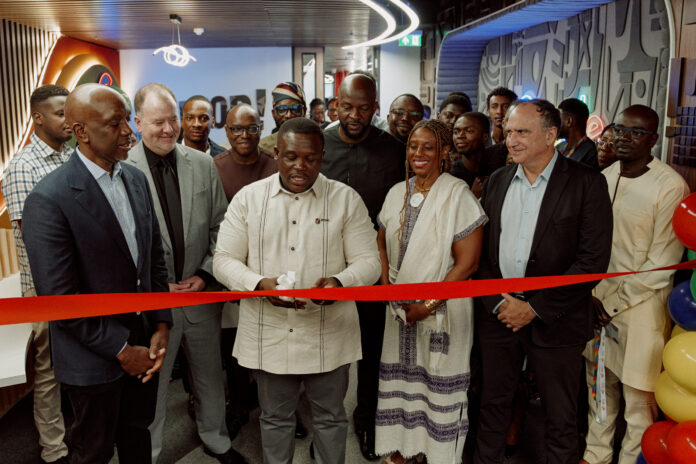
Africa’s AI talent grows rapidly, but infrastructure must grow along with it. This announcement is based on the launch of an AI Community Center in Accra. It will be a space to learn, experiment, and collaborate in Africa.
The Center will host workshops, training sessions, and community events that focus on responsible AI development. Its programming will be based on four pillars – AI literacy, community technologies, social impact and arts and cultures – and provide a platform for a diverse ecosystem to engage with AI based on African priorities.
Google will offer 100,000 Google Career Certicate Scholarships to students at higher learning institutions in Ghana. These self-paced, fully-funded programs will focus on AI Essentials and Prompting Essentials as well as other high-growth fields like IT Support, Data Analytics and Cybersecurity.
Google.org will also commit an additional $7million to support AI education in Nigeria, Kenya and Ghana. The funding will be used to support academic institutions and nonprots in developing localized AI curricula and online safety training.
Google.org has also announced two new grants of $1 million to boost AI research capacity on the continent. One grant will support AI training and research at the African Institute for Data Science and Articial Intelligence, located at the University of Pretoria. The Wits Machine Intelligence and Neural Discovery Institute (MIND) in South Africa will receive the other grant. This institute will fund MSc and Ph.D. students to conduct AI research and help shape Africa’s role in the global AI scene.
Yossi Mathias, Vice-President of Engineering and Research, Google, said: “This new wave reflects our belief in talent, creativity, and innovation across the continent.” By partnering with local communities and organizations, we support solutions that are rooted within Africa’s realities but built for global impact.
Google’s previous efforts include partnerships to support AI powered maternal health dashboards for Ghana and Nigeria, wildfire warnings in East Africa, as well as regional language models developed in Accra and Nairobi.
Read This Now 131

