
How Walmart Navigates Cybersecurity Challenges Amid Autonomous AI Growth
Adapting Security Frameworks for Agentic AI Threats
As autonomous AI systems become more prevalent, Walmart faces novel cybersecurity risks that traditional defenses struggle to contain. These include unauthorized data extraction, misuse of APIs by autonomous agents, and covert collaboration between AI entities that could disrupt operations or breach compliance requirements. To counter these threats, Walmart employs an advanced AI Security Posture Management (AI-SPM) system. This proactive approach continuously monitors risks, enforces regulatory adherence, and maintains operational integrity across its vast infrastructure.
Revolutionizing Identity and Access Management with a Startup Mindset
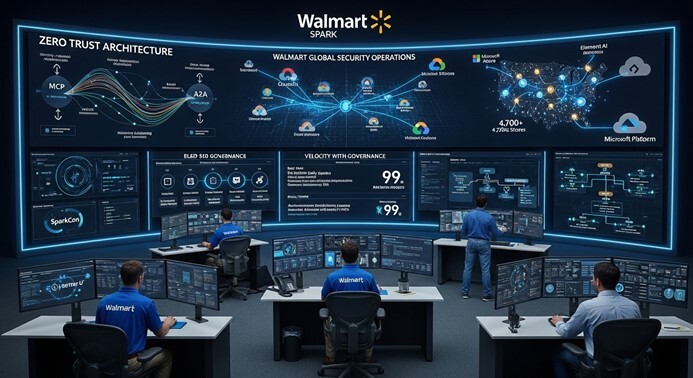
Managing identity and access in a sprawling enterprise like Walmart demands innovation beyond conventional Role-Based Access Control (RBAC). Embracing a startup mentality, the security team reimagines identity management from the ground up, focusing on simplification and modernization. While the principle of least privilege remains foundational, Walmart integrates emerging protocols such as Mutual Consent Protocol (MCP) and Agent-to-Agent (A2A) communication. These enable dynamic, context-aware access decisions using short-lived credentials, ensuring continuous verification of users, tools, and requests in alignment with Zero Trust principles.
Implementing Zero Trust Across a Complex Hybrid Cloud Ecosystem
Walmart’s hybrid cloud environment-spanning Google Cloud, Microsoft Azure, and private data centers-necessitates a consistent security posture that transcends network boundaries. The company prioritizes identity-based segmentation over traditional network location controls, applying uniform access policies across all platforms. The adoption of standardized service edge enforcement protocols like MCP and A2A further strengthens this approach, ensuring seamless Zero Trust implementation throughout its AI workloads and broader IT infrastructure.
Leveraging AI to Combat Sophisticated Cyber Threats
With AI lowering the entry barrier for complex cyberattacks such as advanced phishing, Walmart proactively integrates AI-driven defenses into its security arsenal. Machine learning models analyze behavioral patterns to detect anomalies and phishing attempts in real time. Additionally, generative AI is utilized to simulate attack scenarios, rigorously testing and enhancing the resilience of Walmart’s defenses. This fusion of human expertise and cutting-edge technology fortifies the company’s ability to protect employees and customers in an evolving digital threat landscape.
Addressing Security Challenges in Open-Source AI Deployments
Walmart’s extensive use of open-source AI within its Element AI platform introduces unique cybersecurity considerations. To mitigate risks, the company emphasizes identity-centric access controls and consistent policy enforcement across cloud and on-premises environments. The integration of protocols like MCP and A2A ensures that Zero Trust principles are uniformly applied, safeguarding AI models and data from unauthorized access or manipulation.
Automating Rapid Response for Global Cybersecurity Incidents
Operating at a global scale requires Walmart’s security operations to be both swift and seamless. The company employs Security Orchestration, Automation, and Response (SOAR) platforms to coordinate incident response workflows across multiple regions. Continuous risk assessment and prioritization through automation enable the security team to focus resources on the most critical threats. This synergy of skilled personnel, rapid automation, and contextual intelligence ensures effective threat containment and operational continuity.
Investing in Cybersecurity Talent for the AI Era
Recognizing the importance of skilled cybersecurity professionals, Walmart offers programs like Live Better U (LBU), which provides affordable or free education in cybersecurity and IT disciplines. This initiative empowers associates from diverse backgrounds to acquire practical, job-relevant skills. Furthermore, Walmart’s annual SparkCon event fosters knowledge sharing and networking among cybersecurity experts, spotlighting emerging trends, technologies, and defense strategies to prepare the workforce for future challenges.
Key Insights from Building a Centralized AI Platform
Walmart’s experience developing Element AI has underscored two pivotal lessons shaping its AI security strategy. First, centralizing AI capabilities streamlines innovation by providing a unified “paved road” for data scientists, embedding security controls from the outset, and ensuring consistent data governance. Second, concentrating AI security expertise and defenses in a centralized architecture enables rapid adaptation to evolving threats. This approach facilitates advanced protections such as context-aware access, prompt monitoring, and data exfiltration prevention, delivering comprehensive coverage across use cases.

