
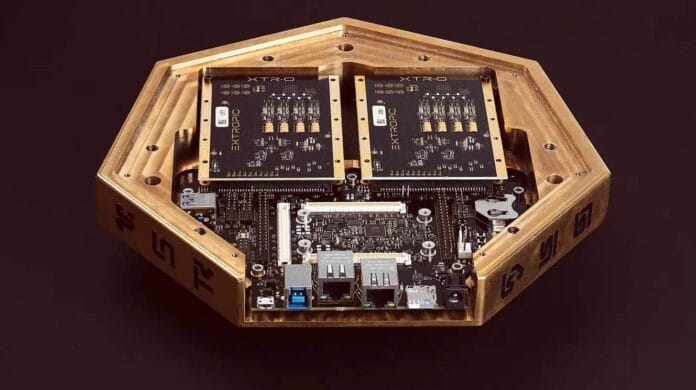
Good morning, AI enthusiasts. Imagine a revolutionary leap in AI energy efficiency-an astonishing 10,000-fold reduction in power consumption to operate AI models. This breakthrough is powered by thermodynamic chips that leverage probabilistic computation rather than conventional processing methods.
Extropic has begun delivering this cutting-edge hardware to AI research centers, heralding what could be a transformative moment in computing. This innovation may offer a viable solution to the escalating energy demands of the AI industry.
Reminder: Join our live workshop today at 4 PM EST to master building Claude Skills for crafting professional, tailored PowerPoint presentations in minutes.
Today’s AI Highlights:
- Extropic unveils a groundbreaking chip promising massive AI energy savings
- Cursor launches Composer, a proprietary coding model, alongside its upgraded 2.0 platform
- Learn how to develop multi-agent applications with Cursor 2.0
- Character AI enforces new age restrictions to protect minors
- Discover four innovative AI tools, community workflows, and more
Revolutionizing AI Efficiency: Extropic’s Thermodynamic Chips

Overview: Extropic has introduced thermodynamic sampling units (TSUs), a novel chip design that performs probabilistic calculations instead of traditional sequential processing. This approach reportedly enables AI models to operate with energy consumption reduced by a factor of 10,000 compared to standard GPUs.
Key Features:
- Unlike conventional GPUs that process data stepwise, Extropic’s chips generate likely solutions directly, sacrificing some precision to achieve remarkable energy efficiency.
- The company has already distributed its initial development kits to AI research labs and meteorological organizations, accompanied by open-source software to facilitate experimentation.
- Next year, Extropic plans to release the Z-1 chip, optimized for a new diffusion model that synthesizes images and videos by iteratively denoising data.
- Founded by ex-Google quantum computing experts, Extropic emphasizes that current chip architectures impose energy constraints that could hinder AI’s future growth unless radically redesigned.
Significance: Spearheaded by Guillaume Verdon, a prominent figure in AI hardware innovation, Extropic’s advancements signal a potential paradigm shift. The critical question remains whether this technology can scale effectively for widespread commercial deployment, potentially reshaping the trillion-dollar AI hardware market.
Boost Your Productivity with HubSpot’s ChatGPT Guide
HubSpot offers a free, extensive guide titled “How to Use ChatGPT at Work,” featuring over 100 practical prompts designed to enhance workplace efficiency and integrate AI into daily workflows.
What’s Inside:
- A concise tutorial to become proficient with ChatGPT in under 30 minutes
- Real-world applications across various industries to inspire your AI use
- Hundreds of prompts to automate tasks and increase output
- Expert advice to overcome common challenges when adopting AI tools
Join over 10,000 professionals who are accelerating their careers by leveraging AI.
Cursor’s Composer and 2.0 Platform: A New Era in AI-Assisted Coding

Summary: Cursor has launched Composer, its first proprietary AI coding model, delivering state-of-the-art performance with code generation speeds approximately four times faster than competitors. Alongside this, the company released Cursor 2.0, a platform enabling simultaneous operation of up to eight independent AI agents.
Highlights:
- Composer combines advanced intelligence with rapid code generation, completing most tasks in under 30 seconds.
- Cursor 2.0 supports parallel workflows by allowing multiple AI assistants to work concurrently without conflicts.
- New features include integrated web browsing for real-time documentation access, a built-in browser for testing, voice command support, and more.
- This marks Cursor’s strategic shift from relying solely on third-party AI models to developing in-house solutions.
Why It Matters: Cursor is pioneering a future where software engineers act more as orchestrators of AI agents, focusing on architectural decisions and quality assurance rather than manual coding, signaling a fundamental transformation in software development roles.
Accelerate Web App Development with Cursor 2.0’s Multi-Agent Feature

Overview: This tutorial guides you through leveraging Cursor 2.0’s multi-agent capabilities to build a web application more efficiently by delegating tasks to multiple AI agents working in parallel.
Step-by-Step Instructions:
- Create a folder named
todo-list-app, open it in Cursor by selecting “Open Project” or drag-and-drop into the IDE. - Click the “Agents” button, then “New Agent,” and input the prompt: “Create a plan to build a To-Do app using Next.js as Plan.md. Divide tasks for two developer agents working concurrently, including integration steps and README.”
- Approve Plan.md, then create two new agents with prompts: “Start Dev 1 tasks from Plan.md” and “Start Dev 2 tasks from Plan.md.” Review and accept their outputs.
- Instruct one agent to “Complete integration from Plan.md and update README with run instructions.” Then, in the terminal, run
npm installfollowed bynpm run dev. - Open http://localhost:3000 to view your fully functional To-Do app created by multiple AI agents simultaneously.
Pro Tip: Use the Voice button on the prompt bar to issue commands hands-free. Simply speak your prompt and conclude with “submit” to send it.
Recraft’s Chat Mode: Conversational Design Meets Infinite Canvas
Recraft introduces Chat Mode, a feature that merges a chat interface with an endless canvas, enabling users to generate and refine professional design elements through natural language interaction while retaining full manual editing control.
Capabilities Include:
- Context-aware suggestions and prompt assistance to enhance creativity
- Rapid generation of brand identity suites from logos or adaptation of existing designs
- AI-driven maintenance of visual consistency by understanding the entire creative context
Sign up now for early access and elevate your design workflow.
Character AI Implements Age Restrictions to Protect Minors

Summary: In response to mounting legal scrutiny and concerns over safety, Character AI will restrict users under 18 from engaging in open-ended conversations with its chatbots starting November 25. However, minors will retain access to creative tools for generating videos and images.
Details:
- The platform will deploy proprietary age detection technology analyzing user behavior to prompt age verification when underage use is suspected.
- Approximately 20 million users engage with Character AI monthly, with under 10% identified as minors; previously, the platform did not verify age at signup.
- This policy update follows the introduction of the GUARD Act, which proposes fines up to $100,000 for companies failing to block minors from AI companion interactions.
Implications: Character AI and OpenAI have faced significant criticism regarding minor safety in chatbot interactions. With increasing regulatory pressure, age verification measures may become the industry standard, though their effectiveness will depend on enforcement and technological robustness.
Quick Updates in AI
- Community-driven open speech datasets now available in over 300 languages, enhancing multilingual AI capabilities.
- Cursor’s new agentic coding model accelerates software development workflows.
- Google Labs experiments with AI-generated branded content to streamline marketing efforts.
- GitHub introduces ‘mission control’ to coordinate multiple AI agents for complex coding tasks.
*Sponsored Listing
Industry News
OpenAI released gpt-oss-safeguard, two open-source models enabling developers to set moderation policies and understand AI’s rationale when flagging harmful content.
Google enhanced NotebookLM with expanded context windows, memory features, customizable chat personas, and improved response accuracy.
TikTok launched Smart Split and AI Outline, tools that automatically convert long videos into short clips and generate structured content outlines.
IBM introduced Granite 4.0 Nano, a suite of compact language models ranging from 350 million to 1.5 billion parameters optimized for on-device applications.
Grammarly rebranded as Superhuman and unveiled ‘Superhuman Go,’ an AI agent suite that automates tasks like scheduling and research across multiple apps.
Community Spotlight
Each edition, we highlight how readers harness AI to enhance productivity and simplify their lives.
Today’s feature comes from Max S. in Las Vegas, NV:
“I’m currently using the Wispr app for speech-to-text, which not only transcribes but also corrects grammar and condenses my thoughts into clear, concise sentences. Recently, I started using the ChatGPT Atlas browser, which has revolutionized my research process and AI integration online. Efficiency is everything.”
How do you incorporate AI into your routine? Share your story with us.
Additional Resources & Upcoming Events
- Explore our previous AI newsletter for more insights.
- Catch up on the latest in technology with our recent Tech newsletter.
- Discover advancements in robotics from our last Robotics newsletter.
- Access today’s curated AI tool guide to enhance your toolkit.
- Reserve your spot for today’s 4 PM workshop and elevate your AI skills.
Looking forward to connecting soon,
Rowan, Joey, Zach, Shubham, and Jennifer – your team behind The Rundown


