
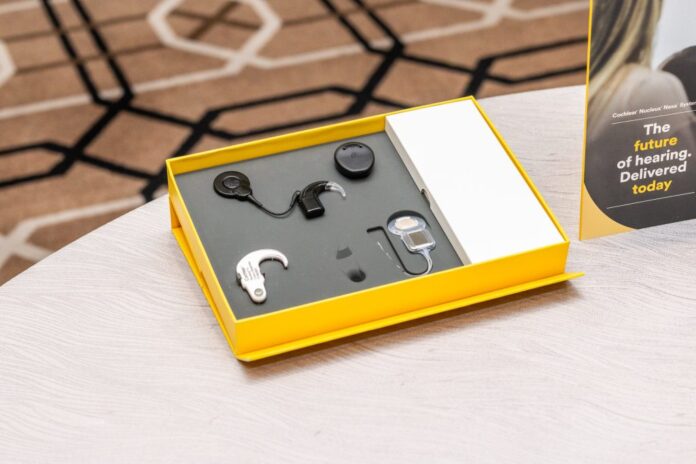
Edge AI in medical technology is advancing beyond external devices like wearables and bedside monitors, moving into fully implantable systems within the human body. Cochlear’s latest innovation introduces the first cochlear implant capable of executing machine learning algorithms under stringent power limitations, storing personalized auditory data internally, and receiving over-the-air firmware updates to continuously enhance its AI capabilities.
Revolutionizing Auditory Environment Recognition with Low-Power AI
At the heart of this implant’s intelligence is SCAN 2, an advanced environmental audio classifier that distinguishes between five auditory scenarios: Speech, Speech in Noise, Noise, Music, and Quiet. This classification feeds into a decision tree machine learning model that dynamically adjusts sound processing parameters to optimize hearing in real time.
Jan Janssen, Cochlear’s Global CTO, highlights that while the decision tree runs on the external sound processor, the implant itself actively participates through Dynamic Power Management. This system cleverly balances data and power transfer via an enhanced radio frequency (RF) link, enabling the implant to conserve energy based on the detected auditory environment. This innovation addresses a critical challenge in implantable devices: sustaining operation for over four decades without battery replacement.
Spatial Audio Processing: Enhancing Focus in Complex Soundscapes
Complementing environmental classification, the implant employs ForwardFocus, a spatial noise reduction algorithm that leverages inputs from dual omnidirectional microphones. By assuming that desired sounds originate from the front and background noise from other directions, ForwardFocus applies spatial filtering to suppress unwanted noise, significantly improving speech clarity in challenging environments.
Importantly, this spatial filtering activates automatically based on real-time environmental analysis, eliminating the need for user intervention and reducing cognitive effort in complex auditory settings.
Firmware Upgradeability: A Paradigm Shift in Implantable Medical Devices
Unlike previous cochlear implants, which were static post-surgery, the Nucleus Nexa Implant introduces a groundbreaking capability: firmware updates delivered wirelessly to the implant itself. This is made possible through Cochlear’s proprietary short-range RF communication, allowing audiologists to enhance signal processing algorithms, machine learning models, and noise reduction techniques remotely.
Security is ensured by the limited transmission range and low power output, requiring close proximity during updates, alongside robust protocol safeguards. Additionally, the implant stores up to four personalized hearing maps internally, enabling seamless recovery of user settings if the external processor is lost or replaced-addressing a key challenge in maintaining personalized AI models over time.
From Decision Trees to Deep Learning: The Future of AI in Cochlear Implants
Currently, decision tree models are favored for their low power consumption and interpretability, essential for medical device safety. However, Cochlear is actively researching the integration of deep neural networks, which promise enhanced performance in noisy environments by capturing more complex auditory patterns.
Beyond signal processing, AI is being explored to automate routine device check-ups and reduce long-term care costs, signaling a shift from reactive hearing assistance to proactive health management.
Overcoming the Unique Constraints of Edge AI in Medical Implants
Deploying AI within implantable devices involves navigating a complex set of constraints:
- Energy Efficiency: The implant must operate continuously for decades on minimal power, with battery life measured in days despite ongoing audio processing and wireless communication.
- Real-Time Responsiveness: Audio processing must occur with imperceptible latency to ensure natural hearing experiences.
- Safety and Reliability: As a life-critical device directly stimulating neural tissue, any AI model failure can severely impact quality of life.
- Long-Term Upgradeability: The system must support software and model improvements over a 40+ year lifespan without hardware replacement.
- Data Privacy: All health data is processed locally on the device, with stringent de-identification protocols before any aggregated data is used for model training across Cochlear’s extensive patient network of over 500,000 users.
These factors demand meticulous architectural design, where every milliwatt of power and every line of code is optimized for safety and longevity-challenges far beyond typical cloud or smartphone AI deployments.
Advancing Connectivity: The Implant as a Node in Assistive Listening Networks
Looking forward, Cochlear plans to integrate Bluetooth LE Audio and Auracast broadcast capabilities through future firmware updates. These technologies offer superior audio quality and reduced power consumption compared to traditional Bluetooth, while enabling the implant to connect directly to public audio streams in venues such as airports, theaters, and gyms.
This connectivity transforms the cochlear implant from a standalone medical device into an active participant in ambient computing environments, enhancing user experience and accessibility.
The ultimate vision includes fully implantable devices with embedded microphones and batteries, eliminating external components entirely. Such systems would autonomously adapt to changing environments, optimize power usage, and maintain seamless connectivity without user input.
Blueprint for Sustainable AI in Medical Implants
Cochlear’s pioneering approach offers a strategic framework for developing edge AI medical devices under extreme constraints: prioritize interpretable models like decision trees, aggressively optimize for power efficiency, embed upgradeability from inception, and design for multi-decade lifespans rather than short consumer cycles.
As Janssen emphasizes, today’s smart implant is merely the foundation for even more advanced future devices. The challenge lies in balancing rapid AI innovation with the demands of long-term medical device reliability.
With over 546 million individuals experiencing hearing loss in the Western Pacific Region alone, the speed at which manufacturers overcome these technical hurdles will determine whether AI-enhanced medical devices become the global standard of care or remain niche innovations.

