
Estimated Reading Time: 3 minutes
Transforming Renewable Energy Operations in Harsh Environments with DJI Drones
DJI’s cutting-edge drone technology is revolutionizing maintenance and inspection processes at China’s expansive desert solar power facility, enabling rapid, automated operations in challenging landscapes.
Enhancing Efficiency at the World’s Largest Renewable Energy Project
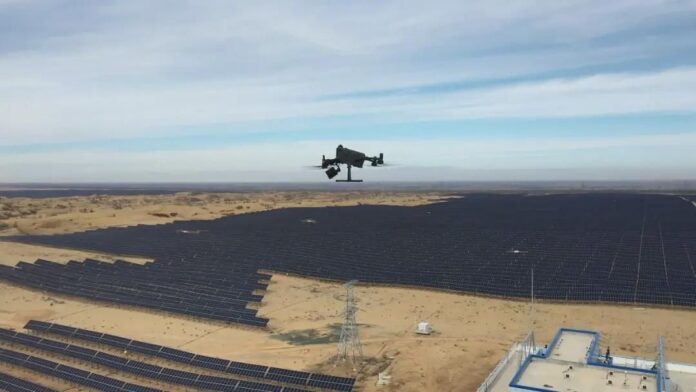
Recently, DJI Enterprise showcased its drone solutions during a live demonstration in the Kubuqi Desert, highlighting their application in large-scale renewable energy infrastructure. The demonstration took place at the Ordos New Energy Base in Inner Mongolia, home to the globe’s pioneering 10-gigawatt renewable energy initiative. This vast solar installation presents unique operational hurdles that traditional manual inspections struggle to overcome.
Spanning extensive sand dunes, the solar panels are mounted at an elevated height of 1.5 meters-significantly above the typical 0.8 to 1 meter-to harmonize ecological restoration efforts with energy production. This elevation, while environmentally beneficial, complicates routine maintenance tasks.
Drone Inspections: A Quantum Leap in Productivity
Liu Chang, representing CTG Mengneng’s Innovation and Digitalization Department, revealed compelling performance metrics from their pilot solar-storage facility:
“Manual inspections required two teams of four personnel to examine roughly 1,000 panels daily. By integrating autonomous drone inspections, we now assess approximately 30,000 panels each day, completing comprehensive site evaluations in just 36 days-an efficiency boost of 26 times.”
Yu Yangyang from DJI’s Energy Solutions division elaborated on the drones’ advanced dual-sensor payloads, which combine ultra-high-resolution visible-light cameras with infrared thermography. This technology swiftly identifies thermal anomalies-often indicative of overloads or bypass diode malfunctions-across solar arrays, regardless of terrain complexity. Beyond panel inspections, drones also monitor collection lines and substations, streamlining maintenance workflows.
Automated Drone Operations with DJI Dock 3 and Matrice Series
During the field event, DJI demonstrated the seamless integration of DJI Dock 3 with Matrice 4TD and Matrice 4T drones. Operators remotely schedule inspection missions via a centralized management platform, enabling drones to autonomously launch, capture diagnostic imagery, detect faults, and return to base for data processing and reporting.
Pan Yu from Huaneng Kubuqi Energy highlighted the impact of drone photogrammetry during the construction phase, where surveying over 60,000 square meters was completed in just two weeks-nearly nine times faster than conventional methods. Post-construction, drone docking stations have automated routine inspection cycles, significantly reducing manual labor.
Addressing Wind Power Challenges with Precision Drone Surveillance
Data from the China Renewable Energy Society indicates a rise in critical wind turbine incidents over the past three years, including tower collapses, fires, and component failures, with blade damage accounting for 44% of these events. Traditional inspection techniques-such as high-altitude visual checks or gondola-based assessments-pose safety risks and require 1-2 days per turbine, often prone to human error.
Yu noted that DJI Docks have been deployed at over 1,000 renewable energy sites across China, covering about half of the nation’s new energy installations. These drones can scan turbine blades in just 15 minutes, detecting 14 distinct defect types, including cracks, with accuracy exceeding 95%.
Integrating Renewable Energy with Ecological Restoration in the Kubuqi Desert
In the Kubuqi Desert, solar panels not only generate electricity but also contribute to environmental sustainability by cooling the soil and reducing water evaporation. This microclimate fosters vegetation growth beneath the arrays, supporting a synergistic system that combines solar energy production with grassland restoration and livestock grazing.
Drones play a vital role in this ecological management by providing continuous, quantitative monitoring data. They assess sand stabilization effectiveness, track vegetation recovery, and evaluate equipment performance. For context, a manual inspection of a 1-gigawatt solar plant spanning 32,000 mu and comprising over two million components would take approximately 180 days and still might miss hidden thermal or electrical faults.
Driving the Future of Smart Energy Inspections
Song Tianqi, head of DJI’s Energy Business, emphasized that ongoing advancements in drone technology are accelerating the adoption of intelligent inspection systems across photovoltaic stations. These innovations ensure dependable, smart, and safe operations even under the most demanding environmental conditions.
Ultimately, DJI’s intelligent drone inspection solutions are indispensable for managing vast renewable energy sites situated in difficult terrains, delivering unparalleled improvements in operational efficiency and safety.

