
Top Optical Character Recognition Systems in 2025: A Comprehensive Overview
Optical Character Recognition (OCR) technology has evolved far beyond simple text extraction, now serving as a cornerstone of advanced document intelligence. Today’s OCR solutions are expected to seamlessly process both scanned and digital PDFs in a single workflow, maintain document layout integrity, identify tables, extract key-value pairs, and support multiple languages. Additionally, many organizations require OCR systems that integrate directly with Retrieval-Augmented Generation (RAG) and AI agent pipelines.
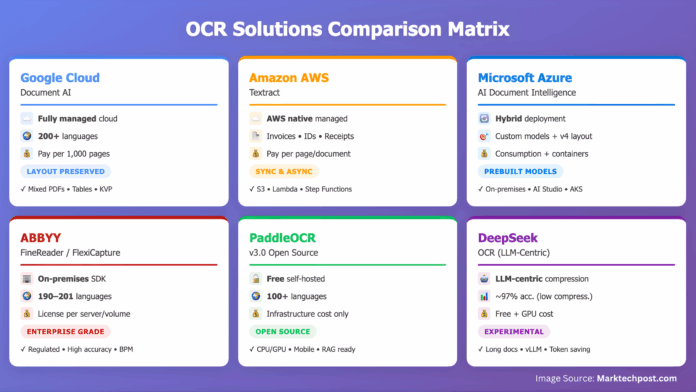
By 2025, six leading OCR platforms dominate the market, addressing the majority of real-world applications:
- Google Cloud Document AI – Enterprise Document OCR
- Amazon Textract
- Microsoft Azure AI Document Intelligence
- ABBYY FineReader Engine and FlexiCapture
- PaddleOCR 3.0
- DeepSeek OCR with Contexts Optical Compression
Key Criteria for Evaluating OCR Solutions
When selecting an OCR system, it’s essential to consider multiple factors that influence performance and suitability:
- Accuracy of OCR: Effectiveness in recognizing text from scanned images, photographs, and digital PDFs.
- Preservation of Document Structure: Ability to detect tables, key-value pairs, selection marks, and maintain reading order.
- Language and Handwriting Support: Range of languages and handwriting recognition capabilities.
- Deployment Flexibility: Options including fully managed cloud services, containerized solutions, on-premises installations, and self-hosted setups.
- Integration Capabilities: Compatibility with Large Language Models (LLMs), RAG frameworks, and Intelligent Document Processing (IDP) tools.
- Cost Efficiency at Scale: Pricing models and scalability considerations for high-volume document processing.
Detailed Analysis of Leading OCR Platforms
1. Google Cloud Document AI – Enterprise Document OCR
Google’s Enterprise Document OCR excels at processing both scanned and digital PDFs, delivering text extraction alongside layout retention, table recognition, key-value pair identification, and selection mark detection. It supports handwriting recognition in over 50 languages and can identify mathematical expressions and font styles, making it ideal for financial reports, academic forms, and archival documents. The output is structured JSON, easily integrated with Vertex AI or any RAG system.
- Advantages: Superior OCR accuracy for business documents, robust layout and table detection, unified pipeline for diverse document types, enterprise-grade security with Identity and Access Management (IAM) and data residency compliance.
- Drawbacks: Usage is metered via Google Cloud, and custom document types require manual configuration.
- Best suited for: Organizations already leveraging Google Cloud infrastructure or those needing precise layout preservation for downstream AI processing.
2. Amazon Textract
Amazon Textract offers two API modes: synchronous for smaller documents and asynchronous for large, multi-page PDFs. It extracts text, tables, forms, and signatures, returning data as relational blocks. The 2025 update includes AnalyzeDocument, which supports query-based extraction, simplifying workflows for invoices and insurance claims. Textract integrates tightly with AWS services like S3, Lambda, and Step Functions, enabling streamlined ingestion pipelines.
- Advantages: Reliable extraction of tables and key-value pairs for receipts, invoices, and insurance forms; clear processing models for both batch and real-time; seamless AWS ecosystem integration.
- Drawbacks: Performance can degrade with poor image quality, necessitating preprocessing for camera-captured documents; customization options are less extensive than Azure’s; locked into AWS environment.
- Best suited for: Enterprises with workloads hosted on AWS requiring structured JSON outputs without extensive customization.
3. Microsoft Azure AI Document Intelligence
Formerly known as Form Recognizer, Azure’s solution combines OCR with generic layout analysis, prebuilt models, and customizable neural or template-based models. The 2025 release introduced containerized deployment options, allowing enterprises to run identical models on-premises. Its layout model extracts text, tables, selection marks, and document structure, optimized for further processing by LLMs.
- Advantages: Industry-leading custom document modeling for business forms; hybrid deployment with containers for air-gapped environments; prebuilt models for invoices, receipts, and IDs; clean, structured JSON output.
- Drawbacks: Slightly lower accuracy on some non-English documents compared to ABBYY; cloud-first pricing and throughput require careful planning.
- Best suited for: Microsoft-centric organizations needing custom templates and hybrid cloud/on-premises flexibility.
4. ABBYY FineReader Engine and FlexiCapture
ABBYY remains a top choice in 2025 due to its exceptional accuracy on printed documents, extensive language support, and granular control over preprocessing and document zoning. Supporting between 190 and 201 languages depending on the edition, ABBYY’s products export structured data and can be embedded in Windows, Linux, and virtual machine environments. It is particularly favored in regulated industries requiring on-premises data processing.
- Advantages: Outstanding recognition quality for contracts, passports, and historical documents; widest language coverage among competitors; FlexiCapture’s adaptability to complex, recurring document types; mature and robust SDKs.
- Drawbacks: Licensing costs are higher than open-source alternatives; less focus on deep learning-based scene text recognition; scaling to large clusters demands engineering effort.
- Best suited for: Organizations with strict compliance needs, multilingual document processing, or on-premises deployment requirements.
5. PaddleOCR 3.0
PaddleOCR 3.0 is an Apache-licensed open-source toolkit designed to convert images and PDFs into structured data ready for LLM consumption. It includes PP OCRv5 for multilingual text recognition, PP StructureV3 for document parsing and table reconstruction, and PP ChatOCRv4 for key information extraction. Supporting over 100 languages, it runs efficiently on CPUs, GPUs, and offers mobile and edge device compatibility.
- Advantages: Completely free with no per-page fees; high-speed GPU performance; comprehensive coverage of detection, recognition, and document structure; vibrant and active community support.
- Drawbacks: Requires self-deployment, monitoring, and maintenance; often needs domain-specific fine-tuning for European or financial documents; security and reliability depend on user management.
- Best suited for: Developers and startups seeking full control over their OCR pipeline or building self-hosted document intelligence services integrated with LLM and RAG frameworks.
6. DeepSeek OCR with Contexts Optical Compression
Launched in late 2025, DeepSeek OCR represents a novel approach by combining vision-language models with optical compression. Instead of traditional OCR, it compresses lengthy texts and documents into high-resolution images before decoding them. Public benchmarks report approximately 97% decoding accuracy at 10x compression and around 60% at 20x compression. Licensed under MIT and built around a 3-billion parameter decoder, it integrates with vLLM and Hugging Face, making it attractive for teams aiming to reduce token usage prior to LLM inference.
- Advantages: Self-hosted and GPU-optimized; excels in handling long documents with mixed text and tables due to pre-decoding compression; open-source license; designed for modern agent-based AI stacks.
- Drawbacks: Lacks standardized public benchmarks against major cloud providers, requiring in-house evaluation; demands GPUs with sufficient VRAM; accuracy varies with compression settings.
- Best suited for: Organizations focused on optimizing OCR for LLM pipelines rather than traditional archival digitization.
Comparative Summary of OCR Platforms
| Feature | Google Cloud Document AI | Amazon Textract | Azure AI Document Intelligence | ABBYY FineReader / FlexiCapture | PaddleOCR 3.0 | DeepSeek OCR |
|---|---|---|---|---|---|---|
| Primary Function | OCR for scanned/digital PDFs with layout, tables, KVP, selection marks | OCR for text, tables, forms, IDs, invoices, receipts; sync & async APIs | OCR plus prebuilt/custom models; containerized on-premises deployment | High-accuracy OCR for multilingual, on-premises document capture | Open-source OCR and document parsing toolkit | LLM-focused OCR with optical compression and decoding |
| Layout & Structure | Blocks, paragraphs, lines, tables, KVP, selection marks | Text, relationships, tables, forms, query responses | Text, tables, KVP, selection marks, figures, structured JSON | Zoning, tables, form fields, classification | Table reconstruction, document hierarchy, KIE modules | Content reconstruction post-compression; suited for long pages |
| Handwriting Support | Printed and handwritten text in 50+ languages | Handwriting in forms and free text | Supported in read and layout models | Strong printed text; handwriting via capture templates | Supported; may require domain-specific tuning | Variable; depends on image quality and compression |
| Language Coverage | 200+ OCR languages; 50 handwriting languages | Main business languages for invoices, IDs, receipts | Major business languages; expanding continuously | 190-201 languages; broadest coverage | 100+ languages | Multilingual via vision-language model; coverage varies |
| Deployment Options | Fully managed Google Cloud service | Fully managed AWS service; sync and async jobs | Managed Azure service plus on-premises containers | On-premises, VM, customer cloud, SDK-based | Self-hosted; CPU, GPU, edge, mobile | Self-hosted; GPU required; vLLM and Hugging Face compatible |
| Integration Ecosystem | Exports JSON to Vertex AI, BigQuery, RAG pipelines | Native integration with S3, Lambda, Step Functions, AWS IDP | Azure AI Studio, Logic Apps, AKS, custom models | BPM, RPA, ECM, IDP platforms | Python pipelines, open RAG stacks, custom services | LLM and agent stacks focused on token reduction |
| Pricing Model | Pay per 1,000 pages with volume discounts | Pay per page/document via AWS billing | Consumption-based; container licensing for local use | Commercial licensing per server or volume | Free; infrastructure costs only | Free repository; GPU costs; license verification needed |
| Ideal Use Case | Mixed scanned/digital PDFs on Google Cloud with layout preservation | High-volume AWS ingestion of invoices, receipts, loans | Microsoft environments needing custom models and hybrid deployment | Regulated industries requiring multilingual, on-premises processing | Self-hosted document intelligence for LLM and RAG applications | Long-document LLM pipelines requiring optical compression |
Choosing the Right OCR Solution for Your Needs
- Cloud-based IDP for invoices, receipts, and medical forms: Amazon Textract or Microsoft Azure Document Intelligence offer robust, scalable options.
- Handling mixed scanned and digital PDFs in banking or telecommunications on Google Cloud: Google Document AI Enterprise Document OCR is the preferred choice.
- Government archives or publishers requiring support for over 150 languages without cloud dependency: ABBYY FineReader Engine and FlexiCapture provide unmatched language coverage and on-premises security.
- Startups or media companies building custom RAG systems over PDFs: PaddleOCR 3.0 offers a flexible, open-source foundation.
- LLM platforms aiming to minimize token usage before inference: DeepSeek OCR’s optical compression approach is highly effective.
Final Thoughts on OCR in 2025
Leading OCR platforms such as Google Document AI, Amazon Textract, and Microsoft Azure AI Document Intelligence now deliver layout-aware text extraction with structured JSON outputs, including tables, key-value pairs, and selection marks. ABBYY FineReader Engine and FlexiCapture continue to excel in on-premises, multilingual environments, exporting data in both XML and JSON formats. PaddleOCR 3.0 empowers developers with a comprehensive open-source toolkit for document parsing, while DeepSeek OCR introduces a groundbreaking compression-based method optimized for LLM pipelines.
In 2025, the emphasis has shifted from mere text recognition to holistic document intelligence, enabling smarter, more integrated AI workflows.

