
Revolutionizing AI Interaction: OpenAI’s Atlas and Its Web-Based Gaming Capabilities
Traditionally, language models have been evaluated through static benchmarks-answering questions, summarizing texts, or solving mathematical problems. These tasks involve the model processing input and generating text in a controlled, predictable manner. While effective for measurement, this approach falls short of mimicking the dynamic, interactive nature of human digital engagement.
Introducing Atlas: Bridging Perception and Action in AI
OpenAI’s Atlas represents a significant leap forward by enabling AI to not only generate text but also to perceive and interact with web content in real time. Unlike previous models limited to passive reading, Atlas can visually interpret webpages and manipulate browser elements using simulated mouse and keyboard inputs. This dual capability of observation and action marks a transformative step in AI functionality.
Exploring the Boundaries: Can AI Master Interactive Web Environments?
The critical inquiry shifts from mere text generation to the AI’s ability to engage with complex, evolving systems. To probe this, researchers have turned to an unexpected yet rigorous testing ground: online games. Games provide clear, quantifiable success criteria-such as scores or victory conditions-and demand a blend of cognitive skills including logical deduction, strategic foresight, and spatial navigation under time constraints.
Unlike static web tasks like form completion or data extraction, gaming environments require continuous adaptation. Each action influences subsequent states, often within milliseconds, challenging the AI to respond swiftly and effectively. This dynamic interplay offers a more authentic measure of an AI’s interactive competence.
Methodology: Diverse Games as Proving Grounds for Atlas
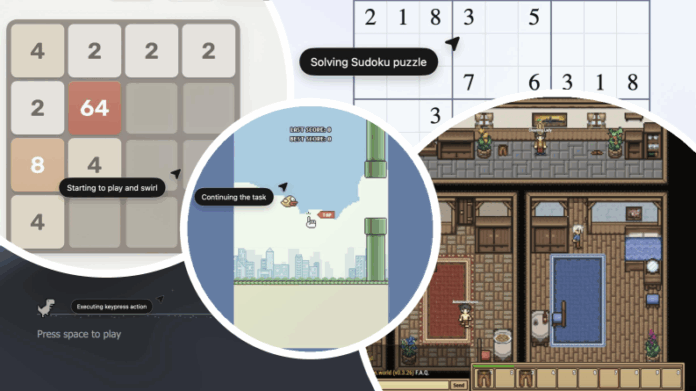
To comprehensively assess Atlas’s capabilities, four distinct games were selected, each emphasizing different cognitive and motor skills:
- Sudoku: A logic-centric puzzle devoid of time pressure, testing pure reasoning ability without the need for rapid responses.
- 2048: A strategic tile-merging game requiring forward planning and spatial awareness, where players must anticipate moves to avoid deadlocks, though pacing remains under player control.
- Additional games (not detailed here) likely include challenges demanding real-time reflexes and navigation in unfamiliar virtual spaces, further evaluating Atlas’s adaptability and precision.
Why Games Are the Ultimate AI Benchmark
Games serve as an ideal platform to evaluate AI because they combine clear objectives with multifaceted challenges. For instance, in a fast-paced platformer, split-second timing and spatial judgment are crucial, while puzzle games emphasize logical deduction and long-term planning. This spectrum of demands ensures that an AI’s performance reflects a holistic understanding of interactive environments rather than isolated task execution.
Looking Ahead: The Future of AI in Dynamic Web Interaction
As AI systems like Atlas continue to evolve, their ability to seamlessly integrate perception and action will unlock new possibilities-from autonomous web navigation and real-time decision-making to enhanced digital assistants capable of complex multitasking. According to recent studies, interactive AI agents have improved task success rates by over 30% when trained in dynamic environments compared to static ones, underscoring the importance of this research direction.
By mastering games that require logic, strategy, reflexes, and spatial reasoning, Atlas sets the stage for AI that can genuinely operate within the fluid, unpredictable contexts of the modern web.

