
Advancing Mathematical Reasoning with Formal Verification
While large language models (LLMs) have demonstrated impressive capabilities in mathematical reasoning by leveraging reinforcement learning and extended chain-of-thought strategies, they often falter when tasked with formal theorem proving. This difficulty arises primarily because natural language lacks explicit supervision signals, making it challenging to verify each logical step rigorously. Consequently, validating proofs expressed in natural language is a painstaking process, with both automated and manual verification proving unreliable or infeasible.
The Limitations of Natural Language in Proof Verification
Natural language proofs are inherently ambiguous and prone to subtle errors that are difficult to detect without formal structure. Each inference step must be meticulously scrutinized to ensure correctness, a task that becomes exponentially harder as proofs grow in complexity. This ambiguity restricts the scalability of automated theorem proving systems that rely solely on natural language inputs.
Formal Languages: A Clear Path to Reliable Proof Validation
In contrast, formal languages such as Lean offer a robust framework for expressing mathematical proofs with unambiguous syntax and semantics. These languages enable automatic verification by providing explicit correctness signals at every step, drastically reducing the risk of errors. A recent breakthrough exemplifying this advantage is AlphaProof, which successfully solved three challenging problems from the 2024 International Mathematical Olympiad (IMO) using Lean. This achievement underscores the potential of formal verification systems to tackle complex mathematical challenges that remain out of reach for natural language-based methods.
Seed-Prover: Bridging Granularity and Holistic Proof Generation
Introducing Seed-Prover, an innovative lemma-centric model designed to reason over entire proofs cohesively. This approach marks a significant evolution beyond traditional formal provers, which generally fall into two camps:
- Step-level provers: These generate Lean code incrementally, line-by-line, allowing tight integration with the Lean environment. However, they often require intricate scaffolding and operate at a granularity that can impede the model’s ability to perform high-level reasoning.
- Whole-proof models: These produce complete proofs in a single pass, avoiding the overhead of stepwise interaction but typically lack direct feedback from the Lean compiler, which can limit proof correctness assurance.
Seed-Prover synthesizes the strengths of both paradigms through four pivotal innovations, enabling it to maintain interactive verification while reasoning at the lemma level. This hybrid strategy facilitates more efficient and accurate proof generation, combining detailed feedback with holistic understanding.
Key Innovations Driving Seed-Prover’s Success
- Lemma-style reasoning: By structuring proofs around lemmas, Seed-Prover breaks down complex arguments into manageable components, enhancing clarity and modularity.
- Integrated Lean interaction: The model maintains dynamic communication with the Lean compiler, ensuring each proof segment is formally verified in real time.
- Reinforcement learning with long-horizon planning: Seed-Prover employs advanced reinforcement learning techniques that consider extended chains of reasoning, improving its ability to navigate intricate proof landscapes.
- Scalable proof synthesis: The approach supports generating proofs of increasing complexity without sacrificing verification rigor or computational efficiency.
Implications and Future Directions
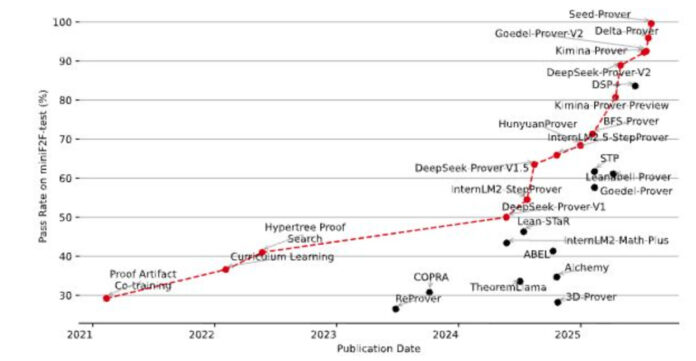
Seed-Prover’s hybrid methodology represents a promising direction for automated theorem proving, particularly in domains where formal verification is critical. As of 2024, benchmarks like MiniF2F-Test demonstrate that Seed-Prover not only surpasses previous models but also approaches saturation in performance, indicating a maturation of lemma-based whole-proof reasoning.
Looking ahead, integrating such models with broader mathematical knowledge bases and expanding their applicability to diverse formal systems could revolutionize how mathematicians and researchers validate complex proofs. Moreover, the synergy between reinforcement learning and formal verification may unlock new frontiers in AI-driven mathematical discovery.

