
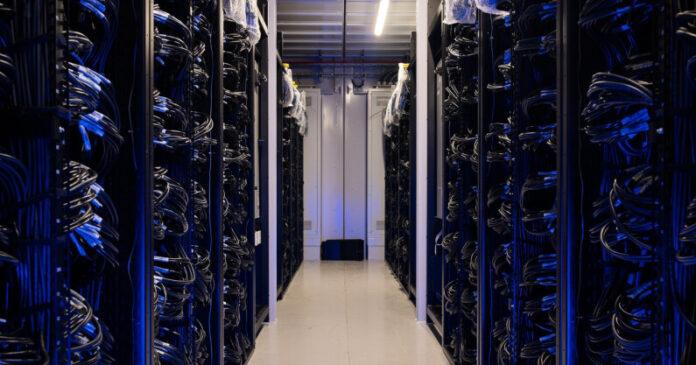
The UK just launched its most powerful supercomputer — the eleventh most powerful in all of the world. This week, Isambard AI, hosted by the University of Bristol went live. The machine was built using Hewlett-Packard Enterprises’ (HPE) Cray EX architecture, and equipped with over 5400 NVIDIA Grace Hopper Superchips.
The raw computing power of the machine is 216.5 petaflops with a theoretical peak performance of 278.6. For the uninitiated, one petaflop is equal to 1 quadrillion (1,000,000,000,000,000) calculations per second. This system is 10x faster than Britain’s next fastest supercomputer, the Njoerd cluster in London. Isambard AI is funded by PS225mn ($300mn) from the government. It’s designed to run artificial intelligence and scientific computations, such as simulating climate changes and training large language model.
Isambard AI’s performance compared to the world’s supercomputers.
Although Isambard AI is the UK’s top supercomputer, it faces stiff competition on the global stage. According to TOP500 rankingthe current world leader in terms of performance is El Capitan, a supercomputer in the United States that clocks in with 1,742 petaflops.
Frontier, and Aurora are ranked second and third. Both systems were built in the United States and operate above the 1,000-petaflop limit — which is equivalent to one exaflop. The top three supercomputers are the only exascale supercomputers currently in operation.
Europe’s frontrunner, Germany’s JUPITER booster, ranks fourth worldwide. Four other machines are also located on the continent: Italy’s HPC6, Switzerland’s Alps, Finland’s LUMI, and Italy’s Leonardo.
Isambard AI’s entry into top 11 is still a significant leap forward for the UK. The Labour government hopes to make the UK a leader of AI development.
Peter Kyle said that the new machine will “propel” Britain into the “forefront” of AI discovery.
He said, “Today, we put the most powerful computing system in the country in the hands of British entrepreneurs and researchers.” Isambard’s first applications include powering the prostate cancer detection system developed at University College London, and helping Liverpool researchers find greener, more sustainable materials.
However, Isambard’s reign as the world’s most powerful supercomputer may not last long. In June, the Keir-Starmer administration committed PS750mn for a supercomputer to be built in Edinburgh. The system will give the UK a chance to have one of the few exascale systems in the world.

