
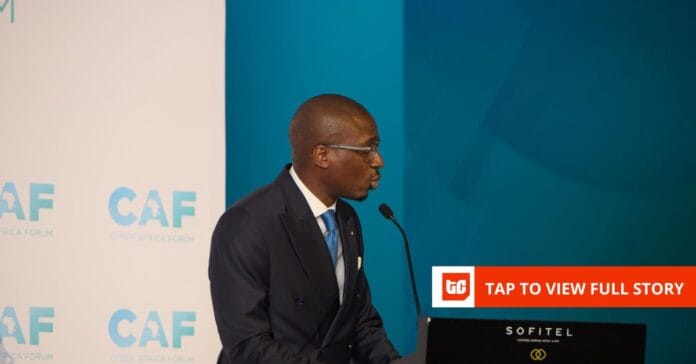
The Republic of Benin is not often thought of when you think of Africa’s tech giants. The small West African nation, which borders Nigeria and has just 14 million residents, is working to change this. Benin, with its startup-friendly policies and currency pegged to Euro, is positioning itself as an important player in the digital economy of the region. This ambition was evident at the Cyber Africa Forum, held in Cotonou on June 24-25 2025.
In its fifth edition, CAF is quickly becoming one of the continent’s largest gatherings on digital transformation and cybersecurity. This year’s theme “Resilience Of Digital Ecosystems: Necessity Of A Changing Paradigm” highlighted the urgency for African nations to reimagine their digital sovereignty, infrastructure safety, and public-private cooperation as cyber risks become more complex and dynamic. The two-day event brought together approximately 1,000 people including ministers and startup founders as well as investors, telco giants and cyber experts. The forum addressed the most pressing digital issues facing the continent, from artificial intelligence to venture capitalism, education policy to critical Infrastructure.
The central theme was clear, however: cybersecurity is not a technical footnote anymore; it’s a national priority. Franck Kie is the founder and chief organizer of the forum. He said, “We created this platform so that everyone in the ecosystem can contribute to the discussion around cybersecurity and digitalization.” “The increasing number of government officials who attend CAF every year shows how seriously this message is received.”
Redda Ben geloune, CEO at AITEC group, in his keynote, urged Africa not to be a passive observer of the digital revolution, but instead to take control of its story by investing in infrastructure and talent. He praised recent initiatives across the Francophone Region: Cote d’Ivoire Senegal announced a $1.7 billion plan for tech transformation ; Benin established a national center. Geloune listed three urgent priorities in his speech
. He called for a sovereign infrastructure, citing Ethiopia’s cloud and Cote d’Ivoire’s investment as models for building capacity locally in data hosting and computation. Second, he emphasised the need for digital education tailored to governance, advocating for the training of 1 million professionals–including legal and public sector experts–by 2030. Third, he emphasized the integration of AI, cybersecurity, and government operations into the core, warning that institutions risk becoming obsolete if they do not adapt.
Africa is lacking in local and patient capital
The first day saw discussions from all angles. Panelists covered everything from the need for blended and patient capital on the African continent to the current state of cybersecurity in Africa.
I first heard the call for patient capital during my conversation with Benin’s Minister of Digital Economy and Communications. He made it clear that Africa needs a new kind of money in order to thrive. This sentiment is shared by many on the continent, and was re-emphasised during an investor panel. Panelists
agreed that Africa’s innovative economy cannot be built on short term returns. What’s required is patient capital – money that understands the long-arc of startup growth – and blended finance structures which de-risk early investments by layering donor assistance, technical assistance, or guarantees.
More than 80% of startup financingin Africa comes from foreign investors. Panelists warned that this dependency creates blindspots. Charles Kie, Director general of Genesis Group, asked “Why do so few African startups incorporate in the U.S.A., Dubai or Mauritius?” “Because these places offer the legal stability and patience that investors require. We must create this environment here.
They argued that local investors bear a large part of the responsibility. There is still a fundamental problem: many domestic investors do not understand the venture capital model. To unlock local funding, it is crucial to change this cultural orientation toward high-risk and long-horizon investments.
One panelist said, “We cannot expect African startups scale on foreign capital alone.” “Our own investors must step in and remain in.”
Ghislaine Smake, CEO of Ecobank Guinea-Bissau outlined how blended capital can look in practice. “At Ecobank Guinea-Bissau, we had no choice but to use several hybrid structures and blended finance mechanisms, including first-loss guarantee,” she said.
In a partnership with the World Food Programme, she cited a microcredit program that is channeled to rural farmers. “WFP provides technical support and guarantees. We do the scoring, and we lend. It reduces our risk and makes financial integration viable.
Irene Auma’s keynote, Visa’s Head Of Risk, about the state of cybersecurity in Africa was one of my favorite conversations. According to the presentation slides she used, cybercriminals lose $1.3 trillion annually around the world. These threats are exacerbated by advances in AI and deepfakes. They also include the exploitation of technology and customers as the weakest link.
You read it right. VISA’s Head Of Risk says that you and I are weakest links in cybersecurity threats. Auma’s argument was reinforced by Uche Ofodile of MTN Benin who shared in a panel that she almost fell for the phishing test run by her company’s IT.
Day 1 ended with panelists of the AI panel divided over whether or not Africa should use sovereign data in its AI. The four-panel team debated data sovereignty and I was left with one question: is there a market in Africa for AI data that is sovereign?
Resilience, Culture, and the Rise of Africa’s Cyber Talent
The second day continued the momentum that the first had. Panel discussions focused on pressing issues such as how to address cyber threats in an era of resilience. Industry leaders also debated the impact of cultural factors on the future of digital economy.
The highlights of the day included a keynote speech from Kaspersky and a highly anticipated HackerLab hackathon, organised by Benin’s Agency for Information Systems and Digital and the Cyber Africa Forum. The continent’s best young talent competed in a Capture The Flag format for 48 hours, non-stop. After a qualification stage that attracted more than 500 participants in the CTF format, 20 finalist team–80 young cybersecurity enthusiasts tackled the challenges set out by bjCSIRT in a simulated environment.
The competition ended with the team BJ_S3C winning the first prize of 2,000,000 CFA ($3,567). Team BoB came in second and received 1.5,000,000 CFA ($2,675). The third-placed st34lthy team received 1 million CFA ($1,783). In addition to the major awards, several participants received recognition for their contributions on the field. Ouanilo Mediegan-Fagla was awarded the Lifetime Achievement Award. Ismene deguenonvo received the Cyber Africa Woman Award, and Francisca djossou received the Cyber Africa Women Ambassador Award.
At the Novotel’s fancy cocktail event, guests enjoyed live music and laughter, as well as the kind of spirited conversations that can only happen when great minds and positive vibes collide.
As final notes from a live band echoed through the Novitel, laughter, conversation, and clinks of glasses mingled, a fitting ending to a conference as much about connecting as it was about coding. Benin is a great example of how to combine business and pleasure. Mark your calendars
Moonshot by TechCabal will be back in Lagos, October 15-16! Join Africa’s leading founders, tech leaders, and creatives for 2 days of keynotes. Early bird tickets are now 20% off — don’t sleep! moonshot.techcabal.com

