
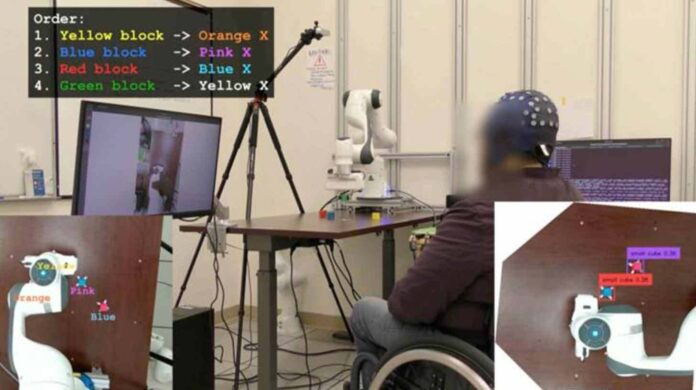
Good morning, AI enthusiasts. Engineers at UCLA have transformed a conventional EEG cap into an advanced brain-computer interface capable of controlling robotic limbs through thought alone.
By integrating this device with AI that deciphers user intent in real time, they have empowered individuals with paralysis to perform tasks previously requiring invasive brain surgery. This breakthrough signals a promising future for non-invasive assistive technologies.
Today’s AI Highlights:
- AI enables paralyzed individuals to operate robotic devices
- AI-inspired terminology increasingly influences everyday language
- Design and prototype mobile applications effortlessly using Figma AI
- MIT develops AI to forecast flu vaccine effectiveness
- Discover four innovative AI tools, community workflows, and more
BREAKING NEWS
UCLA’s Non-Invasive Brain-Computer Interface

UCLA researchers have developed a wearable brain-computer interface (BCI) that leverages AI to decode EEG signals, allowing users with paralysis to control robotic arms purely through thought-without the need for surgical implants.
- The system combines a custom EEG signal decoder with AI-powered computer vision to interpret movement intentions instantly.
- In trials involving four participants, including one paralyzed individual, robotic tasks were completed in just 6.5 minutes-tasks impossible without the BCI.
- Users directed cursors and robotic arms to manipulate objects, achieving speeds nearly four times faster than without AI assistance.
- Utilizing standard EEG caps eliminates surgical risks while delivering performance comparable to invasive BCIs.
This innovation marks a significant leap forward in non-invasive assistive technology, where AI compensates for the limitations of brain signals. Future applications may extend beyond robotic limbs to smart wheelchairs, communication aids, and intelligent home systems that anticipate user needs.
PARTNER SPOTLIGHT: VANTA
In the fast-paced AI landscape, rapid deployment grabs headlines, but establishing trust drives sustainable growth. Vanta and Mercury demonstrate how SOC 2 compliance, audit-ready financials, and robust risk management serve as foundational pillars for scaling businesses from day one.
Join this virtual event to learn how to:
- Confidently navigate investor due diligence with minimal follow-ups
- Prevent security and procurement hurdles that can delay deals
- Maintain compliance proactively without expanding your team
Build enterprise-grade credibility efficiently without compromising speed.
LINGUISTIC TRENDS IN AI
AI Buzzwords Reshape Everyday Language

A recent study from Florida State University reveals a significant rise in AI-related vocabulary within podcasts since the debut of ChatGPT in late 2022, describing this phenomenon as a “seep-in effect” where AI terminology gradually permeates everyday speech.
- Analysis of over 22 million words from unscripted podcasts showed a 75% increase in AI-associated terms post-ChatGPT.
- Science and technology podcasts, where hosts frequently use AI tools, served as early indicators of this linguistic shift.
- Words such as “boast,” “meticulous,” and “delve” surged, likely influenced by AI models trained on extensive corporate and internet content.
- Parallel research in Germany confirmed similar trends across YouTube and podcast platforms.
This rapid integration of AI-influenced language signals a broader cultural transformation, with AI shaping communication styles, web design patterns, and even software development workflows.
AI-POWERED DESIGN
Create Mobile Apps Instantly with Figma AI
Discover how Figma AI can transform simple text prompts into fully interactive mobile app prototypes complete with functional buttons and dynamic states-all within seconds.
- Log into Figma and select “Make” to open the AI chat interface.
- Describe your app concept, for example: “Build an app for tennis enthusiasts to locate courts, track performance, and share activities, similar to Strava but focused on tennis.”
- Specify design preferences such as color schemes and typography; Figma AI will automatically adjust layout and styling.
- Add features by requesting integrations, like calendar booking via Supabase, with AI generating logical interactions.
- Preview your prototype, collaborate with teammates, or export to development platforms like Cursor for full-stack implementation.
Pro tip: Treat Figma AI as a junior designer-clear, detailed instructions yield the most polished, production-ready designs with built-in interactivity.
INSIGHTS FROM FUEL iX
According to Fuel iX’s latest report, Demystifying Shadow AI in the Workplace, 57% of employees input sensitive information into public generative AI platforms like ChatGPT, Claude, and Gemini during work hours. This widespread usage introduces hidden security risks for organizations.
Key takeaways include how to:
- Evaluate your company’s vulnerability to Shadow AI
- Recognize the primary security threats posed by employee use of public AI tools
- Implement expert strategies to safely and responsibly manage AI adoption
ADVANCES IN HEALTHCARE AI
MIT’s VaxSeer Predicts Flu Vaccine Success

MIT scientists have introduced VaxSeer, an AI-driven platform that forecasts dominant influenza strains and identifies the most effective vaccine candidates months before flu season begins.
- VaxSeer employs deep learning trained on decades of viral genetic data and laboratory results to predict strain prevalence and vaccine efficacy.
- Retrospective testing showed VaxSeer outperformed the World Health Organization’s vaccine selections in 15 out of 20 flu seasons across two major virus types.
- The system accurately identified a superior vaccine formulation in 2016 that was only adopted by health authorities the following year.
- Its predictions closely correlated with real-world vaccine performance in patient populations.
This AI tool could revolutionize flu prevention by reducing the guesswork in vaccine strain selection, potentially lowering illness rates significantly each season.
QUICK UPDATES
- 🛠️ A compact, open-source state-of-the-art translation model has been released.
- 🎨 ByteDance unveils a creative AI model specializing in style and subject generation.
- 🤖 New technology enables avatars to perform realistic lip-sync and motion.
- 🔊 Microsoft launches an advanced in-house voice synthesis model.
Upcoming Event: Honeycomb Observability Day in San Francisco on September 11, featuring Charity Majors and Liz Fong-Jones discussing AI’s impact on observability.
OpenAI is reportedly planning a minimum 1GW data center in India as part of its Stagate initiative, with CEO Sam Altman scheduled to visit soon.
Tencent’s open-source AI translation system, Hunyuan-MT-7B and Hunyuan-MT-Chimera, now supports 33 languages and outperforms competitors in its class.
Salesforce CEO Marc Benioff announced a 45% reduction in support staff this year, leveraging AI agents to manage lead responses and customer interactions.
Chinese President Xi Jinping emphasized global collaboration on AI at the Shanghai Cooperation Organization, rejecting divisive “Cold War” mentalities surrounding the technology.
COMMUNITY SPOTLIGHT
Each edition, we highlight how readers harness AI to enhance productivity and simplify their workflows. Today’s feature comes from Hunain A. in Kuala Lumpur, Malaysia:
“I produce a high volume of client videos daily, involving scripting, lighting, filming, editing, and publishing. To streamline this, I developed a custom N8N automation integrating GPT for scriptwriting, Heygen for avatar creation, and custom code for auto-editing. This system has saved me at least 35 hours per week, with only minimal approval steps remaining, which I plan to automate next.”
How are you leveraging AI? Share your story with us.
RESOURCES & UPCOMING EVENTS
- Explore our latest AI newsletter
- Catch up on recent technology insights
- Discover the newest in robotics
- Access today’s curated AI tool guide
- Register for our next live AI workshop
Until next time,
Rowan, Joey, Zach, Shubham, and Jennifer – your team behind The Rundown


