
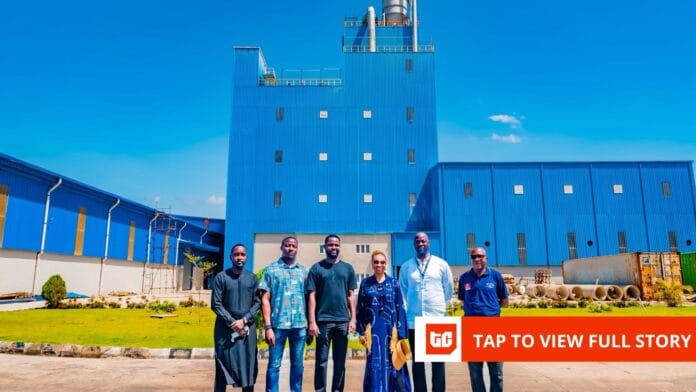
Itana, is building Africa’s first full stack AI and data growth zones, a futuristic enclave that includes servers, startups, machine learning models, and more. Itana’s initiative, dubbed a “zone inside a zone”is more than real estate. It is a strategic infrastructure that serves the entire AI value-chain. The growth zone is a resource-dense ecosystem that includes model developers, data center operators, and AI-first application firms.
What Africa needs from an AI growth zone?
Recent data shows that four countries, South Africa, Nigeria Kenya and Egypt, are responsible for more than 80% of the AI and tech startup financing on the continent. Nigeria alone is home to over 400 AI firms are active. Despite this growing momentum, much African AI development still relies heavily on foreign infrastructure. This includes compute power, data storage, and foundational model access, as well as deployment tools.
Although countries like Egypt and Kenya have made progress in creating AI-focused districts and digital innovation hubs, none has created a fully integrated AI ecosystem like Itana. Egypt’s Knowledge City, and Kenya’s Konza Technopolis both advance smart infrastructure and ICT led growth but their focus is broad.
Receive the best African tech news in your inbox.
Itana’s AI & data growth zone, on the other hand, offers a vertically-integrated environment, bringing AI-first companies together with high-performance computing resources, modular AI ready data centers, growing talent pipelines, and flexible and remote-friendly business frameworks within a special economy zone. There are similar models around the world, including Hub71 in the UAE and Saudi Arabia’s NEOM. However, within Africa, Itana is the most concentrated initiative aimed at accelerating AI innovations. Victor Famubode is the head of advisory and Government Relations at Itana. He believes that this local consolidation will be essential. He explains that there is a global competition for certain resources, from infrastructure to talent and capital. “If Africa wants to be competitive in the AI space, we need to aggregate these resources locally.”
Itana’s AI and Data Growth Zone is a direct answer to this challenge. It’s a hub that will serve both upstream AI firms, those who are building foundational models, and downstream firms, which will be applying these models to industries such as healthcare, finance, education and agriculture. The goal is to create an environment that combines technical talent, computing infrastructure and connectivity with funding, so that companies can build, scale and deploy AI systems in the African context.
Building stack
Compute is the first pillar of the zone. AI development, particularly the kind that involves large language models (LLMs), needs enormous computational power. This is typically delivered by Graphics Processing Units (GPU) Clusters. Itana is already partnered with high compute service providers and actively seeking new players to offer cloud-based, on-premises, and GPU as a service capabilities. Famubode explains that “we know AI is 95% Hardware”. “Without reliable computing infrastructure, we cannot expect to see consistent innovation.”
The next step is data. Itana’s data center partner offers facilities ranging from Tier 3 up to possible Tier 4 upgrades. These centers are not only used to store AI training data, but also to ensure that latency-sensitive deployments within the zone can be made. This is crucial for real-time AI apps. Talent is the third crucial piece. Itana intentionally builds a talent pipeline through partnerships with local and foreign partners to develop AI skill sets that match the needs for companies in the zone. Famubode says, “You cannot build and deploy systems without the right talent.” “We also think about infrastructure in terms of talent.”
OpenAI to Open Africa.
This zone caters to an array of AI organisations. On one end, there are LLM builders like OpenAI or Anthropic that develop upstream models which form the basis of generative AI. AI-first application firms, on the other hand, customise and fine-tune models in order to build products for specific industry sectors. Famubode: “We welcome both ends.”
“We’re not only focused on those building foundational models but also on the companies deploying AI in ways consumers can directly experience–chatbots, recommendation engines, diagnostics tools, fraud detection systems, and more.”
Interestingly, the zone has a particular interest in small language models–compact, efficient systems trained on localised data. These models are easier to tailor to African languages and contexts, are less expensive to run and require less infrastructure. “Smaller models work best in resource-constrained environments such as ours,” Famubode says. “But we are not excluding larger players.” We’re creating space for both.
Local impact, global interest
Over 70% of the companies who have joined Itana’s Special Digital Economic Zone (which houses the AI Growth Zone) are owned by foreigners or diasporas. Over 30 AI-focused businesses are in the pipeline. Around 5% of these companies are located in Nigeria, and 20% are based in Africa. It costs only $2,000 to register a company in Itana. The license is valid for one year, and renewals are $1,150. Itana allows remote operations and distributed teams. Famubode, who is a spokesperson for Itana, says that this flexibility, combined with Itana’s unique infrastructure proposition is generating strong interest across the globe. “We want green unicorns and AI companies founded here. Scaling from here and solving real African issues while being globally competitive.”
This vision is clear: A continent that doesn’t simply import AI solutions, but builds them themselves for the continent and the world.
Location still matters
Physical infrastructure remains central to long-term ambitions of the zone, despite the remote-first design. Alaro City is Itana’s host and already provides utilities such as energy, water and broadband. These are essential for running cooling-intensive clusters and data centers. Itana will scale up these resources as demand grows in partnership with Alaro, and other infrastructure providers.
This is not a test launch. We’ve already begun operations,” says Famubode. “The AI growth area is a continuum. We’re iterating on real demand and with real companies.”

