TLDR: Chai Discovery Team introduces Chai-2, a multimodal AI model that enables zero-shot de novo antibody design. Achieving a 16% hit rate across 52 novel targets using ≤20 candidates per target, Chai-2 outperforms prior methods by over 100x and delivers validated binders in under two weeks—eliminating the need for large-scale screening.
In a significant advancement for computational drug discovery, the Chai Discovery Team has introduced Chai-2, a multimodal generative AI platform capable of zero-shot antibody and protein binder design. Unlike previous approaches that rely on extensive high-throughput screening, Chai-2 reliably designs functional binders in a single 24-well plate setup, achieving more than 100-fold improvement over existing state-of-the-art (SOTA) methods.
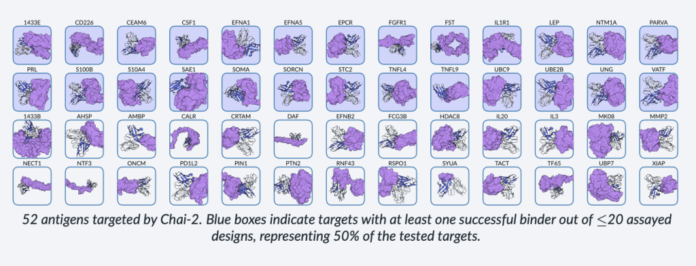
Chai-2 was tested on 52 novel targets, none of which had known antibody or nanobody binders in the Protein Data Bank (PDB). Despite this challenge, the system achieved a 16% experimental hit rate, discovering binders for 50% of the tested targets within a two-week cycle from computational design to wet-lab validation. This performance marks a shift from probabilistic screening to deterministic generation in molecular engineering.
AI-Powered De Novo Design at Experimental Scale
Chai-2 integrates an all-atom generative design module and a folding model that predicts antibody-antigen complex structures with double the accuracy of its predecessor, Chai-1. The system operates in a zero-shot setting, generating sequences for antibody modalities like scFvs and VHHs without requiring prior binders.
Key features of Chai-2 include:
No target-specific tuning required
Ability to prompt designs using epitope-level constraints
Generation of therapeutically relevant formats (miniproteins, scFvs, VHHs)
Support for cross-reactivity design between species (e.g., human and cyno)
This approach allows researchers to design ≤20 antibodies or nanobodies per target and bypass the need for high-throughput screening altogether.
Benchmarking Across Diverse Protein Targets
In rigorous lab validations, Chai-2 was applied to targets with no sequence or structure similarity to known antibodies. Designs were synthesized and tested using bio-layer interferometry (BLI) for binding. Results show:
15.5% average hit rate across all formats
20.0% for VHHs, 13.7% for scFvs
Successful binders for 26 out of 52 targets
Notably, Chai-2 produced hits for hard targets such as TNFα, which has historically been intractable for in silico design. Many binders showed picomolar to low-nanomolar dissociation constants (KDs), indicating high-affinity interactions.
Novelty, Diversity, and Specificity
Chai-2’s outputs are structurally and sequentially distinct from known antibodies. Structural analysis showed:
No generated design had <2Å RMSD from any known structure
All CDR sequences had >10 edit distance from the closest known antibody
Binders fell into multiple structural clusters per target, suggesting conformational diversity
Additional evaluations confirmed low off-target binding and comparable polyreactivity profiles to clinical antibodies like Trastuzumab and Ixekizumab.
Design Flexibility and Customization
Beyond general-purpose binder generation, Chai-2 demonstrates the ability to:
Target multiple epitopes on a single protein
Produce binders across different antibody formats (e.g., scFv, VHH)
Generate cross-species reactive antibodies in one prompt
In a cross-reactivity case study, a Chai-2 designed antibody achieved nanomolar KDs against both human and cyno variants of a protein, demonstrating its utility for preclinical studies and therapeutic development.
Implications for Drug Discovery
Chai-2 effectively compresses the traditional biologics discovery timeline from months to weeks, delivering experimentally validated leads in a single round. Its combination of high success rate, design novelty, and modular prompting marks a paradigm shift in therapeutic discovery workflows.
The framework can be extended beyond antibodies to miniproteins, macrocycles, enzymes, and potentially small molecules, paving the way for computational-first design paradigms. Future directions include expanding into bispecifics, ADCs, and exploring biophysical property optimization (e.g., viscosity, aggregation).
As the field of AI in molecular design matures, Chai-2 sets a new bar for what can be achieved with generative models in real-world drug discovery settings.
Check out the. All credit for this research goes to the researchers of this project. Also, feel free to follow us on , and and don’t forget to join our and Subscribe to .