
Malaysia Emerges as Southeast Asia’s Premier AI Investment Hub
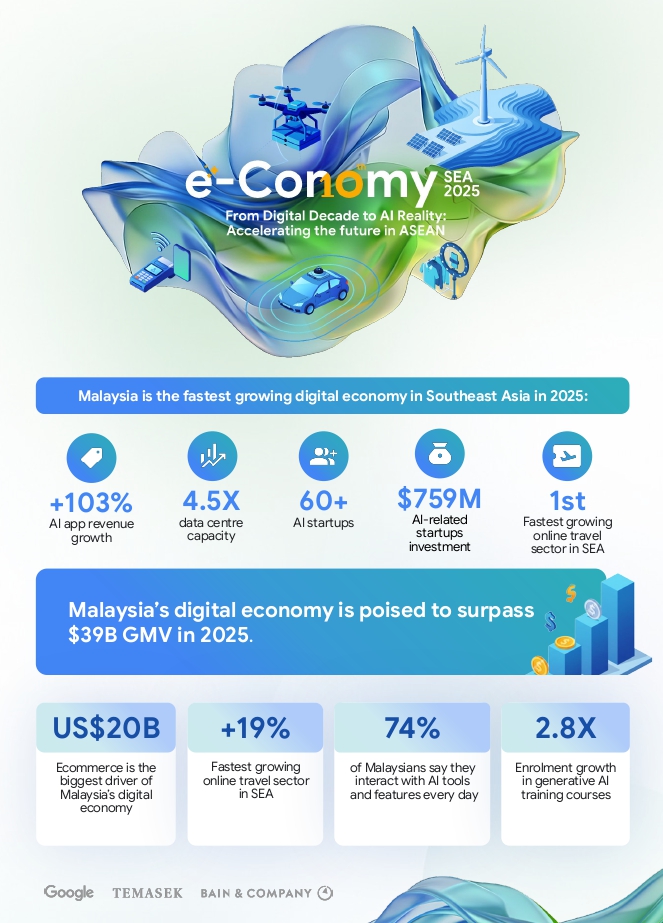
Between the second half of 2024 and the first half of 2025, Malaysia secured a commanding 32% share of Southeast Asia’s total artificial intelligence (AI) funding, amounting to approximately US$759 million. This remarkable achievement positions Malaysia as the foremost destination for AI investments in the region. The surge is driven by a combination of expansive infrastructure development and robust consumer adoption, which together are transforming the nation’s technological ecosystem.
Unprecedented Growth in Data Center Infrastructure
Malaysia’s AI investment boom is strongly supported by its rapid expansion in physical infrastructure, setting it apart from neighboring countries. Data center capacity skyrocketed from 120 megawatts in 2024 to 690 megawatts by mid-2025. Plans are underway to further amplify this capacity by an additional 350%, which would account for half of all planned data center expansions across Southeast Asia. This infrastructure-first strategy is attracting major global players, exemplified by Google’s commitment of US$2 billion to establish its inaugural data center and Google Cloud region in Malaysia, aimed at meeting escalating demand for AI-ready cloud services both domestically and internationally.

Investment Landscape: Concentration Amidst Opportunity
While the headline figure of US$759 million underscores Malaysia’s leadership in AI funding, a closer examination reveals a nuanced picture. The bulk of this capital influx stems from significant deals in the digital financial services sector, including a landmark private equity transaction in late 2024 that substantially boosted overall investment totals.
Despite the increase in deal size, the number of private funding transactions has contracted sharply. In the first half of 2025, only 23 deals were recorded, a steep decline from the 236 deals seen at the peak in 2021. This trend suggests a narrowing of investment breadth, raising concerns about the ecosystem’s resilience if fintech consolidation slows or regulatory challenges arise.
Digital financial services dominated 84% of funding in the first half of 2024, highlighting a heavy sectoral concentration. However, investor confidence remains high, with 64% of surveyed investors anticipating growth in Malaysia’s funding activity through 2030, particularly in software, AI, deep technology, and services-sectors that promise to diversify the current fintech-heavy landscape.
Malaysia also led Southeast Asia in initial public offerings (IPOs) over the past year, accounting for nearly half of the region’s listings. This robust exit activity signals investor confidence in viable liquidity pathways, a critical factor for sustaining long-term AI investment momentum.
Consumer Engagement: A Catalyst for AI Commercialization
Malaysia’s strategic infrastructure investments are mirrored by enthusiastic consumer adoption. Approximately 74% of Malaysian digital users engage with AI-powered tools daily, ranking the country among the region’s most active AI user bases. This engagement extends beyond passive use; 68% of consumers interact conversationally with AI chatbots, demonstrating comfort with advanced AI interfaces that facilitate dynamic communication rather than mere task execution.
Importantly, 55% of Malaysian consumers expect AI to accelerate decision-making processes while reducing cognitive effort, indicating a readiness to embrace autonomous AI applications. This consumer trust is translating into tangible commercial success, with revenues from AI-enabled applications doubling (a 103% increase) in the first half of 2025 compared to the same period in 2024.
Ben King, Managing Director of Google Malaysia & Singapore, highlights this momentum: “With three out of four Malaysian digital consumers using generative AI tools daily, the country is laying a strong foundation for the next wave of AI-driven growth. Google is committed to supporting Malaysia’s vision of becoming a regional digital powerhouse by 2030 through fostering an inclusive and innovative AI ecosystem.”
Balancing Data Sharing and Privacy Concerns
A striking aspect of Malaysia’s AI adoption is the high willingness among consumers to share personal data with AI systems. An overwhelming 92% of respondents are open to sharing information such as shopping habits, viewing history, and social connections, surpassing levels seen in more privacy-sensitive markets.
However, this openness coexists with significant privacy concerns-60% of Malaysians express apprehension about data security and privacy related to AI, which is 10 percentage points above the ASEAN-10 average. This duality suggests that while consumers recognize the benefits of AI personalization, they also demand stringent data governance and protection measures.
Pragmatic motivations drive AI adoption: 51% of users value AI for saving time on research and comparisons, 39% appreciate cost savings through better deals and price tracking, and 30% seek exclusive product access and round-the-clock customer support. These factors indicate that Malaysian consumers prioritize practical benefits over mere technological novelty.
Strategic Infrastructure Expansion and Its Challenges
Malaysia’s ambitious plan to increase data center capacity by 350% positions the country as a critical hub for hosting AI workloads at domestic, regional, and global scales. Hosting half of Southeast Asia’s planned data center capacity could foster network effects and attract AI talent clusters.
Nonetheless, questions remain about Malaysia’s ability to evolve from an infrastructure host to a creator of proprietary AI technologies. The launch of ILMU, Malaysia’s first indigenous large language model, marks a promising start, but the scale of domestic AI innovation is still nascent.
Another challenge lies in translating infrastructure investments into high-value employment opportunities. With an 80% AI awareness rate among Malaysians, there is potential for workforce development, but awareness alone does not equate to advanced technical skills.
The regulatory landscape is also evolving. The introduction of the Consumer Credit Act, which mandates licensing for buy-now-pay-later providers and non-bank lenders, reflects growing regulatory oversight in digital sectors. How Malaysia balances AI innovation with consumer protection through regulation will be pivotal in sustaining its AI investment trajectory.
Regional Dynamics and Future Outlook
Malaysia’s concentrated infrastructure and funding create both collaborative and competitive dynamics within Southeast Asia. The expanding interoperability of the DuitNow QR payment standard, now adopted in markets including Cambodia, exemplifies Malaysia’s capacity for regional digital integration-a capability that could extend to AI services.
However, neighboring countries are likely to accelerate their own infrastructure developments in response. Malaysia’s continued leadership will depend on converting its first-mover advantage into lasting strengths such as a skilled AI workforce, supportive regulatory frameworks, and vibrant commercial ecosystems that foster innovation rather than commoditization.
Amanda Chin, Partner at Bain & Company, emphasizes this strategic imperative: “The true potential lies in how businesses leverage AI to create meaningful impact, building upon Malaysia’s solid digital foundation. Infrastructure and funding are essential, but execution is the key to unlocking sustainable growth.”
Ultimately, Malaysia’s challenge is to transform its substantial US$759 million investment and infrastructure expansion into groundbreaking AI applications, rather than merely replicating technologies developed elsewhere. While the country has secured a leadership role in Southeast Asia’s AI landscape, advancing from infrastructure provision to innovation remains a work in progress.

