
Revolutionizing XPU Connectivity: Ayar Labs and Global Unichip Corp Collaborate on Optical I/O Integration
Breaking Bandwidth Barriers with Photonic Chiplets
Ayar Labs, a pioneering startup specializing in photonics and supported by semiconductor design service leader Global Unichip Corp. (GUC), has announced a strategic collaboration to embed their cutting-edge optical input/output (I/O) chips into GUC’s XPU reference architectures. This partnership aims to dramatically enhance data transfer rates within next-generation computing platforms.
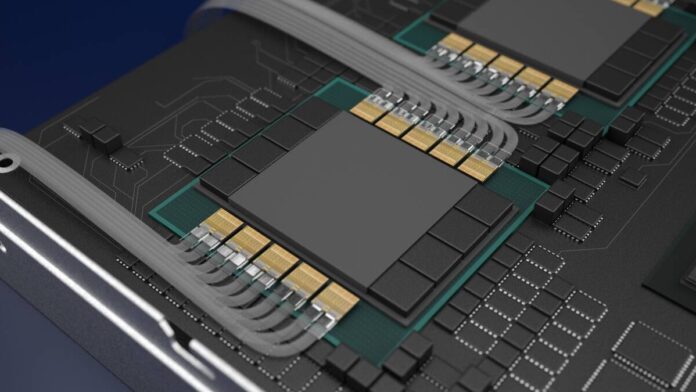
At the heart of this innovation are Ayar’s TeraPHY photonic chiplets, which can be co-packaged alongside compute dies to deliver an unprecedented aggregate bandwidth exceeding 200 terabits per second (Tbps). This represents a quantum leap compared to current interconnect technologies, which max out at approximately 14.4 Tbps.
Scaling Compute Domains Beyond Traditional Limits
Integrating optical I/O directly into XPUs enables scaling compute clusters far beyond the confines of a single rack. This technology facilitates seamless expansion across multiple racks, entire rows, or even data center halls, all while maintaining efficient power consumption. Ayar Labs’ CTO, Vladimir Stojanovic, envisions connecting up to 10,000 GPU dies within a unified scale-up domain, with power and density constraints kept near 100 kilowatts per rack.
Historically, companies like Nvidia have relied on copper cabling for high-speed interconnects, as seen in their NVL72 rack system. Optical transceivers available at that time would have introduced an additional 20 kW power overhead to an already power-intensive 120 kW system, making copper the more practical choice despite its limitations. However, copper interconnects restrict accelerators to the same rack due to signal degradation beyond roughly one meter, limiting scalability.
Optical I/O: The Future of High-Performance Computing Interconnects
By embedding photonic I/O directly into GPUs and AI-specific ASICs, chip designers can overcome copper’s physical constraints, enabling larger, more flexible compute domains without sacrificing performance or power efficiency. This approach eliminates the need for ultra-high-power racks-such as Nvidia’s recent 600 kW designs-since GPUs no longer need to be densely packed to maintain communication integrity.
Ayar’s optical I/O technology has already been validated in several prototype systems, including a joint project with Intel and the Defense Advanced Research Projects Agency (DARPA). According to Stojanovic, the technology’s form factor and integration capabilities have been proven, demonstrating compatibility with multi-chip package platforms.
Ensuring Production-Ready Optical Solutions Through Strategic Partnerships
Transitioning from prototype to production-grade optical I/O presents significant challenges. A malfunctioning optical interface could render a high-value accelerator-costing upwards of $50,000-nonfunctional. To mitigate these risks, Ayar Labs is collaborating closely with GUC to rigorously validate their designs against multiple reference architectures favored by hyperscale data center operators.
This partnership aims to establish a standardized design flow accessible to high-volume manufacturers, streamlining the adoption of photonic interconnects in future computing platforms. Given that many hyperscalers prefer licensing intellectual property from established vendors like Broadcom and Marvell rather than developing in-house solutions, Ayar and GUC’s collaboration could offer a valuable shortcut for integrating photonics into next-generation systems.
Industry Context and Future Outlook
The race to commercialize co-packaged optics is intensifying. For instance, House of Zen recently entered the market through its acquisition of Enosemi, while Lightmatter anticipates shipping chip-to-chip optical interconnects by mid-2024. Meanwhile, Nvidia continues to rely on copper-based solutions for GPU data delivery, highlighting the ongoing challenges in silicon photonics adoption.
As AI workloads push copper interconnects to their physical limits, optical I/O stands out as a promising path forward. Ayar and GUC’s initial focus on XPU designs marks a significant step toward fully photonic accelerators. However, widespread integration is expected to mature over the next two to three years, as the technology and manufacturing processes evolve to meet the stringent demands of hyperscale environments.

