
Essential Insights
- Tesla’s Bold Leap into Semiconductor Manufacturing: Elon Musk envisions a colossal “terafab” capable of producing over 100,000 wafer starts monthly to fuel Tesla’s autonomous driving, robotics, and AI ambitions, aiming to reduce reliance on Nvidia and other suppliers.
- Reviving Vertical Integration with AI5 and AI6 Chips: Tesla’s in-house chip design and manufacturing strategy mirrors Intel’s historic integrated approach, signaling a return to controlling both design and production.
- Global Industry Impact and Geopolitical Shifts: The emergence of Tesla’s terafab could disrupt the semiconductor hierarchy, shift supply chains predominantly to the U.S., and leave Europe trailing in advanced chip fabrication.
Reimagining Semiconductor Production: Tesla’s Terafab Vision
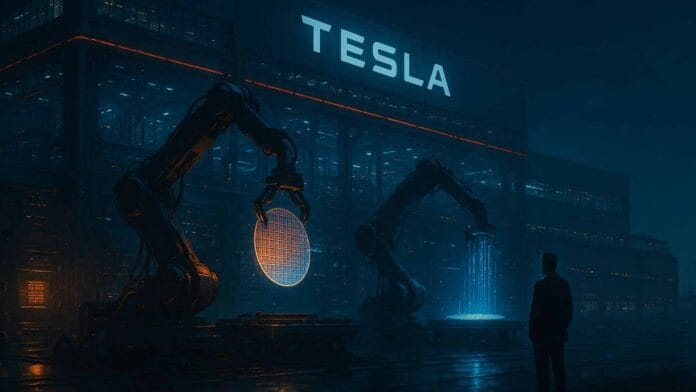
At Tesla’s recent annual shareholder meeting, Elon Musk unveiled an audacious plan to construct an enormous semiconductor fabrication facility-dubbed a “terafab”-to meet Tesla’s skyrocketing demand for AI chips. This move marks a significant departure from Tesla’s traditional focus on electric vehicles and energy storage, positioning the company as a future leader in AI hardware manufacturing.
Musk’s vision extends beyond simply producing chips; it aims to establish Tesla as a vertically integrated powerhouse, designing and fabricating its own processors to power everything from self-driving cars to humanoid robots and the Dojo supercomputer.
From Gigafactories to Terafabs: Scaling Up Chip Production
Tesla’s existing Gigafactories have revolutionized battery production, but Musk’s ambitions now target semiconductor manufacturing on an unprecedented scale. The proposed terafab would produce at least 100,000 wafer starts per month, rivaling the largest chip fabs globally, such as TSMC’s Fab 18.
This scale is essential because Tesla’s AI ecosystem demands an extraordinary volume of chips, far exceeding what current suppliers like TSMC and Samsung can provide, even at full capacity. Musk has openly acknowledged that relying solely on external foundries will not suffice to achieve Tesla’s long-term AI goals.
AI5 and AI6: Tesla’s Next-Generation Custom Chips
Central to Tesla’s chip strategy is the AI5 processor, designed to power Full Self-Driving (FSD) capabilities and future robotics applications. Initial production is slated for 2026, with mass manufacturing expected by 2027.
Looking further ahead, Tesla plans to release the AI6 chip around mid-2028, promising to double the performance of AI5 while maintaining production within the same fab facilities. Musk claims these chips will be significantly more energy-efficient-consuming roughly one-third the power of Nvidia’s flagship Blackwell chip-and dramatically cheaper to produce, at just 10% of the cost.
This aggressive roadmap signals Tesla’s intent to compete directly with industry giants like Nvidia, AMD, and Intel in chip design and manufacturing.
Disrupting the Semiconductor Ecosystem
The global semiconductor market is currently dominated by a handful of foundries, including TSMC, Samsung, and Intel, which manufacture the vast majority of advanced processors. Most leading chip designers, such as Apple, AMD, and Nvidia, outsource fabrication to these external foundries.
Tesla’s terafab initiative challenges this status quo by combining chip design and manufacturing under one roof, a model last successfully executed by Intel decades ago. This vertical integration could reduce Tesla’s dependence on external suppliers and reshape industry dynamics.
Intel’s Potential Role and Market Implications
Musk hinted at preliminary discussions with Intel, sparking a 4% surge in Intel’s stock price. Intel, which has struggled to attract foundry clients despite heavy investments in U.S.-based fabs, could benefit significantly from a partnership with Tesla.
The U.S. government’s recent 10% investment in Intel aims to bolster domestic chip production and reduce reliance on Asian supply chains. Collaborating with Tesla could validate Intel’s foundry ambitions and accelerate its resurgence in the AI chip market.
However, the nature of Tesla’s collaboration with Intel remains uncertain-it could range from co-developing manufacturing processes to temporarily leasing fab capacity before Tesla’s terafab becomes operational.
Global Semiconductor Landscape: A Potential Earthquake
Tesla’s entry into chip manufacturing could trigger significant shifts in the semiconductor supply chain. U.S. export restrictions on AI chips have already prompted Chinese firms to accelerate domestic innovation, while U.S. companies reassess their supply dependencies.
If Tesla’s terafab comes online, it may reduce demand for TSMC and Samsung’s fabrication services, potentially shrinking their market share and altering global trade flows.
This vertical integration model could inspire other tech giants-such as Apple, Amazon, or OpenAI-to consider building their own fabs, gradually eroding the dominance of contract foundries.
Implications for Startups and the Broader Tech Ecosystem
While Tesla’s fab could increase global chip supply and drive down costs over time, the immediate effect might tighten manufacturing capacity. Tesla may prioritize its own chip needs, limiting fab availability for smaller AI startups and innovators.
Given the current GPU shortages impacting AI research and development, this could pose additional challenges for emerging companies competing for compute resources.
Moreover, Tesla’s fab will require top-tier engineering talent, potentially drawing skilled professionals away from other chipmakers and concentrating expertise within Tesla’s ecosystem.
Europe’s Semiconductor Ambitions in the Shadow of Tesla’s Terafab
While the U.S. and Asia accelerate their semiconductor advancements, Europe’s efforts to achieve chip sovereignty lag behind. The EU’s Chips Act outlines ambitious goals, but large-scale, cutting-edge fabs remain scarce.
Most European initiatives focus on mid-range and specialty chips rather than the advanced AI processors Tesla and Nvidia develop.
If Tesla’s terafab materializes, it could further marginalize Europe’s position in the global semiconductor race, forcing European automakers like Mercedes, Volkswagen, and BMW to rely on American-made AI chips-a stark contrast to Europe’s historic leadership in automotive innovation.
Challenges and Prospects: Can Tesla Deliver?
Constructing and operating a semiconductor fab is an extraordinarily complex and costly endeavor. Maintaining ultra-clean environments and managing billion-dollar equipment surpasses the challenges of automotive manufacturing.
Musk’s terafab project will test Tesla’s operational discipline and engineering prowess like never before.
Nonetheless, Musk’s track record of meeting ambitious deadlines and his commitment to vertical integration-evident in SpaceX’s success-suggests Tesla could become a formidable player in chip manufacturing by 2027.
Whether Tesla succeeds or not, the company’s entry into semiconductor fabrication signals a tectonic shift in the industry, compelling established players to prepare for a new era of competition and innovation.
And true to form, Musk is expected to share every milestone publicly, keeping the world watching closely.

