
Introducing Cursor 2.0: A Revolutionary AI Platform for Software Development
Cursor has unveiled its latest AI-driven software development platform, featuring a cutting-edge multi-agent interface alongside the launch of its innovative coding model, Composer.
Composer: A Breakthrough in AI Coding Speed and Efficiency
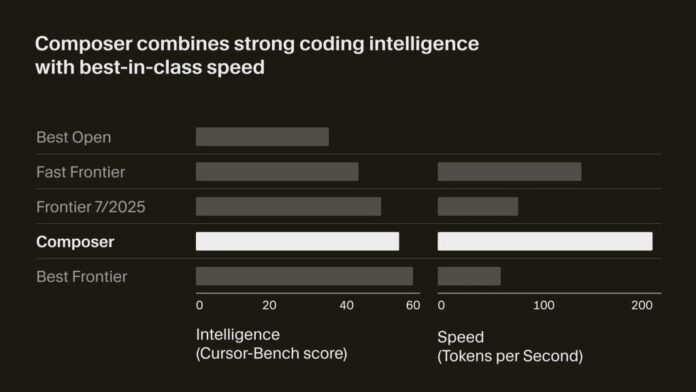
Composer is positioned as a “frontier model” in AI coding technology, boasting speeds up to four times faster than comparable models. Designed specifically for “low-latency agentic coding” within the Cursor ecosystem, Composer can handle most conversational coding interactions in less than 30 seconds. This rapid response time is engineered to streamline developers’ workflows, enabling faster iteration and boosting productivity.
Early adopters have praised Composer for its reliability in managing intricate, multi-step programming challenges, highlighting its ability to maintain accuracy while accelerating development cycles.

Advanced Training Techniques Empower Composer’s Capabilities
Composer’s impressive performance stems from its training on sophisticated tools, including a “codebase-wide semantic search” mechanism. This feature significantly enhances the model’s ability to comprehend and navigate large, complex codebases-a common hurdle for many AI coding assistants. By understanding the broader context of code, Composer delivers more accurate and contextually relevant solutions.
Redesigned User Interface: Agent-Centric Development Experience
The latest Cursor update introduces a revamped user interface that shifts focus from traditional file-based workflows to an agent-centered approach. This design philosophy allows developers to concentrate on their project goals while AI agents autonomously handle the underlying code generation and management.
For those who prefer direct code interaction, the platform maintains easy access to file views and offers an option to switch back to the classic integrated development environment (IDE) layout, ensuring flexibility for diverse coding preferences.

Parallel Multi-Agent Processing Enhances Problem Solving
A standout feature of Cursor 2.0 is its ability to run multiple AI agents simultaneously without conflicts, leveraging technologies such as “git worktrees” and remote computing resources. This parallel processing enables the platform to tackle complex problems more effectively.
Cursor discovered that assigning identical tasks to different AI models and then selecting the optimal solution significantly improves output quality, especially for challenging coding assignments. This ensemble approach mirrors strategies used in advanced machine learning to boost accuracy and robustness.
Addressing New Challenges: Code Review and Automated Testing
As AI agents increasingly take on coding responsibilities, new bottlenecks have emerged, particularly in reviewing generated code and validating changes. Cursor 2.0 tackles these issues with features designed to simplify and accelerate code review processes, allowing developers to quickly assess modifications and intervene only when necessary.
Additionally, the platform introduces a “native browser tool” that empowers AI agents to autonomously test their code. This tool enables iterative refinement, where the agent runs tests, identifies errors, and adjusts its output until achieving the correct final result. This advancement marks a significant step toward fully autonomous software development, where AI not only writes but also verifies code quality.
Looking Ahead: The Future of AI-Driven Software Engineering
Cursor 2.0 exemplifies the evolving landscape of AI-assisted programming, combining speed, accuracy, and autonomy to redefine developer workflows. As AI models continue to mature, features like multi-agent collaboration and self-testing will become essential tools for tackling increasingly complex software projects.
With the integration of these innovations, developers can expect a more seamless, efficient, and reliable coding experience, paving the way for accelerated software delivery and enhanced product quality.

