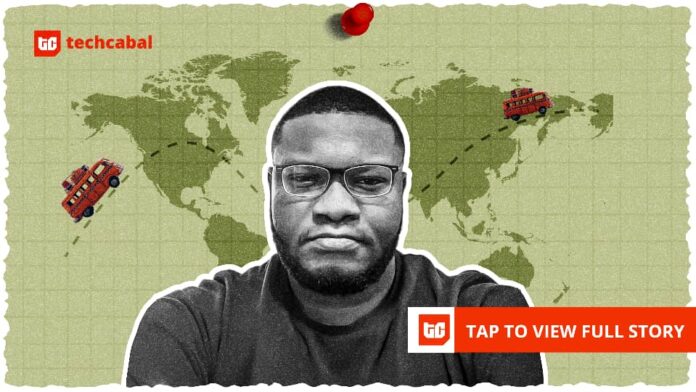
Digital nomad travel can be expensive. A Dubai-based digitalnomad told me in September that it costs more to be privileged enough to travel, but not to take advantage of this opportunity.
He said, “There’s a lot more in the world to see when you let go [proclivities] of what you are used to,” “When people travel it’s usually for the show, but when you travel and experience the random things that are out there, then the experience is what matters.” Mirois the founder of the popular whiteboarding platform in the Netherlands. This year, he decided to become a digital nomad.
Get African tech newsletters delivered to your inbox.
An Eye for a Better Quality of Life
Ayodeji started building a foundation in technology at a young age. He began programming in 2013, when he was in his teens. He hoped to one day create video games. In 2016, he began working remotely for US-based companies. He began his career in backend development with Oktium, a US-based video calling app. This was followed by brief stints at Qwertee and Eze, a YC backed B2B IT device procurement platform.
He joined a tech fellow with Andela in 2019, which he described as “the beginning of his career.” “It was an intensive 6-month programme in which we worked as a group on a real-life project. This simulation helped me launch my career as I was able to identify technical skills that I needed to improve.
Ayodeji had always had one goal in mind: to work for global companies. To achieve this, he knew that he would have to learn how to stay relevant and dynamic in tech and, most importantly, to improve his leadership skills. Ayodeji said, “I’ve been wanting to travel for quite some time.”
“I wanted places where I didn’t have to worry about electricity and internet. My fastest way to do that was to stack up money.” In 2021, he was the head of the technology team at Butter, an online collaboration platform based in Copenhagen. Miro acquired by Miro four years later. This role changed his life.
A freelancer visa and a way to escape
Based in Dubai, Ayodeji travelled from Nigeria for the first time in 2021. The freelance visaallows professionals to work and live in the UAE, without having to be sponsored by an employer.
This visa is usually tied to an independent permit from Dubai’s free zone, such as Dubai Internet City and Dubai Media City. It is open to professionals working in tech, media, education, and design. Holders are allowed to live in the country and open a bank, as well as take on multiple projects. It will still be one of the most popular remote worker options in 2025. New applications are temporarily halted as the UAE reviews its residency program.
Ayodeji’s freelance visa cost him about $3,000 at the time (excluding the flight) and the process was much easier. Today, however, the income benchmarks – about AED 15,000 ($4,000 per month) for the green visa – and tightened travel restrictions make it a little harder for some Africans to obtain. Ayodeji worked remotely for a year in the country. Dubai was “a lot fun” for the first few weeks, and maybe even up to a full year, but that excitement faded. Ayodeji loves the UAE, its sense of stability and freedom, as well as the low tax burden it offers its residents. However, he needed a way to express himself. This outlet came in the shape of a sponsored trip by his employer. Butter was planning an offsite for 2022 in Malaysia, and they were flying in teammates from other countries. Ayodeji originally wanted to decline the invitation. Ayodeji said, “As a Nigerian, I don’t hear much good about Malaysia, despite it being a great country.” “You hear a lot about racism and how they treat Nigerians and black people in general, so I was a bit worried.” Ayodeji was initially hesitant to go because most of his teammates [at Butter] are Malaysians.
But after his colleagues persuaded him otherwise, Ayodeji changed. Malaysia had a certain “je ne sais quoi” that he loved. The people, the food, and the connection he felt when he met some of his colleagues after working together for almost two years.
Talking with them opened up a world he was not used to in Dubai where he was clacking on his keyboard in his $1500-per month apartment. He was missing adventure. Ayodeji decided to adopt a nomadic lifestyle after returning from the trip. He travels today across Southeast Asia, and he hopes to expand his adventures soon to include the Eurasian mountains.
Ayodeji in the Basho Valley in the mountains of Skardu (Pakistan)/Image Source: Ayodeji.
In Nigeria, there is a level of materialism that makes us feel like we need to earn the most money to be happy. “South East Asia has changed me,” said he. “People live simply and happily.” Travel for experience and depth, not just for show
Ayodeji is critical of the “lack” of depth many Africans have when they travel. He said that they try to explore a new location while trying to keep their “game settings” similar to what they are used to at home. Ayodeji, a high-flyer and traveler who has visited several countries but doesn’t have a single pixel to show for it, reclines to find comfort from the little micro interactions.
According to him, his best friend is Grab driver – the ride-hailing application popular in Southeast Asian countries like Thailand and Vietnam.
In Thailand, I asked the [Grab driver] driver to take me anywhere,” Ayodeji said. The trip that was supposed be fifteen minutes turned into a twelve-hour journey. We shared food and conversation. He refused to take money from me. “I’d never experienced anything like it before.”
Ayodeji standing near a golden statue of Buddha in Phuket, Thailand/Image Source: Ayodeji
Nomadism, for Ayodeji, is how he stays curious about life. It’s what keeps him from getting stuck in one way of thinking. He says being on the move forces him to pay attention and to find meaning in small, random moments that most people rush past.
When asked about how jet lag from frequent travelling, loneliness, and instability push many nomads to eventually seek structure again, Ayodeji said that is not something he worries about. He waxed philosophical about spontaneity, drifting with the tides, and embracing the uncertainty that comes with it. It felt, to me, like a modern echo of the hip idealism that defined 60s America.
Ride a bike up Mount Bromo, try the food in Phuket, and feel the sun hit your face as you lose track of time, he argued passionately. Yet that, for Ayodeji, is what it means to truly live.
Ayodeji and a Friend at Mount Bromo, Indonesia/Image Source: Ayodeji
Three things keep him grounded in the nomadic life: the freedom to choose where he wants to be, the connections he makes with people who start out as strangers, and the new perspectives he gains from seeing how others live.
Travel is not merely work or an escape for Ayodeji. Being present, open, and willing to see the world as it is, not as a backdrop for pictures.
Ayodeji hiking on Mount Ijen Volcano, Java, Indonesia/Image Source: Ayodeji
Get all the best African tech news in your inbox.
“Biases shouldn’t have a place in the dream world we imagine”
Ayodeji, despite his bubbling optimism, and his adept handling of people
still cringes when he thinks about the existential prejudices that plague travellers who fit his archetype: Nigerians, with strong accents, and weak passport He has experienced it in the most mundane and painful ways.
He lost a European Job when he was in Nigeria, before he became Ayodeji The Traveller. The company rejected him because of the way he sounded during a phone call.
He recalled that the email stated that they could not understand him. It wasn’t my skill.
People are still subject to some of these biases and it is hard to build real leverage if you can’t land roles which give you the buffer to travel freely. As a nomad, his passport has often been the only thing that allowed him to travel. Some embassies asked for police reports or guarantors, while others never replied.
But that hasn’t deterred him. He has a nomadism that works, even though he is rooted in Dubai because of the tax incentives it offers. He schedules flights and visa appointments months in advance, before they are needed.
He said, “Today I am a resident of the UAE.” “To maintain this residency, I cannot be outside the UAE more than six month. I usually travel for five months, then spend the following month in Dubai booking flights and applying for visas for the next five. But sometimes, I travel at random.”
Now, he doesn’t rent an apartment in Dubai. He only rents a small storage space that costs $80 per month where he stores his belongings. When he returns home, he stays at an Airbnb. It allows him to be mobile without feeling disoriented.
When you have to fit your entire life into a suitcase, safety nets like health insurance are necessary. Ayodeji’s safety net is Genki, a travel-insurance platform designed for digital nomadics.
For people like him, insurance isn’t a formality,” said he. “You can be anywhere and still have something go wrong. You just need to be sure that someone will answer the phone.
Safe and Not Sorry’s Nomad Insurance Calculatorshows that coverage for travellers in the twenties can start at $45 per month, depending on where they are. Ayodeji, who works remotely at Miro and supplements his income with freelance gigs, pays for his travels using his budget and his remote job. He doesn’t indulge in extravagant living, but he doesn’t deprive himself of the joys of travel.
He said, “It isn’t as expensive as people believe.” “Once you stop spending money on comfort and start paying more for the experience, everything changes. I want more Africans traveling for depth and not just for show. We’d love to hear your thoughts on this edition of Digital Nomads. Share your thoughts with us
Editor’s note: Ayodeji’s name has been changed on request.