
IBM’s Strategic Advances in Enterprise AI Agent Deployment and Governance
Despite the growing interest in agentic AI, many organizations still face significant hurdles in fully leveraging these technologies. IBM identifies the primary challenge not in creating AI agents, but in effectively managing and governing them once deployed in production environments.
IBM’s Three-Pronged Approach to Enterprise AI Challenges
At the TechXchange 2025 event, IBM introduced a suite of innovative solutions aimed at closing critical gaps in enterprise AI adoption. These include:
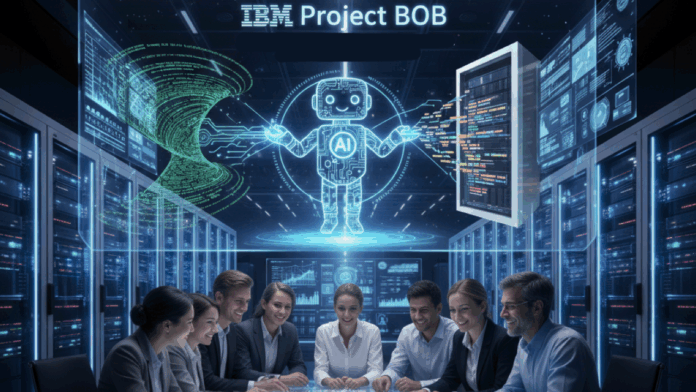
- Project Bob: An AI-centric integrated development environment (IDE) that coordinates multiple large language models (LLMs) to automate the modernization of legacy applications.
- AgentOps: A real-time governance platform designed to oversee AI agents throughout their lifecycle in production.
- Open-Source Integration: The first incorporation of open-source tools into IBM’s watsonx platform for streamlined AI agent deployment and management.
This comprehensive strategy targets three interconnected enterprise pain points: updating outdated codebases, ensuring robust governance of AI agents, and bridging the gap between prototype development and scalable production deployment.
Revolutionizing Legacy Code Modernization with Project Bob
While the market is saturated with AI coding assistants like GitHub Copilot and vibe coding platforms such as Replit and Cursor, Project Bob distinguishes itself by focusing on enterprise-scale modernization rather than simple code generation.
Bruno Aziza, IBM’s Vice President of Data, AI, and Analytics Strategy, explains that Project Bob maintains full repository context across editing sessions, enabling it to automate complex upgrades-such as migrating from Java 8 to newer Java versions and transitioning frameworks from Struts or JSF to contemporary technologies like React, Angular, or Liberty.
Project Bob’s architecture intelligently orchestrates tasks among multiple LLMs-including Anthropic’s Claude, Mistral, Meta’s Llama, and IBM’s proprietary models-using a data-driven model selection process. This dynamic routing optimizes for accuracy, latency, and cost efficiency in real time.
By comprehending the entire codebase, development goals, and security protocols, Project Bob empowers developers to design, debug, refactor, and modernize software seamlessly without disrupting their workflow.
Among the 6,000 IBM developers who have piloted Project Bob internally, 95% utilized it primarily for task completion rather than mere code generation. The tool also integrates DevSecOps features such as vulnerability scanning and compliance verification directly within the IDE, enhancing security throughout the development lifecycle.
Enhancing Project Bob Through IBM’s Partnership with Anthropic
IBM’s collaboration with Anthropic marks a significant milestone, embedding Claude models into the watsonx ecosystem, starting with Project Bob. This partnership extends beyond model integration to co-developing a pioneering framework for enterprise AI agent deployment.
The joint initiative introduced the Agent Development Lifecycle (ADLC), a structured methodology for designing, deploying, and managing AI agents in business environments. Central to this is the Model Context Protocol (MCP), an open standard from Anthropic that facilitates seamless connectivity between AI assistants and the necessary data and systems.
Bridging Prototype to Production with Open-Source Integration
IBM is expanding its watsonx Orchestrate platform by integrating Langflow, an open-source visual agent builder led by DataStax, which IBM acquired in May 2024. This integration addresses a critical industry challenge: transitioning from open-source prototyping to enterprise-grade, scalable, and compliant AI systems.
According to Aziza, “While many teams can build agents using open-source tools like LangChain or n8n, the missing piece is governance, lifecycle management, security, and observability necessary for production readiness.” Watsonx Orchestrate enhances Langflow by adding these enterprise capabilities, transforming it into a robust orchestration platform suitable for mission-critical applications.
Key Enhancements from Langflow Integration
- Agent Lifecycle Management: Features provisioning, version control, deployment, monitoring, multi-agent coordination, and role-based access control.
- Built-in AI Governance: watsonx.governance offers audit trails, explainability for agent decisions, bias and drift detection, and policy enforcement-capabilities absent in native Langflow.
- Enterprise-Grade Infrastructure: Supports SaaS and on-premises hosting with data isolation, single sign-on (SSO), LDAP integration, and granular permission settings.
- Flexible Development Options: Combines no-code visual Agent Builder and pro-code Agent Development Kit to facilitate smooth progression from prototype to production.
- Pre-Configured Domain Agents: Includes ready-to-use agents for HR, IT, and finance, integrated with platforms like Workday, SAP, and ServiceNow.
- Production Monitoring: Provides dashboards, analytics, and enterprise support service-level agreements (SLAs) with continuous performance tracking.
Introducing Agentic Workflows and AgentOps for Scalable AI Management
Complementing the Langflow integration, IBM launched two new watsonx Orchestrate features: Agentic Workflows and AgentOps.
Agentic Workflows tackles the fragility of custom scripts that often break when scaled across complex enterprise environments. It offers standardized, reusable workflows that coordinate multiple agents and tools, ensuring consistent execution of business processes. While Langflow focuses on building individual agents visually, Agentic Workflows manages their orchestration at scale.
AgentOps delivers comprehensive governance and observability for AI workflows in production. It provides real-time monitoring, policy enforcement, and lifecycle management, closing the governance gap that can lead to operational risks.
For example, without AgentOps, an AI-driven HR onboarding agent might incorrectly apply benefits policies without immediate detection. With AgentOps, every action is tracked live, enabling prompt identification and correction of anomalies.
Implications for Enterprises Embracing Agentic AI
Technical debt remains a significant obstacle for many organizations aiming to deploy agentic AI solutions. Project Bob’s demonstrated 45% productivity improvement in internal IBM tests highlights its potential to accelerate modernization efforts, particularly for companies with extensive legacy Java codebases. However, the effectiveness of multi-model orchestration on diverse customer environments with varying technical debt and team expertise remains to be fully validated.
The Langflow integration fills a vital gap for enterprises already experimenting with open-source agent frameworks by providing the necessary governance, security, and operational controls to move from experimental prototypes to reliable production systems.
For businesses striving to lead in AI adoption, IBM’s announcements underscore a critical truth: rapid agent development is achievable with existing tools, but scaling safely and sustainably demands robust lifecycle management, observability, and policy governance.
Availability and Next Steps
Project Bob is currently accessible via a private technical preview, with plans for broader release in the near future. Interested developers can request access through IBM’s developer portal. Meanwhile, AgentOps and Agentic Workflows are available now within watsonx Orchestrate, and the Langflow integration is slated for general availability by the end of this month.

