
Microsoft’s Strategic Shift Toward Proprietary AI Hardware
Microsoft currently relies heavily on GPUs sourced from industry leaders Nvidia and AMD to power its AI workloads. However, the company is actively transitioning to its own custom-built accelerators, aiming to reduce dependence on third-party GPUs and optimize performance and cost-efficiency within its data centers.
Late Entry into Custom Silicon Development
While tech giants like Amazon and Google have been developing bespoke CPUs and AI accelerators for several years, Microsoft only unveiled its Maia AI accelerator line in late 2023. This relatively recent entry into the custom silicon arena highlights Microsoft’s intent to catch up and innovate in-house to better tailor hardware to its specific AI demands.
Driving Factors: Cost Efficiency and Performance Optimization
For hyperscale cloud providers, maximizing performance per dollar is paramount. Microsoft’s CTO, Kevin Scott, acknowledged that Nvidia currently offers the best price-to-performance ratio. Nonetheless, Microsoft is open to exploring all options to meet the surging demand for AI compute power. Scott emphasized that the company envisions a future where the majority of its data center workloads run on Microsoft-designed chips.
When asked about the long-term vision for data center silicon, Scott affirmed, “Absolutely, the goal is to predominantly utilize Microsoft’s own processors.” He further explained to CNBC that optimizing AI workloads requires holistic system design, including network architecture and cooling solutions, which is only achievable with full control over hardware components.
Maia 100: Microsoft’s First AI Accelerator
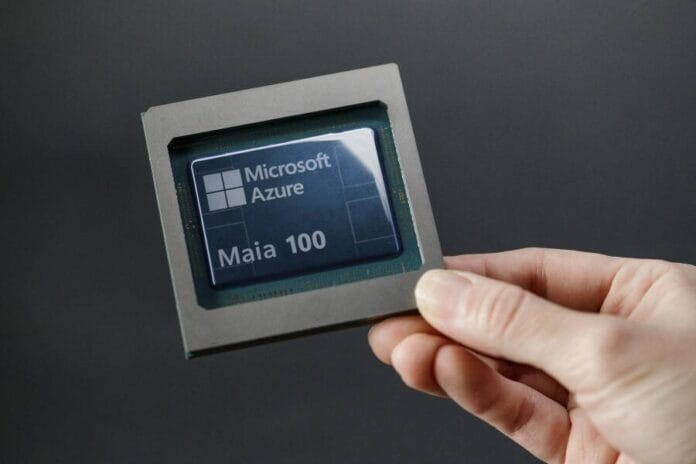
Microsoft’s inaugural AI chip, the Maia 100, debuted in 2023 and enabled the company to offload some AI tasks-such as running OpenAI’s GPT-3.5-from GPUs to its own silicon. Despite this milestone, the Maia 100’s specifications lagged behind competitors, delivering 800 teraFLOPS in BF16 precision, equipped with 64GB of HBM2e memory, and offering 1.8TB/s memory bandwidth.
In comparison, Arm-based processors have been gaining traction in the server market, capturing approximately 25% share by leveraging their custom CPU designs. For instance, SiPearl has introduced reference designs for the high-performance Rhea1 Arm chip, and Arm projects to control half of the data center market by the end of 2024.
Upcoming Innovations and Market Dynamics
Microsoft is reportedly preparing to launch a second-generation Maia accelerator next year, expected to feature enhanced compute capabilities, increased memory capacity, and improved interconnect technologies. While this signals a gradual shift from GPUs to AI-specific ASICs within Microsoft’s infrastructure, it is unlikely that AMD and Nvidia GPUs will be completely phased out anytime soon.
Google’s extensive deployment of its custom TPUs and Trainium accelerators-numbering in the tens of thousands-demonstrates the effectiveness of tailored AI hardware. These chips not only accelerate Google’s internal AI workloads but also attract prominent clients like Anthropic, underscoring the commercial viability of proprietary accelerators.
Despite the rise of AI ASICs, cloud customers continue to demand Nvidia and AMD GPUs, ensuring their sustained presence in large-scale deployments across major cloud platforms.
Beyond AI: Microsoft’s Broader Custom Chip Initiatives
Microsoft’s chip development extends beyond AI accelerators. The company is also designing its own CPU, known as Cobalt, alongside a suite of platform security chips aimed at accelerating cryptographic operations across its extensive cloud and enterprise services. This diversified chip strategy reflects Microsoft’s commitment to enhancing performance, security, and efficiency across its technology stack.

