
Integrating Advanced Machine Learning with Gemini for Diabetes Prediction
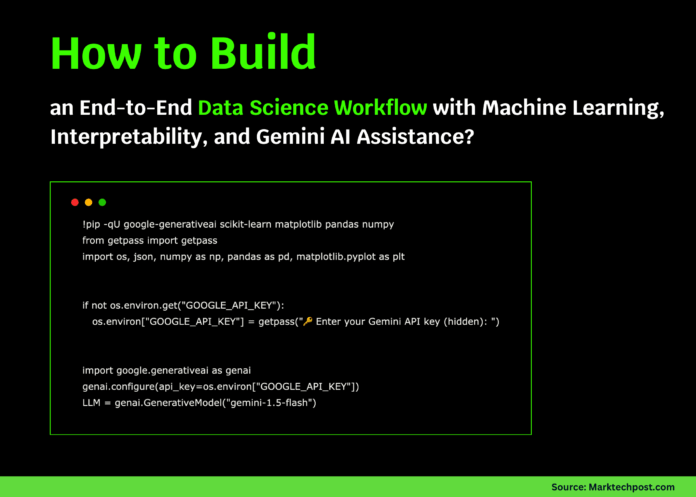
This guide demonstrates a comprehensive data science pipeline that merges classical machine learning techniques with the advanced capabilities of Gemini AI. We start by preparing and modeling the diabetes dataset, then proceed to evaluate the model, analyze feature significance, and explore partial dependence effects. Throughout the process, Gemini acts as an AI data scientist-interpreting results, answering exploratory queries, and identifying potential risks. This approach not only builds a predictive model but also enriches our understanding and decision-making through natural language interaction.
Data Preparation and Model Construction
We utilize the diabetes dataset, which contains clinical measurements and a target variable indicating disease progression. After loading the data, we preprocess the features using a combination of standard scaling and quantile transformation to normalize distributions effectively. Our predictive model employs a histogram-based gradient boosting regressor, optimized with early stopping and regularization to prevent overfitting.
The dataset is split into training and testing subsets, with 20% reserved for evaluation. We apply 5-fold cross-validation on the training set to estimate the model’s root mean squared error (RMSE), ensuring robust performance assessment before fitting the final model.
Model Evaluation and Feature Importance Analysis
Post-training, we assess the model’s accuracy by calculating RMSE on both training and test sets, alongside mean absolute error (MAE) and R-squared metrics on the test data. Residual plots visualize prediction errors, helping detect any systematic biases.
To understand which features most influence predictions, we compute permutation importance scores. This method quantifies the increase in prediction error when each feature’s values are randomly shuffled, highlighting the top contributors. A horizontal bar chart presents the ten most impactful features, offering clear insights into the model’s decision drivers.
Exploring Feature Effects with Partial Dependence
We manually calculate partial dependence plots (PDPs) for the three most important features. PDPs illustrate how varying a single feature affects the predicted outcome, averaged over the dataset. This visualization aids in interpreting the model’s behavior and understanding nonlinear relationships.
Additionally, we compile a structured JSON report summarizing dataset characteristics, evaluation metrics, and feature importances. This report is fed into Gemini, which generates an executive summary including key risks, assumptions, prioritized next steps for experimentation, and quick-win feature engineering suggestions expressed as Python pseudocode.
Interactive Exploratory Data Analysis with Gemini
To facilitate dynamic data exploration, we implement a secure sandbox environment that executes Python pandas code snippets generated by Gemini. This setup allows us to pose natural language questions about the dataset-such as correlations between body mass index (BMI) and disease progression or identifying the feature most correlated with the target-and receive precise answers derived from live code execution.
Risk Assessment and What-If Scenario Analysis
Gemini further assists by reviewing the model for potential pitfalls including data leakage, overfitting, calibration issues, out-of-distribution robustness, and fairness concerns. It proposes concise Python checks to validate these aspects.
We also perform “what-if” analyses to quantify how small perturbations in top features influence predictions. For example, increasing a key feature by 5% and observing the corresponding change in predicted disease progression helps clarify the model’s sensitivity and interpretability.
Summary and Future Directions
This workflow exemplifies how integrating traditional machine learning with Gemini’s AI reasoning capabilities can transform data science into a more interactive and insightful endeavor. By training, evaluating, and interpreting a predictive model alongside an AI collaborator, we achieve a balance of performance and explainability. This approach encourages iterative refinement through natural language queries, risk evaluation, and feature engineering recommendations.
To extend this framework, consider experimenting with alternative datasets or adjusting model hyperparameters to further enhance predictive accuracy and robustness.

