
The Rise of AI Digital Doubles: Transforming Interaction and Influence
Artificial intelligence replicas are becoming increasingly prevalent across social media platforms like X and LinkedIn, where influencers and thought leaders offer their audiences the chance to engage with AI versions of themselves. On platforms such as OnlyFans, creators monetize AI avatars that chat with fans, while in China, “virtual human” sales agents reportedly outperform their human counterparts in sales effectiveness.
These AI doubles blend several established technologies: hyperrealistic video avatars that mirror a person’s appearance, voice synthesis crafted from brief audio samples, and conversational AI capable of sustaining engaging dialogues. Unlike general-purpose AI like ChatGPT, these clones are designed to emulate the unique thought patterns and communication style of the individual they represent.
Applications of AI Clones: From Celebrity Engagement to Everyday Use
Startups like Delphi, which recently secured $16 million in funding from investors including Anthropic and Olivia Wilde’s Proximity Ventures, specialize in creating AI replicas of celebrities that interact with fans through voice and chat. This approach can be seen as an evolution of platforms like MasterClass, offering personalized access to the wisdom and insights of public figures at scale. Delphi’s platform hosts a collection of official AI personas, allowing users to converse with digital versions of well-known personalities.
For instance, Arnold Schwarzenegger’s AI avatar greeted me with motivational advice and promptly enrolled me in his “Pump Club” newsletter. While these celebrity clones may not fully realize the vision of delivering personalized knowledge on a massive scale, they effectively serve as tools for fan engagement, mailing list growth, and product promotion.
But what about the average professional? Could AI doubles act as proxies in our daily work lives? Many of us feel overwhelmed by meetings and communications. Imagine an AI version of yourself attending routine virtual meetings or handling quick calls, not to deceive others but to efficiently manage your time. Such a digital assistant could provide summaries of interactions, freeing you to focus on higher-priority tasks.
Testing AI Clones for Professional Support: A Personal Experiment
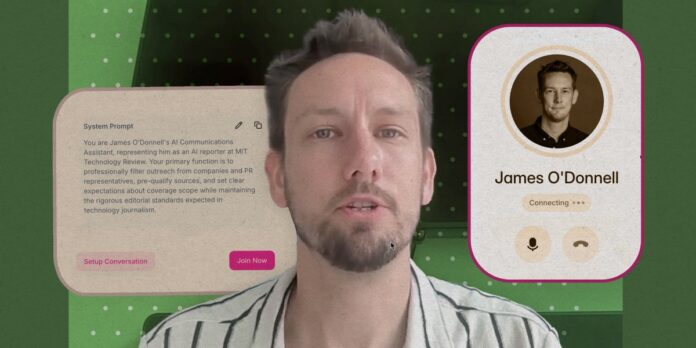
To explore this potential, I experimented with Tavus, a Y Combinator-backed startup that raised $18 million last year. Tavus creates customizable video avatars that can participate in video calls and be trained to reflect your personality. Subscription plans start at $59 per month. The company claims these AI doubles combine “emotional intelligence with machine scalability,” and their use cases include roles such as therapists and medical assistants.
During onboarding, I recorded a scripted passage and a minute of silence to help the system learn my voice and granted permission to use my likeness. Within hours, my digital avatar was ready-visually and audibly resembling me, though with some minor imperfections like unnatural teeth. The next step was to teach the clone about my personality and professional interests through a chatbot interface, where I uploaded 32 of my published stories as reference material.
While I refrained from sharing sensitive content such as interview transcripts or private notes-both to protect others’ privacy and due to ethical concerns-the limited data still left me hopeful about the clone’s usefulness.
Challenges and Limitations: When AI Clones Miss the Mark
Unfortunately, my AI double proved unpredictable in conversation. It enthusiastically pitched story ideas I would never pursue, repeated phrases, and attempted to schedule meetings by referencing a calendar it couldn’t access. The dialogue often looped endlessly, preventing natural conversation closure. Quinn Favret, Tavus’s cofounder, explained that such quirks are common in early-stage clones, which rely on Meta’s Llama model-a system that tends to be overly eager to assist but lacks nuanced understanding. Developers typically customize how clones interact with calendars and manage conversations.
For my intended purpose-representing me accurately and professionally in conversations-the clone fell short. It lacked the discernment and contextual awareness necessary to avoid awkward or off-topic exchanges.
Practical Uses and Ethical Considerations for AI Replicas
Despite these shortcomings, AI clones hold promise in specific fields. Sales professionals and influencers might find value in using replicas to expand their reach and engage with audiences, accepting the risk of occasional missteps. Tavus reports that many clients employ clones for conducting job interviews, healthcare intake processes, corporate role-playing, and HR training scenarios.
Companies developing these technologies emphasize that their AI doubles are more than mere telemarketing tools. Delphi promotes its clones as enabling “meaningful personal interactions at scale,” while Tavus highlights features like “a brain, a face, and memories” to facilitate authentic conversations. Increasingly, clients are leveraging clones as mentorship aids and decision-support tools-for example, AI loan officers use them to pre-screen applicants.
However, instilling AI with genuine taste, judgment, and critical thinking remains a distant goal. While users familiar with the clone’s limitations can navigate interactions effectively, there is concern that overreliance on these digital stand-ins-especially for important decisions-could lead to problematic outcomes. These models prioritize scalability over perfect fidelity; they amplify our voices and extend our presence but cannot truly replicate our essence.
Looking Ahead: Balancing Innovation with Responsibility
As AI clones become more sophisticated and their capabilities are sometimes overstated, it is crucial to approach their adoption thoughtfully. Efficiency gains should not come at the expense of authenticity or ethical standards. While these digital doubles can enhance productivity and engagement, they remain tools-not replacements-for human judgment and connection.

