
Anyone who has attempted to develop an effective agentic Retrieval-Augmented Generation (RAG) system knows the frustration all too well. You input a set of documents, hope for accurate answers, and often end up with irrelevant or hallucinated responses that barely address the query.
Elysia, an innovative open-source Python framework created by the team at Weaviate, aims to revolutionize this experience. Instead of simply layering more AI on top of existing methods, Elysia reimagines how AI agents interact with data, delivering smarter, more reliable results.
Note: Requires Python 3.12 or higher.
Why Conventional RAG Systems Fall Short
The core issue with most RAG implementations is their inherent lack of insight. These systems convert user questions into vector embeddings, retrieve “similar” text snippets, and hope the output is relevant-akin to asking for restaurant recommendations while blindfolded. The results are often hit-or-miss.
Additionally, many frameworks overwhelm AI agents by providing access to every available tool simultaneously. This approach is comparable to handing a child a full toolbox and expecting them to assemble complex furniture without guidance.
Elysia’s Innovative Framework: Three Key Components
1. Structured Decision Trees
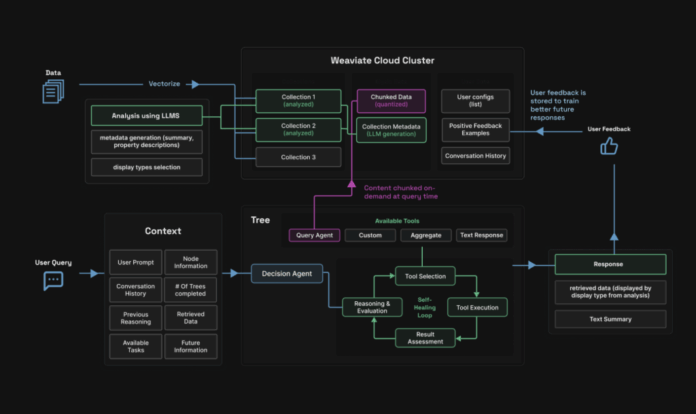
Rather than bombarding AI agents with all tools at once, Elysia employs decision trees that guide the agent through a logical sequence of choices. This method resembles a well-designed flowchart, where each node contains context from previous steps and outlines possible next actions.
What sets this apart is the transparency: Elysia tracks and displays the exact path the agent takes, enabling developers to diagnose and fix errors instead of blindly retrying.
Moreover, when the AI encounters an unresolvable task-such as searching for car prices in a cosmetics database-it flags the issue as “impossible” and moves on, preventing endless futile attempts.
2. Intelligent Data Presentation
Unlike traditional systems that output raw text blocks, Elysia dynamically adapts how it presents data based on its structure. For example, e-commerce product information is shown as product cards, GitHub issues appear as ticket summaries, and spreadsheet data is rendered in tables.
The framework analyzes the data’s fields, types, and relationships, then selects from seven distinct display formats to best suit the content, enhancing clarity and user experience.
3. Deep Data Understanding
Before performing any search, Elysia conducts a thorough analysis of the database to grasp its contents. It generates metadata, summarizes key points, and determines the most appropriate display methods by examining:
- Field types and categories
- Data value ranges and distributions
- Interconnections between data elements
- Relevant search targets based on data context
How Elysia Operates
Adaptive Learning from User Feedback
Elysia improves over time by remembering when users confirm helpful responses. This feedback loop refines future answers tailored to your specific queries without negatively impacting other users’ experiences.
This approach allows the use of smaller, cost-effective AI models that still deliver high-quality results by learning from real-world success cases.
On-Demand Document Chunking
Most RAG systems pre-chunk entire document collections, consuming excessive storage and often splitting content awkwardly. Elysia, however, performs chunking only when necessary: it first searches whole documents, then breaks down relevant but lengthy texts dynamically based on the user’s query.
This strategy conserves storage and improves retrieval accuracy by making chunking decisions informed by actual search intent.
Dynamic Model Selection
Recognizing that different tasks require different AI capabilities, Elysia automatically routes queries to the most suitable model. Simple questions avoid expensive large models like GPT-4, while complex analyses receive the necessary computational power, optimizing both cost and response time.
Getting Started with Elysia
Installation and setup are straightforward:
pip install elysia-ai
elysia start
This command launches both a user-friendly web interface and the underlying Python framework.
For developers seeking customization, here’s a simple example:
from elysia import tool, Tree

tree = Tree()

@tool(tree=tree)
async def add(x: int, y: int) -> int:
    return x + y

tree("What is the sum of 9009 and 6006?")
If you’re working with Weaviate data, integration is even more seamless:
import elysia

tree = elysia.Tree()
response, objects = tree(
    "What are the 10 most expensive items in the Ecommerce collection?",
    collection_names=["Ecommerce"]
)
Practical Application: Glowe’s Intelligent Chatbot
Glowe leverages Elysia to power its advanced product recommendation chatbot. Users can inquire, for instance, “Which skincare products complement retinol without irritating sensitive skin?” The system delivers nuanced answers that consider ingredient interactions, user preferences, and stock availability.
This goes beyond simple keyword matching, demonstrating a sophisticated understanding of context and relationships-something that would be challenging to program manually.
Conclusion
Elysia marks a significant evolution in RAG technology by integrating decision-tree-driven agents, context-aware data visualization, and adaptive learning from user feedback. Unlike traditional ask-retrieve-generate models, it pre-analyzes data structures to select optimal presentation formats and maintains clear visibility into its reasoning process.
As Weaviate’s forthcoming successor to their Verba RAG system, Elysia lays the groundwork for more intelligent AI applications that not only comprehend user queries but also deliver answers in the most effective manner. While still in beta, its innovative design promises to enhance real-world performance substantially.

