
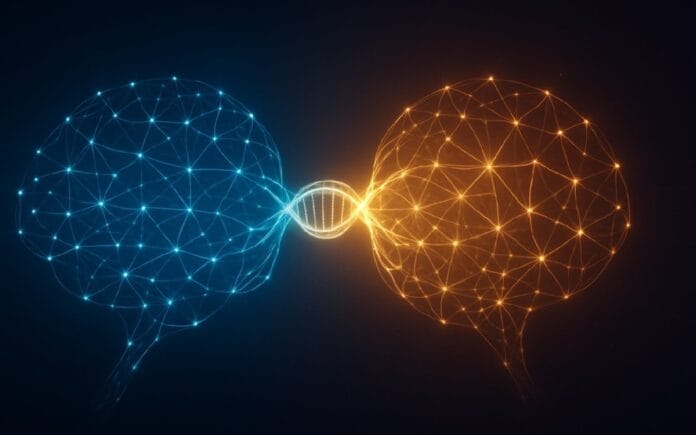
Revolutionizing AI Development: The Power of Model Merging with M2N2
In the rapidly evolving landscape of artificial intelligence, a novel approach from Japan’s AI Lab Sale and Dweet is transforming how developers enhance AI models. Their innovative method, Model Merging of Natural Niches (M2N2), enables the creation of advanced AI systems without the need for expensive retraining or fine-tuning. This breakthrough technique not only overcomes the constraints of previous model merging methods but also facilitates the generation of entirely new models from existing ones.
Understanding Model Merging: A New Paradigm in AI Integration
Model merging is a process that synthesizes the expertise embedded in multiple specialized AI models into a single, more capable entity. Unlike traditional fine-tuning, which incrementally adjusts a model using new datasets, merging combines the internal parameters of several models simultaneously. This approach bypasses the need for costly gradient-based optimization and access to original training data, making it especially valuable when such data is unavailable.
One of the key advantages of model merging is its computational efficiency. Since it relies solely on forward passes rather than backpropagation, it significantly reduces resource consumption. Additionally, it mitigates the risk of “catastrophic forgetting,” a phenomenon where fine-tuning on new tasks causes a model to lose proficiency in previously learned skills. By merging weights directly, enterprises can preserve diverse capabilities within a unified model.
Challenges in Traditional Model Merging and the Evolutionary Leap of M2N2
Earlier model merging techniques often demanded extensive manual tuning, with developers painstakingly adjusting coefficients to find the right balance between models. Although evolutionary algorithms have automated parts of this process by searching for optimal parameter combinations, they still rely on fixed merging units such as layers or blocks. This rigidity limits the exploration of potentially superior model blends.
M2N2 revolutionizes this by drawing inspiration from natural evolutionary processes, introducing three key innovations:
- Flexible Parameter Partitioning: Instead of adhering to rigid layer boundaries, M2N2 employs dynamic “split points” and “mixing ratios” to blend model parameters. For instance, it might merge 40% of one model’s parameters with 60% of another’s within the same layer, allowing for nuanced combinations.
- Population Diversity Through Competitive Selection: M2N2 maintains a diverse pool of models by simulating competition for limited resources. This mechanism favors models with unique strengths-akin to ecological niches-ensuring that merged models benefit from complementary capabilities rather than redundant ones.
- Attraction-Based Pairing: Instead of merging only the highest-performing models, M2N2 pairs models based on complementary performance profiles. An “attraction score” identifies pairs where one model excels in areas where the other struggles, enhancing the merged model’s overall effectiveness.
Practical Applications and Demonstrated Successes of M2N2
The versatility of M2N2 has been validated across multiple AI domains:
- Image Classification: On the MNIST dataset, M2N2 outperformed competing methods by preserving a diverse archive of models with complementary strengths, leading to superior classification accuracy.
- Large Language Models (LLMs): By merging a math-specialist model (WizardMath-7B) with an agentic expert (AgentEvol-7B), both based on Llama 2 architecture, M2N2 produced a multi-talented agent excelling in mathematical reasoning and web-based tasks, demonstrating robust performance on benchmarks like GSM8K.
- Text-to-Image Generation: Combining a Japanese prompt-trained diffusion model (JSDXL) with several English-trained Stable Diffusion models, M2N2 created a bilingual image generator. This merged model not only enhanced photorealism and semantic understanding but also gained the ability to interpret prompts in both languages, despite being optimized primarily on Japanese captions.
Business Implications: Unlocking Hybrid AI Capabilities
For organizations with existing specialized AI models, M2N2 offers a compelling strategy to develop hybrid solutions that would be challenging to build from scratch. Imagine integrating a language model fine-tuned for persuasive sales communication with a vision model capable of analyzing customer facial expressions in real time. The resulting AI agent could dynamically tailor its sales pitch based on live feedback, combining linguistic finesse with emotional intelligence-all while operating as a single, efficient model.
This approach not only reduces operational costs and latency but also leverages the collective intelligence of multiple AI systems, paving the way for more adaptive and responsive enterprise applications.
The Future of AI: Towards an Ecosystem of Continually Evolving Models
The creators of M2N2 envision a future where AI development resembles an evolving ecosystem rather than the construction of monolithic models. In this vision, organizations maintain a dynamic collection of AI models that continuously merge and adapt to emerging challenges, fostering innovation through collaboration and evolution.
However, this promising future also presents organizational challenges. Integrating diverse models-commercial, open-source, and proprietary-raises critical concerns around privacy, security, and regulatory compliance. Enterprises must carefully evaluate which models to incorporate into their AI stacks to ensure safe and effective deployment.
Accessing M2N2 and Moving Forward
The M2N2 algorithm has been made publicly available on GitHub, inviting developers and researchers to explore and extend its capabilities. As AI continues to scale, methods like M2N2 offer a promising path to more efficient, versatile, and intelligent systems.

