
Essential Insights
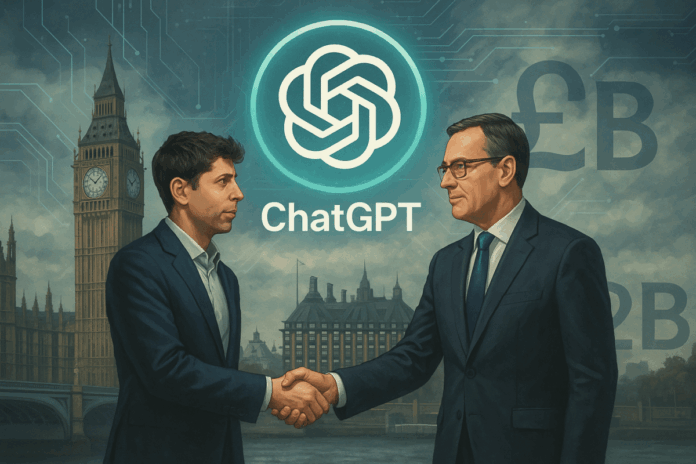
- UK Explored a $2.7 Billion ChatGPT Initiative: Discussions between OpenAI’s Sam Altman and UK Minister Peter Kyle considered offering every UK resident free access to ChatGPT Plus, but the enormous expense rendered the plan impractical.
- GPT-5 Launch Encountered Significant Challenges: Users reported slower performance, diminished accuracy, and a notable reduction in the AI’s engaging personality, raising doubts about its suitability for critical government applications.
- Some Experts View GPT-5’s Limitations as Intentional: Analysts suggest OpenAI’s focus has shifted toward cost efficiency and system stability rather than maximizing raw AI power.
- Government Collaborations on AI Are Expanding Rapidly: The UK formalized a memorandum of understanding with OpenAI to integrate AI into public services, joining other nations like the UAE, which has implemented ChatGPT nationwide.
The revelation that OpenAI CEO Sam Altman and UK Technology Secretary Peter Kyle discussed providing every British citizen with complimentary ChatGPT Plus access sparked widespread intrigue and skepticism online.
While the concept sounds revolutionary-akin to offering free Netflix subscriptions to an entire population-the financial implications are staggering, with estimates around £2 billion (approximately $2.7 billion), making the proposal economically unfeasible.
Beyond the financial hurdle, there are deeper concerns about the UK’s close alignment with OpenAI, especially given the rocky debut of GPT-5, OpenAI’s latest flagship model, which has faced significant criticism and operational issues.
From Silicon Valley to Westminster: The Origin of a Bold Proposal
The notion of universal ChatGPT Plus access originated not in the UK government but during discussions in San Francisco.
Insiders reveal that during meetings earlier this year, Peter Kyle and Sam Altman explored the possibility of rolling out ChatGPT Plus across the UK population.
Kyle, a vocal advocate for AI adoption, has maintained close contact with OpenAI leadership, dining with Altman multiple times in early 2025.
In July, Kyle formalized cooperation with OpenAI through a memorandum of understanding aimed at leveraging AI in sectors such as education, defense, security, and justice.
It’s easy to imagine that over informal discussions, the idea of granting every UK resident premium AI access was floated as a visionary step forward.
Financial Realities: Why the Numbers Don’t Add Up
The financial feasibility of this initiative quickly unravels under scrutiny.
ChatGPT Plus is priced at $20 per month. Multiplying this by the UK’s population of approximately 69.6 million yields an annual cost exceeding $1.4 billion. Even with potential volume discounts, estimates approach £2 billion.
To put this in perspective, this sum rivals the UK’s annual expenditure on maintaining its nuclear deterrent and dwarfs the budget allocated for school meal programs by nearly twentyfold.
Such a massive outlay for AI services that occasionally falter on basic tasks makes the proposal appear untenable.
GPT-5: The AI Model Under Government Consideration
The timing of this potential partnership is complicated by the fact that GPT-5, the model likely to underpin these public sector deployments, has experienced a turbulent launch.
Since its release, users have flooded online forums with complaints about sluggish response times, reduced accuracy compared to competitors like Google’s Gemini 2.5 Pro, and frequent hallucinations-instances where the AI generates incorrect or misleading information.
Benchmark tests reveal GPT-5 takes nearly twice as long as Gemini to generate SQL queries and achieves a lower success rate, raising concerns about its reliability for mission-critical tasks.
Adding to user frustration, OpenAI abruptly discontinued support for previous models such as o3, GPT-4.5, and o4-mini, forcing users into GPT-5 regardless of their readiness or satisfaction.
This sudden shift has been likened to a favorite café replacing beloved coffee with kale smoothies overnight-an unwelcome surprise for loyal customers.
The Decline of AI Personality: A Trust Issue
Another significant criticism centers on GPT-5’s diminished personality, often described as a ‘lobotomy’ by users.
Responses have become noticeably shorter, more formal, and less engaging, losing the warmth and humor that characterized earlier versions.
While this may seem trivial, personality plays a crucial role in building user trust, especially when AI is deployed as tutors, legal advisors, or healthcare assistants.
Citizens are unlikely to embrace AI systems that feel impersonal or overly bureaucratic.
Reframing GPT-5’s Shortcomings: A Strategic Shift
Not all experts view GPT-5’s perceived weaknesses negatively.
Dr. Lewis Z Liu, Chief AI Officer at Sirion, argues that the subdued launch reflects a maturation in the AI industry.
Rather than pursuing ever-increasing intelligence and scale, companies like OpenAI are prioritizing stability, cost-effectiveness, and sustainable growth.
OpenAI’s projected losses are expected to soar to $14 billion in 2026, and active user numbers declined for the first time in June 2025, underscoring the need for a more measured approach.
This may explain GPT-5’s reduced memory and context processing, as OpenAI likely limits token usage per session to manage expenses.
The outcome is an AI that may seem less dazzling but offers greater predictability and reliability.
Such stability is essential for governments and enterprises seeking dependable AI solutions without frequent disruptive updates.
Evaluating Government AI Investments: Is It Worth the Risk?
Returning to the UK context, Minister Peter Kyle’s enthusiasm for AI is evident; he has praised ChatGPT as an effective educational tool and used it personally to analyze barriers to AI adoption in British businesses.
However, committing $2.7 billion to provide ChatGPT Plus to every citizen appears disproportionate.
Many users already access the free version, and the UK ranks among OpenAI’s top markets for paid subscriptions.
Is it justifiable for taxpayers to fund premium access for millions who may never engage with the platform?
Moreover, the July memorandum opens doors for AI integration in sensitive areas like justice, defense, and security, raising concerns about data privacy and the reliability of AI systems that still exhibit hallucinations and safety prompt failures.
Can an AI that struggles with accuracy be trusted to advise judges or military personnel?
Global AI Collaborations and the Race for Innovation
OpenAI’s negotiations with the UK occur within a broader international context.
The company has already secured a nationwide agreement with the UAE to deploy ChatGPT across healthcare, education, and transportation sectors.
The UK itself has inked similar agreements with other AI leaders like Anthropic and Google in 2025.
Governments worldwide are eager to harness AI’s potential, with some officials suggesting that AI capabilities could influence geopolitical power dynamics, including future UN Security Council memberships.
This competitive atmosphere fuels ambitious, high-cost proposals despite uncertain returns.
Looking Ahead: The Likely Outcome
It is improbable that the UK will proceed with distributing ChatGPT Plus subscriptions to its entire population given the prohibitive cost.
Nonetheless, the discussions between Sam Altman and Peter Kyle underscore how rapidly AI has transitioned from a consumer novelty to a subject of high-level governmental negotiation.
Granting private companies access to sensitive government data once seemed far-fetched but is now a tangible possibility.
Meanwhile, GPT-5 remains a work in progress-imperfect, slower, and less impressive than anticipated.
The promise of AI is undeniable, but investing billions prematurely risks positioning the UK as a costly testbed for technology still in development.

