
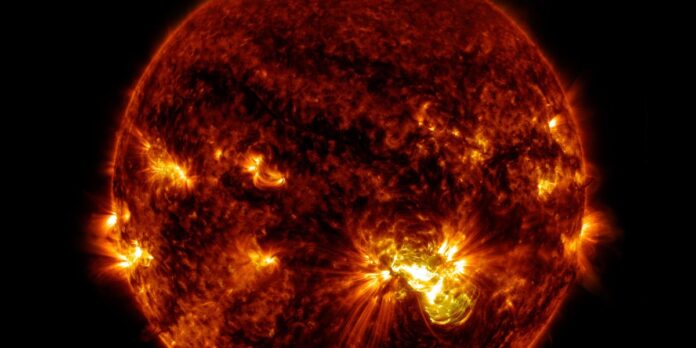
NASA Unveils Advanced AI Model to Enhance Solar Storm Forecasting
NASA has introduced an innovative open-source machine learning platform designed to improve scientists’ ability to forecast solar activity and decode the complex physics governing the sun’s behavior. Named Surya, this cutting-edge system leverages extensive solar data to provide earlier alerts for potentially hazardous solar storms that could impact Earth.
Understanding Solar Storms and Their Impact
Solar storms occur when the sun emits bursts of energy and charged particles into space. These phenomena include intense solar flares and slower-moving coronal mass ejections (CMEs), both of which can interfere with satellite communications, disrupt GPS signals, and even pose serious radiation risks to astronauts. While these effects cannot be prevented, timely predictions enable better preparation and mitigation strategies. Louise Harra, an astrophysicist at ETH Zurich, highlights the challenge: “The critical issue is pinpointing exactly when a solar flare will erupt.” The unpredictability of flare timing and magnitude is significant because the consequences range from minor regional radio blackouts to catastrophic solar superstorms capable of disabling satellites and causing widespread power outages. Many experts warn that Earth may be overdue for such a severe event.
Leveraging Machine Learning for Enhanced Solar Weather Prediction
Although machine learning has previously been applied to solar weather forecasting, the Surya project distinguishes itself through the unprecedented volume and quality of its training data. NASA’s Solar Dynamics Observatory (SDO) supplied over 250 terabytes of multi-wavelength solar imagery, enabling Surya to learn from a vast array of solar phenomena. Initial evaluations demonstrate that Surya can forecast solar flares up to two hours before they occur, a significant improvement over existing models.
Capabilities and Limitations of Surya’s Predictions
Juan Bernabe Moreno, the lead AI researcher at IBM behind Surya, explains that the model not only predicts the timing but also estimates the flare’s shape, location on the sun, and intensity. While a two-hour lead time may not fully shield against the most powerful flares, it represents a potential doubling of current warning periods, which is critical for safeguarding satellites and power infrastructure. Ongoing refinements and the integration of additional datasets could further extend this predictive window.
Decoding the Mysteries of Solar Flare Triggers
Despite advances, the precise triggers of solar flares remain elusive. Harra notes that although scientists understand the general conditions that lead to solar eruptions, the exact timing is governed by subtle instabilities that are difficult to detect from Earth. “We know these small destabilizations will happen, but we have no way to predict when,” she says. Surya’s strength lies in its ability to rapidly identify hidden patterns associated with these instabilities, offering a promising tool to anticipate solar activity more reliably than ever before.
Expanding Horizons: Surya’s Broader Scientific Potential
Beyond flare prediction, Bernabe Moreno envisions Surya as a key to unlocking deeper insights into the interplay between solar storms and terrestrial weather phenomena. Emerging research suggests that solar activity may influence atmospheric events such as lightning. “Understanding the crossover effects and mapping the interactions between solar and Earth weather systems could revolutionize our knowledge,” he explains. Furthermore, Surya’s methodologies might be adapted to study other stars, using the sun as a natural laboratory to explore stellar physics on a broader scale.
Using the Sun as a Stellar Benchmark
Bernabe Moreno emphasizes, “By comprehending the sun’s dynamics, we gain indirect insights into countless other stars.” This perspective positions Surya not only as a tool for space weather forecasting but also as a gateway to advancing astrophysical research across the cosmos.

