
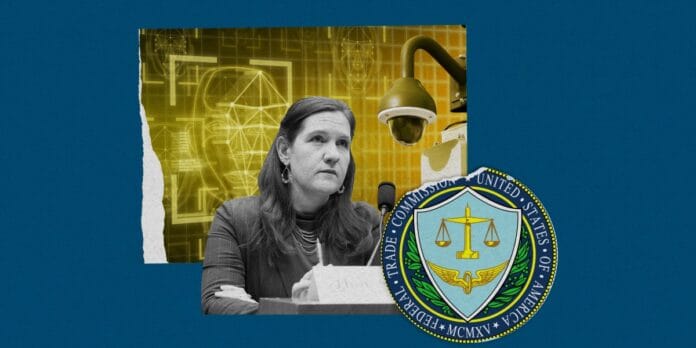
Most Americans only encounter the Federal Trade Commission if they have been scammed. It deals with identity theft, fraud and stolen data. During the Biden Administration, the agency pursued AI companies that were deceiving customers with deceptive advertisements or harming people through the sale of irresponsible technology. Yesterday’s announcement by President Trump of his AI Action Plan may have ended that era.
During the last months of the Biden Administration, under chair Lina Khan, the FTC imposed a series high-profile fines against AI companies who were overhyping their technologies and making false claims.
The FTC found that Evolv, a security company, lied about the cybersecurity of its products. The accuracy was not high enough for its AI-powered checkpoints that are used in schools and stadiums. However, they failed to detect a seven-inch blade used to stab an innocent student. It took on Intellivision for making unfounded claims about the tools’ ability to operate without gender or race bias. It fined startups that offered phony “AI lawyer” services and another that sold fake product review generated by AI.
Although these actions did not resulted in crippling fines, they did stop the companies from making false claims and offered ways for customers to recover their money or out of contracts. The FTC found that AI companies who let their technology run amok had caused harm to everyday people in each case.
According to the plan released yesterday by the Trump administration, it believes that these actions went too much. The White House, in a section on removing “red-tape and onerous regulations,” says it will review the FTC’s actions under the Biden Administration “to ensure they do not advance theories that burden AI innovation unduly.” In the same section the White House also says it will withhold AI related federal funding from the states with “burdensome regulation.”
The Trump administration’s latest attack on the agency is a new phase in its ongoing assault against it. It provides a significant avenue of redress to people who have been harmed by AI. It will likely lead to a faster deployment of AI, with fewer checks for accuracy, fairness or consumer harm.
Khan, a Biden-appointed FTC commissioner, found unexpected fans. Progressives wanted it to stop monopolistic behavior by Big Tech. But some in Trump’s circle, including Vice President JDVance, supported Khan in her fights with tech elites.
In January, however, with Khan gone and Trump in the White House again, this dynamic was all but destroyed. In February, Trump issued an executive order promising to “rein” independent agencies such as the FTC who wage influence without consulting with the president. Next month, he began to take this vow beyond its legal limits.
He fired the two Democratic commissioners of the FTC in March. On July 17, a federal judge ruled that the firing of Rebecca Slaughter was illegal, given the independence and autonomy of the agency. Slaughter was reinstated to her position. Slaughter is now the only Democrat.
By naming the FTC as part of its action plan, White House goes one step further and paints the agency’s activities as a major obstacle for the US to win the “arms-race” to develop AI faster than China. It promises to not only change the FTC’s approach moving forward, but also to review and possibly even repeal AI-related restrictions it has imposed over the past four years.
What could happen? Leah Frazier who worked for the FTC from May 2017 until May 2018 and served as a Khan advisor, says that it is helpful to think of the agency’s action against AI companies in two different areas, with very different levels support across political lines.
First, there are cases of deception where AI companies mislead their consumers. Consider the case Evolv or a recent case announced in April, where the FTC alleged that a company named Workado which offers a tool for detecting whether something was written using AI, does not have evidence to support its claims. Frazier says that deception cases received bipartisan support under her tenure.
There are also cases that involve the responsible use of AI. These did not seem to receive much support from the public, says Frazier, now the director of the Lawyers’ Committee for Civil Rights Under Law’s Digital Justice Initiative. These cases do not allege deception, but rather that companies have used AI in a manner that harms people.
In 2023, the FTC announced the most serious case, which led to the largest AI-related action taken by the FTC. Frazier investigated the case. The FTC banned Rite Aid’s use of AI facial recognition technology in its stores, after finding that the technology falsely identified people, especially women and people from color, as shoplifters. The FTC reported that Rite Aid employees “acted on false positive alerts”and “followed customers around its stores, searched for them, ordered them out, [and] and called the police to confront them or remove them.”
They found that Rite Aid did not protect people against these mistakes, failed to monitor or test technology, nor did they properly train employees how to use it. The company was prohibited from using facial recognition technology for five years.
It was a big deal. This action went beyond fact checking the deceptive claims made by AI companies in order to hold Rite Aid responsible for the harm its AI technology caused consumers. Frazier believes that these types of responsible AI cases will disappear under the new FTC. This is especially true if the cases involve testing AI models to determine bias.
She says that there will be few, if any enforcement actions, about how companies are using AI. The White House’s AI philosophy, as outlined in the plan is a “try-first” approach, which aims to accelerate AI adoption from the Pentagon to doctors’ offices. Frazier says that the lack of FTC enforcement is “dangerous for the public.”

