
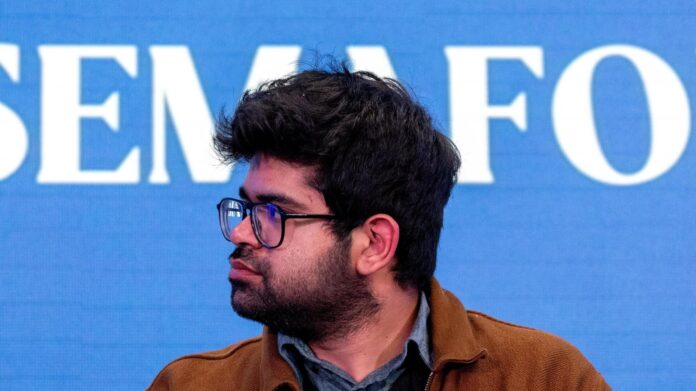
Aravind Srinivas is the CEO of ambitious AI startup Perplexity. He has a clear vision for the future. It starts with a simple question and ends with the automation for entire professional roles.
Srinivas said in a recent interview that a recruiter’s week-long work is only one prompt, sourcing and reaching out. The Verge’s “Decoder” podcastis a prediction which serves as a mission statement for Comet, his new AI-powered web browser, and a warning to the modern knowledge worker.
The company is leading a new arms race in technology to create not only a smarter search agent, but also a true AI agent. Imagine it as a digital entity that can perform complex, multi-step processes from beginning to end. Srinivas believes that the web browser is the tool that every office worker uses. The first jobs that it will target are those of executive assistants and recruiters.
The Automation of Expertise.
For many years, AI was marketed as a tool to help, not replace. Srinivas’ vision is that a much more capable assistant will replace the recruiter. He describes an AI agent that can “carry any workflow end-to-end, from instructions to actual completion of a task.”
In his description he explains exactly how Comet will be designed to absorb the core recruiter functions. The agent could be asked to find all engineers who have studied at Stanford and worked at Anthropic. It would then transfer that list to a Google Sheet, add their LinkedIn URLs and find their contact details. The agent could then “bulk draft personal cold emails to each one to reach out for a coffee talk.”
This logic also applies to an executive assistant’s work. The agent can automate the back-and-forth scheduling process by having secure client-side access. Srinivas explains that if some people respond, the agent will “go and update the Google Sheets and mark the status as replied or in progress, and follow up with these candidates, sync my Google calendar and then resolve conflicts, schedule a chat and then push me a short ahead of the meeting.” This is a fundamentally new way of thinking about productivity, where humans are no longer responsible for performing tasks but rather defining the outcomes.
Six-Month Horizon.
Although Comet is not able to perform these complex “long-horizon”, “long-term” tasks perfectly, Srinivas believes that the final barriers will soon fall. He bases his timeline on the arrival of the next-generation of powerful AI.
He says that he is betting on the progress of reasoning models to get there, referring to upcoming models such as GPT-5 or Claude 4.5. He believes that these new AI brains are the final push to make seamless end-to-end automated a reality. His timeline is aggressive, and should be a warning to anyone in these fields. “I’m sure it will change everything in six months or a year,” he predicts. This suggests that disruption is not a faraway abstract concept, but an imminent reality that could reshape whole departments before the end next year.
From browser to OS: A new layer of automation
Srinivas’ ambition goes far beyond building a faster browser. He envisions the future, where this tool will become more integral to our lives.
He says, “We want to make the browser feel more like an OS with processes running constantly.”
This new paradigm transforms the browser from a passive window into an intelligent, active layer that manages the work in the background. Srinivas says that users could “launch a bunch Comet assistant tasks” and then spend their time doing other things, while the AI worked. This changes the nature of office work, from a series active inputs into a process of delegation.
Liberation or Mass Displacement?
How does the human worker react when their job functions can be condensed to a single prompt. Srinivas’ optimistic view suggests that this newfound efficiency would free up time and attention for humanity. He believes that people will spend their time on leisure, personal enrichment and entertainment, rather than intellectual work. In his vision, AI will do the drudgery and we can “chill out and scroll through X, or whatever social media we like.” But this utopian outlook ignores the more pressing and painful economic question: what happens to millions of people whose livelihoods depend on performing the tasks these agents were designed to automate. Some may be elevated to “AI orchestrator” roles, but many could face displacement.
According to one of its chief architects the AI agent is not just a new feature. It is a catalyst that could lead to a radical and brutal transformation of white-collar workers. Srinivas says that the future of work will be written in code and the first draft of it will be ready much sooner than we think.

